


Authorities yesterday searched for a sniper who assassinated Charlie Kirk, a conservative activist and close ally of US President Donald Trump, with one bullet and then slipped away amid the mayhem resulting from the latest act of political violence to befall the US.
Kirk was killed by a gunshot from a distant rooftop at the Utah Valley University campus, where he was speaking on Wednesday, authorities said.
Federal, state and local authorities were working what they called “multiple active crime scenes.”
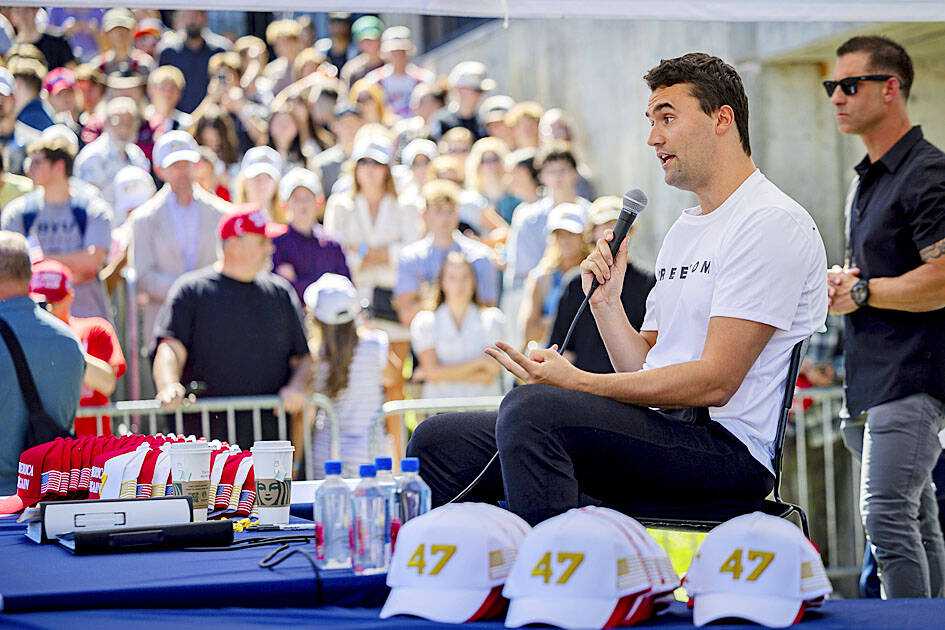
Photo: AP
As the search stretched into a second day, they provided little information about the shooter’s identity, motive, location or evidence, and were reviewing grainy security videos of a mysterious person in dark clothing.
“This is a dark day for our state. It’s a tragic day for our nation,” Utah Governor Spencer Cox said. “I want to be very clear this is a political assassination.”
Two people were detained on Wednesday, but neither was determined to be connected to the shooting and both were released, public safety officials said.
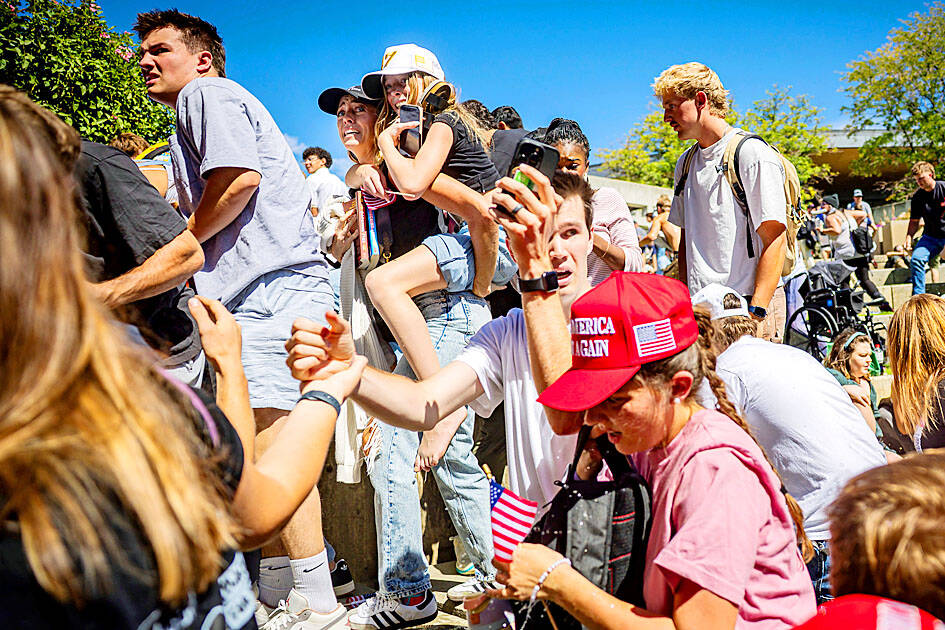
Photo: AP
The circumstances of the shooting drew renewed attention to an escalating threat of political violence in the US that in the past several years has cut across the ideological spectrum.
The assassination drew bipartisan condemnation, but a national reckoning over ways to prevent political grievances from manifesting as deadly violence seemed elusive.
Videos posted to social media from Utah Valley University showed Kirk speaking into a handheld microphone while sitting under a white tent emblazoned with the slogans “The American Comeback” and “Prove Me Wrong.” A shot rings out, and Kirk can be seen reaching up with his right hand as blood gushes from the left side of his neck. Stunned spectators gasp and scream before people start running away.
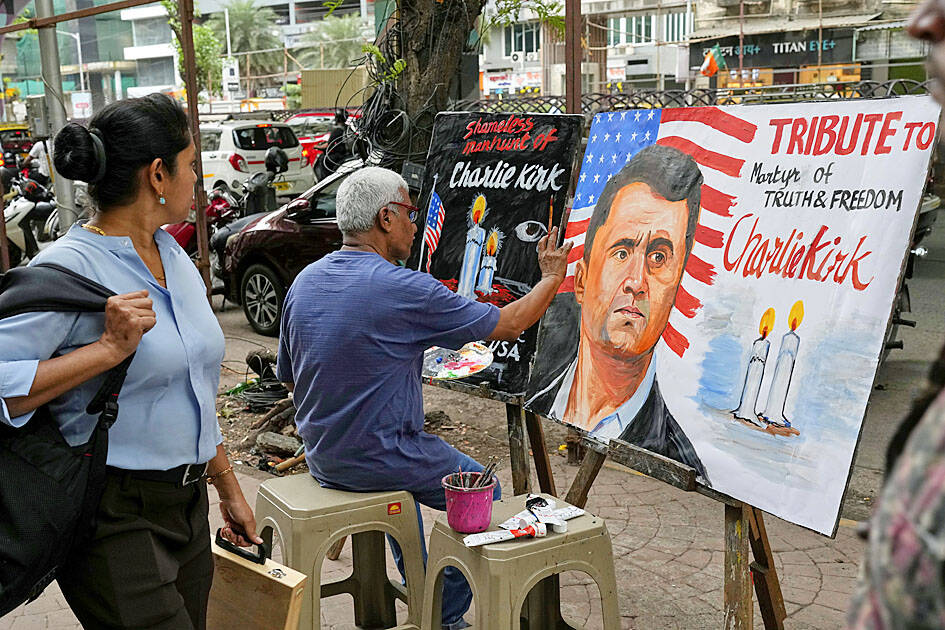
Photo: AP
“So much of the success we’ve had in this administration traces directly to Charlie’s ability to organize and convene,” US Vice President J.D. Vance wrote on social media about Kirk. “He didn’t just help us win in 2024, he helped us staff the entire government.”
Kirk was speaking at a debate hosted by his nonprofit political youth organization, Arizona-based Turning Point USA, at the Sorensen Center courtyard on campus. Immediately before the shooting, he was taking questions from an audience member about gun violence.
“Do you know how many transgender Americans have been mass shooters over the last 10 years?” the person asked. Kirk responded, “Too many.”
The questioner followed up: “Do you know how many mass shooters there have been in America over the last 10 years?”
“Counting or not counting gang violence?” Kirk asked.
Then the shot rang out.
The shooter, who Cox pledged would be held accountable in a state with the death penalty, wore dark clothing and fired from a building roof some distance away.
About 3,000 people were in attendance, the Utah Department of Public Safety said in a statement.
Trump announced Kirk’s death on social media and praised the 31-year-old cofounder and CEO of Turning Point as “Great, and even Legendary.”
Later, he released a recorded video from the White House in which he called Kirk a “martyr for truth and freedom.”
The shooting drew swift condemnation across the political aisle as Democratic officials joined Trump, who ordered flags lowered to half-staff and issued a presidential proclamation, and Republican allies of Kirk in decrying the violence.
“The murder of Charlie Kirk breaks my heart. My deepest sympathies are with his wife, two young children, and friends,” said Gabrielle Giffords, a former Democratic congresswoman who was wounded in a 2011 shooting in her Arizona district.
The shooting appeared poised to become part of a spike of political violence that has touched a range of ideologies and representatives of both major political parties.
The attacks include the assassination of a Minnesota state lawmaker and her husband at their house in June, the firebombing of a Colorado parade in June to demand Hamas release hostages and a fire set at the house of Pennsylvania Governor Josh Shapiro, who is Jewish, in April.
The most notorious of these events was the shooting of Trump during a Pennsylvania campaign rally last year.
“This event [Wednesday’s shooting] is horrifying, alarming, but not necessarily surprising,” said Mike Jensen, a researcher at the University of Maryland, which has tracked such violence in a terrorism database since 1970.
In the first six months of the year, the US experienced about 150 politically motivated attacks — nearly twice as many as over the same period last year, Jensen said.
“I think we are in a very, very dangerous spot right now that could quite easily escalate into more widespread civil unrest if we don’t get a hold of it,” he said. “This could absolutely serve as a kind of flash point that inspires more of it.”
Additional reporting by Reuters

The Ministry of Transportation and Communications yesterday inaugurated the Danjiang Bridge across the Tamsui River in New Taipei City, saying that the structure would be an architectural icon and traffic artery for Taiwan. Feted as a major engineering achievement, the Danjiang Bridge is 920m long, 211m tall at the top of its pylon, and is the longest single-pylon asymmetric cable-stayed bridge in the world, the government’s Web site for the structure said. It was designed by late Iraqi-British architect Zaha Hadid. The structure, with a maximum deck of 70m, accommodates road and light rail traffic, and affords a 200m navigation channel for boats,
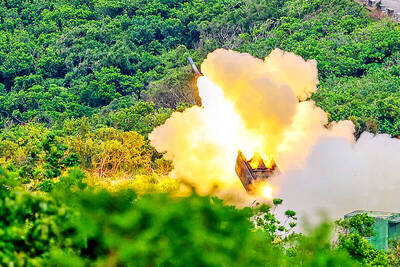
PRECISION STRIKES: The most significant reason to deploy HIMARS to outlying islands is to establish a ‘dead zone’ that the PLA would not dare enter, a source said A High Mobility Artillery Rocket System (HIMARS) would be deployed to Penghu County and Dongyin Island (東引) in Lienchiang County (Matsu) to force the Chinese military to retreat at least 100km from the coastline, a military source said yesterday. Taiwan has been procuring HIMARS and Army Tactical Missile Systems (ATACMS) from the US in batches. Once all batches have been delivered, Taiwan would possess 111 HIMARS units and 504 ATACMS, which have a range of 300km. Considering that “offense is the best defense,” the military plans to forward-deploy the systems to outlying islands such as Penghu and Dongyin so that

WHAT WAS ALL THAT FOR? Jaw Shaw-kong said that Cheng Li-wen had pushed for more drastic cuts and attacked him, just for the outcome to be nearly identical to his bill The legislature yesterday passed a supplementary budget bill to fund the purchase of separate packages of US military equipment, with the combined amount of spending capped at NT$780 billion (US$24.8 billion). The Chinese Nationalist Party (KMT) and Taiwan People’s Party (TPP) used their legislative majority to pass the bill, which runs until 2033 and has two main funding provisions. One was for NT$300 billion of arms sales already approved by the US for Taiwan on Dec. 17 last year, the other was for NT$480 billion for another arms package expected to be announced by Washington. The bill, which fell short of the NT$1.25

‘CLEAR MESSAGE’: The bill would set up an interagency ‘tiger team’ to review sanctions tools and other economic options to help deter any Chinese aggression toward Taiwan US Representative Young Kim has introduced a bill to deter Chinese aggression against Taiwan, calling for an interagency “tiger team” to preplan coordinated sanctions and economic measures in response to possible Chinese military or political action against Taiwan. “[Chinese President] Xi Jinping [習近平] has directed the People’s Liberation Army to be ready to invade Taiwan by 2027. China has a plan. America should have one too,” Kim said in a news release on Thursday last week. She introduced the “Deter PRC [People’s Republic of China] aggression against Taiwan act” to “ensure the US has a coordinated sanctions strategy ready should


 RSS
RSS