


Pacific island leaders yesterday issued a call for an “ocean of peace,” urging respect for their sovereignty at a summit clouded by China’s alleged meddling and great power competition in the strategically vital region, with Taiwan’s ally Palau saying there “absolutely” had been outside interference.
After a day of largely closed-door talks in the Solomon Islands capital, Honiara, the 18 Pacific Islands Forum (PIF) leaders endorsed a Fiji-backed push for a statement proclaiming the region’s cohesion, and its desire for peace and climate action.
A heavy police presence guarded the leaders, who met in the Friendship Hall, near the 10,000-seat National Stadium built and financed by the Chinese government. Once pot-holed roads had been repaired ahead of the gathering.
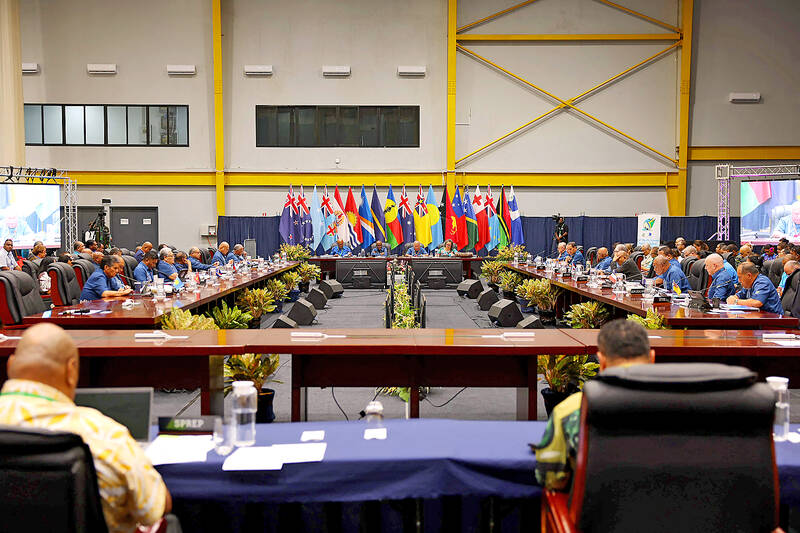
Photo: AFP
“The ‘ocean of peace’ declaration is a reclamation of our sovereignty and our shared destiny,” Solomon Islands Prime Minister Jeremiah Manele said.
“It is a solemn vow that our seas, air and lands will never again be drawn into the vortex of great power rivalry,” he said.
Fijian Prime Minister Sitiveni Rabuka said the declaration “will demonstrate that our region is free from militarization.”
“Emerging trends and patterns of diluting the global rule-based order is of utmost concern for small states like us,” he said.
Alongside member states — including key players Australia and New Zealand — gatherings of the Pacific Islands Forum are typically attended by dozens more countries as observers or dialogue partners.
However, the Solomon Islands has barred most of those partners from attending, sparking accusations that Honiara worked at Beijing’s behest to exclude long-time participant Taiwan.
The move prompted concern among fellow Pacific nations, of which three — the Marshall Islands, Palau and Tuvalu — are diplomatic allies of Taiwan.
On Tuesday, Minister of Foreign Affairs Lin Chia-lung (林佳龍) said that Taipei regretted its exclusion, but looked forward to next year, when Palau hosts the forum.
Palauan President Surangel Whipps Jr said after the declaration that there had “absolutely” been outside meddling in the summit.
“We should engage and be inclusive and have all partners here,” he said.
“We shouldn’t say ‘this partner should be allowed and that partner shouldn’t be’ — everybody should be here, because in solving our challenges, we need everybody,” he said.
Taiwan and China have long vied for influence in the South Pacific, with Beijing spending hundreds of millions of dollars building sports stadiums, presidential palaces, hospitals and roads across the region.
China counts the Solomon Islands among its closest partners and backers in the South Pacific, and the two signed a secretive security pact in 2022.
Observers warned a split over China’s role in yesterday’s forum could undermine essential regional cooperation on everything from climate change to health, security and transnational crime.
New Zealand Minister of Foreign Affairs Winston Peters last month said it was “obvious” that outside forces were meddling in the summit.

A signaling system malfunction disrupted high-speed rail (HSR) services beginning at 8am today, with trains temporarily reduced to three northbound and three southbound trains per hour as authorities conduct inspections. The malfunction occurred on a section of track in Miaoli County during pre-operation checks early this morning, forcing northbound and southbound trains to use a single track, the HSR operator said. The regular schedule has been replaced with three hourly trains offering only nonreserved seating in each direction, stopping at every station, it said, adding that business class cars would still have reserved seating. Departures from terminal stations are scheduled at the top

Taiwan is still in the process of assessing the possibility of recruiting workers from Eswatini, the Ministry of Foreign Affairs said yesterday, adding that its goal is to help Eswatini upgrade its vocational training centers. If there are plans to recruit workers from Eswatini, safeguarding national security, protecting public health and ensuring the employment rights of Taiwanese would be prerequisites, Department of West Asian and African Affairs Director-General Yen Chia-liang (顏嘉良) told a news conference. Key considerations would also include filling labor shortages in specific industries, and fostering bilateral professional and technical exchanges, he said. Yen was asked about the progress of labor

VERBOSE VESSELS: A CGA cutter and a China Coast Guard exchanged verbal barbs for more than a day in Taiwanese-controlled waters before the Chinese vessel left The Taiwanese and Chinese coast guards had a standoff near the strategically located Pratas Islands (Dongsha Islands, 東沙群島) in the north of the South China Sea, the Coast Guard Administration (CGA) said yesterday. The two sides engaged in intense radio exchanges over sovereignty claims during the 33-hour standoff. China Coast Guard vessel 3501 eventually left the restricted waters, 26.6 nautical miles (49.2km) west of the Pratas Islands, at 5pm yesterday, the CGA said. Lying approximately between southern Taiwan and Hong Kong, the Taiwan-controlled Pratas are seen by some security experts as vulnerable to Chinese attack due to their distance — more than

A US uncrewed surface vessel (USV) encountered multiple Chinese warships during an autonomous transit of the Taiwan Strait, US defense company Seasats said in a statement on Wednesday. Seasats announced that a Lightfish USV had completed the first autonomous transit of the Taiwan Strait. Over five days, the USV traversed the entire length of the Strait while constantly monitoring surface vessel traffic, the company said. The Lightfish encountered multiple Chinese warships, one of which was a Chinese People’s Liberation Army Navy (PLAN) Type 056 corvette, it said. The Chinese vessels were operating “well within Taiwan’s exclusive economic zone without transmitting their identity via the


 RSS
RSS