


Israel on Monday launched strikes across the Gaza Strip, killing at least 31 people, while leading academics accused it of genocide, allegations the Israeli government vehemently rejected.
“Another merciless night in Gaza City,” said Saeed Abu Elaish, a Jabaliya-born medic sheltering in the northwestern side of the city.
Hospitals in Gaza said at least 31 people were killed by Israeli fire on Monday, more than half of them women and children. At least 13 people were killed in Gaza City.
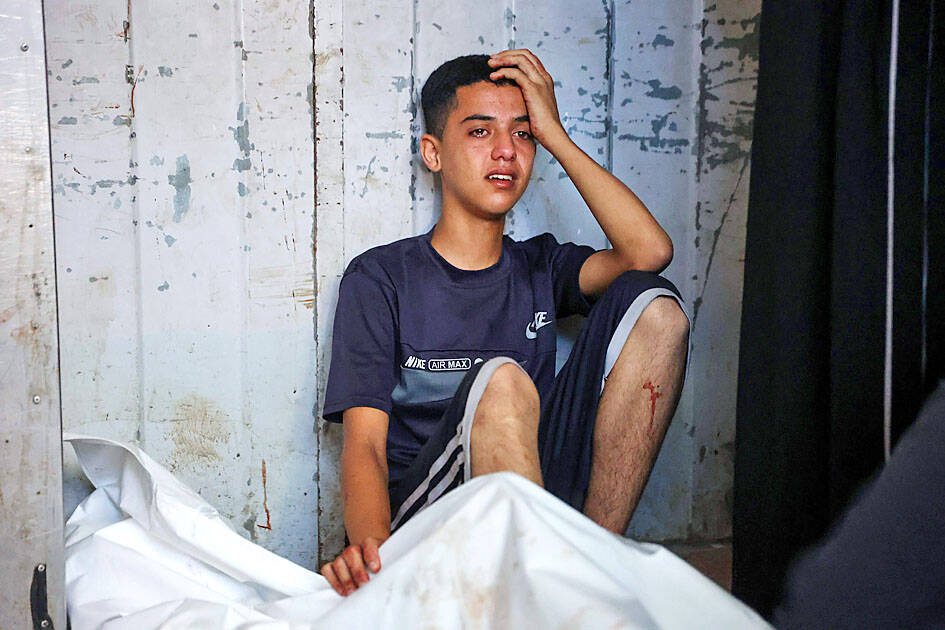
Photo: AFP
Israel says it only targets militants and blames Hamas for civilian casualties because the militant group — now largely reduced to a guerrilla organization — operates in densely populated areas.
A total of 63,557 Palestinians have been killed in the war, according to Gaza’s health ministry, which says another 160,660 people have been wounded. The ministry does not differentiate between civilians and combatants in its count, but says women and children make up about half the dead.
Meanwhile, the largest professional organization of academics studying genocide on Monday said that Israel is committing genocide in Gaza.
A resolution from the International Association of Genocide Scholars — which has about 500 members worldwide, including a number of Holocaust experts — said that “Israel’s policies and actions in Gaza meet the legal definition of genocide,” as well as crimes against humanity and war crimes.
The resolution was supported by 86 percent of those who voted. The organization did not release the specifics of the voting.
“People who are experts in the study of genocide can see this situation for what it is,” said association president Melanie O’Brien, a professor of international law at the University of Western Australia.
The Israeli Ministry of Foreign Affairs called it “an embarrassment to the legal profession and to any academic standard.”
It said the determination was “entirely based on Hamas’ campaign of lies.”
Two prominent Israeli rights groups — B’Tselem and Physicians for Human Rights-Israel — in July said that their nation is committing genocide in Gaza. The organizations do not reflect mainstream thinking in Israel, but it marked the first time that local Jewish-led organizations have made such accusations.
International human rights groups have also leveled the allegation.
In Spain, an activist flotilla bound for Gaza left Barcelona hours after a last-minute delay caused by stormy weather.
The Global Sumud Flotilla, consisting of about 20 boats with participants from 44 nations, had earlier set sail and then turned back, with organizers citing safety concerns.
The expedition includes climate campaigner Greta Thunberg, who took part in a previous flotilla that was intercepted in June.
The flotilla is the largest attempt yet to symbolically break Israel’s blockade of Gaza. All previous ones have been intercepted at sea by Israeli forces. Israel says the blockade is needed to prevent Hamas from importing arms and that there are multiple other channels for sending aid to Gaza.

A signaling system malfunction disrupted high-speed rail (HSR) services beginning at 8am today, with trains temporarily reduced to three northbound and three southbound trains per hour as authorities conduct inspections. The malfunction occurred on a section of track in Miaoli County during pre-operation checks early this morning, forcing northbound and southbound trains to use a single track, the HSR operator said. The regular schedule has been replaced with three hourly trains offering only nonreserved seating in each direction, stopping at every station, it said, adding that business class cars would still have reserved seating. Departures from terminal stations are scheduled at the top

Taiwan is still in the process of assessing the possibility of recruiting workers from Eswatini, the Ministry of Foreign Affairs said yesterday, adding that its goal is to help Eswatini upgrade its vocational training centers. If there are plans to recruit workers from Eswatini, safeguarding national security, protecting public health and ensuring the employment rights of Taiwanese would be prerequisites, Department of West Asian and African Affairs Director-General Yen Chia-liang (顏嘉良) told a news conference. Key considerations would also include filling labor shortages in specific industries, and fostering bilateral professional and technical exchanges, he said. Yen was asked about the progress of labor

A US uncrewed surface vessel (USV) encountered multiple Chinese warships during an autonomous transit of the Taiwan Strait, US defense company Seasats said in a statement on Wednesday. Seasats announced that a Lightfish USV had completed the first autonomous transit of the Taiwan Strait. Over five days, the USV traversed the entire length of the Strait while constantly monitoring surface vessel traffic, the company said. The Lightfish encountered multiple Chinese warships, one of which was a Chinese People’s Liberation Army Navy (PLAN) Type 056 corvette, it said. The Chinese vessels were operating “well within Taiwan’s exclusive economic zone without transmitting their identity via the

VERBOSE VESSELS: A CGA cutter and a China Coast Guard exchanged verbal barbs for more than a day in Taiwanese-controlled waters before the Chinese vessel left The Taiwanese and Chinese coast guards had a standoff near the strategically located Pratas Islands (Dongsha Islands, 東沙群島) in the north of the South China Sea, the Coast Guard Administration (CGA) said yesterday. The two sides engaged in intense radio exchanges over sovereignty claims during the 33-hour standoff. China Coast Guard vessel 3501 eventually left the restricted waters, 26.6 nautical miles (49.2km) west of the Pratas Islands, at 5pm yesterday, the CGA said. Lying approximately between southern Taiwan and Hong Kong, the Taiwan-controlled Pratas are seen by some security experts as vulnerable to Chinese attack due to their distance — more than


 RSS
RSS