


The Ministry of Foreign Affairs yesterday confirmed that Taiwan and Japan had signed an agreement to promote information exchanges and cooperation on border management, although it did not disclose more details on the pact.
Ministry spokesman Hsiao Kuang-wei (蕭光偉) said the ministry is happy to see that the two nations continue to enhance cooperation on immigration control, in particular because Taiwan and Japan “share a deep friendship and frequent people-to-people exchanges.”
“Last year, more than 7.32 million visits were made between the two countries, making it even more crucial for both sides to work closer on immigration and border control,” he said.
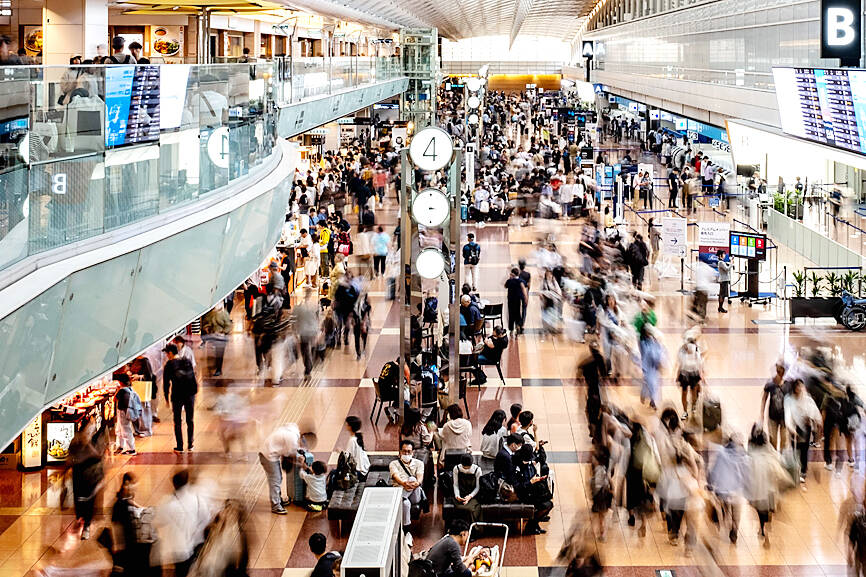
Photo: AFP
Hsiao did not provide any details about the agreement and instead referred journalists to the National Immigration Agency (NIA), the authority responsible for immigration, border security, and entry and exit services.
According to a list on the NIA Web site, Taiwan has signed memorandums of understanding (MOUs) on immigration and border control affairs with 23 nations. Japan appears at the bottom of the list after an MOU on information exchanges, and cooperation on border security and management was signed on Dec. 18 last year.
The NIA did not release a statement after the MOU was signed last year, nor did it disclose any details about the agreement.
Hsiao’s comments were made after the Yomiuri Shimbun reported earlier yesterday that a pact was signed in December last year.
The Japanese-language report quoted unnamed Japanese sources as revealing that Taiwan and Japan signed the MOU regarding the sharing of information on foreign nationals entering Japan from Taiwan in the event of an emergency in Taiwan.
By sharing information on foreign nationals evacuating in the event of an emergency, including a Chinese invasion, the aim is to prevent Chinese spies from taking advantage of such a chaotic situation to enter Japan, the report said.
Under the MOU, Japan would receive information on foreign nationals wishing to enter the nation from Taiwan. This would enable Tokyo to effectively screen those who might harm domestic security in the event of an emergency, the newspaper said.
The Japanese Immigration Services Agency has signed similar pacts with nations such as Australia and New Zealand, but it is unusual for Tokyo to have such a pact with a non-diplomatic ally.
Due to the sensitivity of the issue, the Japan-Taiwan Exchange Association asked that the content of the MOU be listed as confidential, the report said.

South Korea has adjusted its electronic arrival card system to no longer list Taiwan as a part of China, a move that the Ministry of Foreign Affairs said would help facilitate exchanges between the two sides. South Korea previously listed “Taiwan” as “Taiwan (China)” in the drop-down menus of its online arrival card system, where people had to fill out where they came from and their next destination. The ministry had requested South Korea make a revision and said it would change South Korea’s name on Taiwan’s online immigration system from “Republic of Korea” to “Korea (South),” should the issue not be

Tainan, Taipei and New Taipei City recorded the highest fines nationwide for illegal accommodations in the first quarter of this year, with fines issued in the three cities each exceeding NT$7 million (US$220,639), Tourism Administration data showed. Among them, Taipei had the highest number of illegal short-term rental units, with 410. There were 3,280 legally registered hotels nationwide in the first quarter, down by 14 properties, or 0.43 percent, from a year earlier, likely indicating operators exiting the market, the agency said. However, the number of unregistered properties rose to 1,174, including 314 illegal hotels and 860 illegal short-term rental
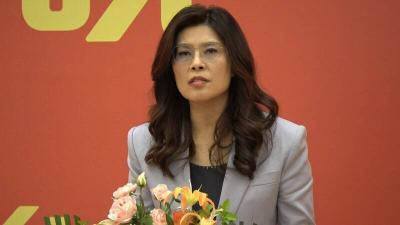
Both sides of the Taiwan Strait share a political foundation based on the “1992 consensus” and opposition to Taiwanese independence, Chinese Nationalist Party (KMT) Chairwoman Cheng Li-wun (鄭麗文) today said during her meeting with Chinese President Xi Jinping (習近平). Both sides of the Strait should plan and build institutionalized and sustainable mechanisms for dialogue and cooperation based on that foundation to make peaceful development across the Strait irreversible, she said. Peace is a shared moral value across the Strait, and both sides should move beyond political confrontation to seek institutionalized solutions to prevent war, she said. Mutually beneficial cross-strait relations are what the

ECONOMIC COERCION: Such actions are often inconsistently applied, sometimes resumed, and sometimes just halted, the Presidential Office spokeswoman said The government backs healthy and orderly cross-strait exchanges, but such arrangements should not be made with political conditions attached and never be used as leverage for political maneuvering or partisan agendas, Presidential Office spokeswoman Karen Kuo (郭雅慧) said yesterday. Kuo made the remarks after China earlier in the day announced 10 new “incentive measures” for Taiwan, following a landmark meeting between Chinese President Xi Jinping (習近平) and Chinese Nationalist Party (KMT) Chairwoman Cheng Li-wun (鄭麗文) in Beijing on Friday. The measures, unveiled by China’s Xinhua news agency, include plans to resume individual travel by residents of Shanghai and China’s Fujian


 RSS
RSS