


Representative to Japan Lee Yi-yang (李逸洋) yesterday accused Beijing of interference after Taiwan’s official delegation to the Nagasaki Peace Memorial Ceremony in Japan was assigned seating in the “international non-governmental organizations [NGO]” area.
“Taiwan is by no means an international NGO, but a sovereign nation that is active on the international stage,” Lee said.
Lee and Chen Ming-chun (陳銘俊), head of the Taipei Economic and Cultural Office (TECO) in Fukuoka, attended the ceremony in Nagasaki yesterday, which marked the 80th anniversary of the atomic bombing of the city.
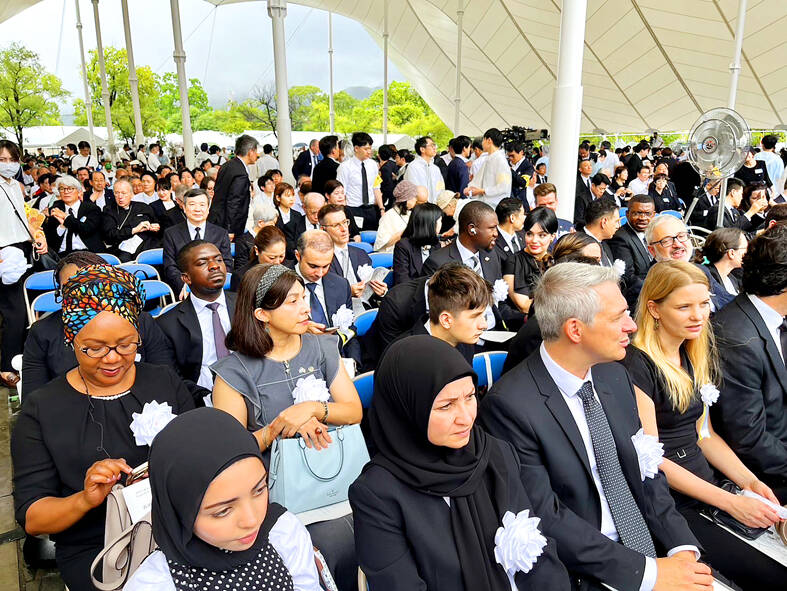
Photo courtesy of the Taiwan Economic and Cultural Representative Office in Japan via CNA
That followed Lee’s attendance at the Hiroshima Peace Memorial Ceremony on Wednesday — the first time Taiwan was invited — in which the Taiwanese delegation was seated in the area for diplomatic envoys.
Although Nagasaki initially did not invite Taiwan to the ceremony, the nation’s representatives eventually received an invitation for the first time thanks to multi-party communication and mutual understanding, Lee said, thanking the Nagasaki administration and those who assisted in the process.
However, the event organizers arranged for the Taiwanese delegation to be seated in the “international NGO” area, he said.
Despite the seating arrangement, TECO decided to attend the ceremony, considering Taiwan’s top goal of conveying to the world its determination for pursuing peace and its years of efforts to demonstrate its close connection with the international community, he said.
“We understand that the inappropriate arrangement by the host, Nagasaki City, has its reasons,” Lee said, accusing Beijing of being “the force pulling the strings behind the scenes.”
China, which had taken part in the annual memorial for years, did not attend Saturday’s event, and the Nagasaki government did not provide a reason.
The ceremony, held at Nagasaki Peace Park, commemorated the victims of the atomic bombing by the US on Aug. 9, 1945, which killed an estimated 74,000 people.
It was the second atomic bomb that the US dropped on Japanese soil to stop the Japanese imperial army in Asia, following the bombing of Hiroshima three days earlier, which claimed about 140,000 lives.
Most of the casualties were civilians.
Lee cited data compiled by the Stockholm International Peace Research Institute that showed China’s nuclear arsenal is growing faster than any other country’s.
China’s behavior runs against the noble and peaceful idea of a “world free of nuclear weapons” advocated by Hiroshima and Nagasaki, he added.
Lee during the ceremony said that it is deeply regrettable that China, which is expanding its nuclear arsenal, is suppressing Taiwan, which is pursuing peace.
Taiwan has long played an indispensable role in the international society and is the world’s 22nd-largest economy, leading in various fields including high-tech, democratic governance and healthcare, and is absolutely not an “international NGO,” but an active sovereign state, he said.
As a responsible and peace-loving member of the international society, Taiwan would continue to cooperate with Japan, the US and other like-minded partners in countering authoritarian expansion, and protect the peace, stability and sustainable prosperity in the Taiwan Strait and Indo-Pacific region, he added.
Additional reporting by CNA

A signaling system malfunction disrupted high-speed rail (HSR) services beginning at 8am today, with trains temporarily reduced to three northbound and three southbound trains per hour as authorities conduct inspections. The malfunction occurred on a section of track in Miaoli County during pre-operation checks early this morning, forcing northbound and southbound trains to use a single track, the HSR operator said. The regular schedule has been replaced with three hourly trains offering only nonreserved seating in each direction, stopping at every station, it said, adding that business class cars would still have reserved seating. Departures from terminal stations are scheduled at the top

Taiwan is still in the process of assessing the possibility of recruiting workers from Eswatini, the Ministry of Foreign Affairs said yesterday, adding that its goal is to help Eswatini upgrade its vocational training centers. If there are plans to recruit workers from Eswatini, safeguarding national security, protecting public health and ensuring the employment rights of Taiwanese would be prerequisites, Department of West Asian and African Affairs Director-General Yen Chia-liang (顏嘉良) told a news conference. Key considerations would also include filling labor shortages in specific industries, and fostering bilateral professional and technical exchanges, he said. Yen was asked about the progress of labor

A US uncrewed surface vessel (USV) encountered multiple Chinese warships during an autonomous transit of the Taiwan Strait, US defense company Seasats said in a statement on Wednesday. Seasats announced that a Lightfish USV had completed the first autonomous transit of the Taiwan Strait. Over five days, the USV traversed the entire length of the Strait while constantly monitoring surface vessel traffic, the company said. The Lightfish encountered multiple Chinese warships, one of which was a Chinese People’s Liberation Army Navy (PLAN) Type 056 corvette, it said. The Chinese vessels were operating “well within Taiwan’s exclusive economic zone without transmitting their identity via the

VERBOSE VESSELS: A CGA cutter and a China Coast Guard exchanged verbal barbs for more than a day in Taiwanese-controlled waters before the Chinese vessel left The Taiwanese and Chinese coast guards had a standoff near the strategically located Pratas Islands (Dongsha Islands, 東沙群島) in the north of the South China Sea, the Coast Guard Administration (CGA) said yesterday. The two sides engaged in intense radio exchanges over sovereignty claims during the 33-hour standoff. China Coast Guard vessel 3501 eventually left the restricted waters, 26.6 nautical miles (49.2km) west of the Pratas Islands, at 5pm yesterday, the CGA said. Lying approximately between southern Taiwan and Hong Kong, the Taiwan-controlled Pratas are seen by some security experts as vulnerable to Chinese attack due to their distance — more than


 RSS
RSS