


Japanese warships yesterday docked in New Zealand’s capital for the first time in almost 90 years amid efforts by Tokyo to deepen its strategic ties in the South Pacific Ocean.
Two destroyers with more than 500 crew on board sailed into Wellington Harbour accompanied by the New Zealand Navy’s HMNZS Canterbury.
The JS Ise helicopter carrier and the JS Suzunami destroyer were on a deployment in the Indo-Pacific region and arrived from Sydney, where Japan’s military this month took part in war games involving New Zealand, Australia and other countries.
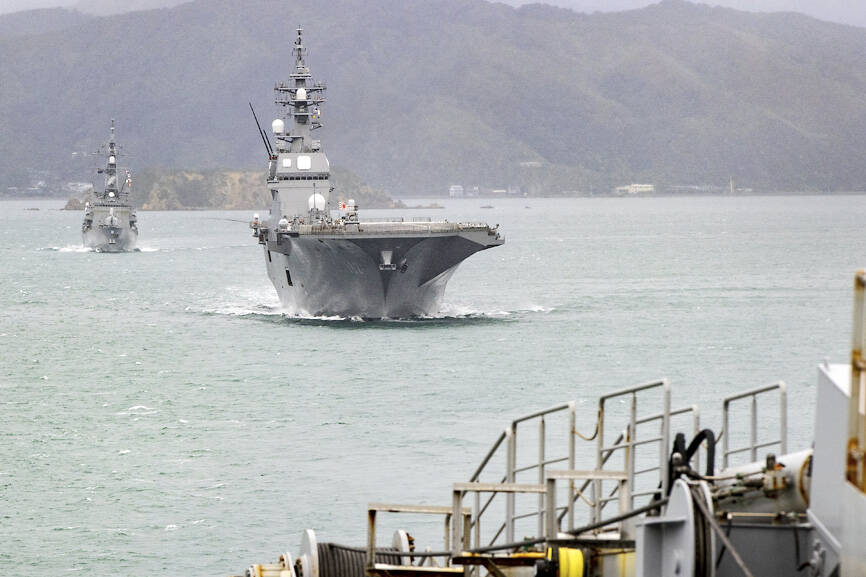
Photo: AP
The Wellington visit was a ceremonial one, but it came as Japan, whose only treaty ally is the US, has increasingly sought to deepen bilateral military cooperation amid ongoing regional tensions.
“Our defense force are developing cooperative work, not only with New Zealand and Australia, but also many Pacific island countries,” Japanese Ambassador to New Zealand Makoto Osawa told reporters. “Our main goal is the free and open Indo-Pacific.”
Osawa’s remarks followed an announcement on Tuesday by Australia’s government that Japanese firm Mitsubishi Heavy Industries had won the bid for a contract to build Australian warships, beating out a German firm.
While officials in Canberra said that the Japanese proposal was the best and cheapest, they also hailed it as the biggest defense industry agreement between the countries.
New Zealand, too, has sought to shore up its strategic and military relations in Asia as part of a foreign policy reset in the past few years that the government says has turned more attention on Pacific cooperation and security.
Officials in Wellington last month announced that work had started on a defense logistics agreement with Japan, intended to make it easier for the countries’ militaries to work together.
The last port visit to Wellington by a Japanese naval vessel was in 1936, New Zealand’s military said.
A Japanese ship visited New Zealand’s largest city, Auckland, in 2016.


FORCED LABOR: A US court listed three Taiwanese and nine firms based in Taiwan in its indictment, with eight of the companies registered at the same address Nine companies registered in Taiwan, as well as three Taiwanese, on Tuesday were named by the US Department of the Treasury’s Office of Foreign Assets Control (OFAC) as Specially Designated Nationals (SDNs) as a result of a US federal court indictment. The indictment unsealed at the federal court in Brooklyn, New York, said that Chen Zhi (陳志), a dual Cambodian-British national, is being indicted for fraud conspiracy, money laundering and overseeing Prince Holding Group’s forced-labor scam camps in Cambodia. At its peak, the company allegedly made US$30 million per day, court documents showed. The US government has seized Chen’s noncustodial wallet, which contains
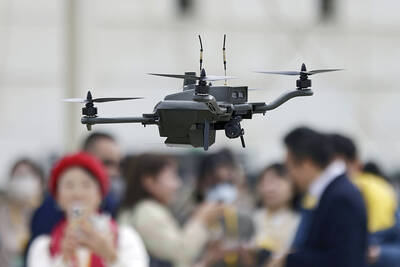
SUPPLY CHAIN: Taiwan’s advantages in the drone industry include rapid production capacity that is independent of Chinese-made parts, the economic ministry said The Executive Yuan yesterday approved plans to invest NT$44.2 billion (US$1.44 billion) into domestic production of uncrewed aerial vehicles over the next six years, bringing Taiwan’s output value to more than NT$40 billion by 2030 and making the nation Asia’s democratic hub for the drone supply chain. The proposed budget has NT$33.8 billion in new allocations and NT$10.43 billion in existing funds, the Ministry of Economic Affairs said. Under the new development program, the public sector would purchase nearly 100,000 drones, of which 50,898 would be for civil and government use, while 48,750 would be for national defense, it said. The Ministry of

SENATE RECOMMENDATION: The National Defense Authorization Act encourages the US secretary of defense to invite Taiwan’s navy to participate in the exercises in Hawaii The US Senate on Thursday last week passed the National Defense Authorization Act (NDAA) for Fiscal Year 2026, which strongly encourages the US secretary of defense to invite Taiwan’s naval forces to participate in the Rim of the Pacific (RIMPAC) exercise, as well as allocating military aid of US$1 billion for Taiwan. The bill, which authorizes appropriations for the military activities of the US Department of Defense, military construction and other purposes, passed with 77 votes in support and 20 against. While the NDAA authorizes about US$925 billion of defense spending, the Central News Agency yesterday reported that an aide of US

UNITED: The other candidates congratulated Cheng on her win, saying they hoped the new chair could bring the party to victory in the elections next year and in 2028 Former Chinese Nationalist Party (KMT) lawmaker Cheng Li-wun (鄭麗文) yesterday won the party’s chair election with 65,122 votes, or 50.15 percent of the votes. It was the first time Cheng, 55, ran for the top KMT post, and she is the second woman to hold the post of chair, following Hung Hsiu-chu (洪秀柱), who served from 2016 to 2017. Cheng is to succeed incumbent Eric Chu (朱立倫) on Nov. 1 for a four-year term. Cheng said she has spoken with the other five candidates and pledged to maintain party unity, adding that the party would aim to win the elections next year and


 RSS
RSS