


North Korea has no interest in pursuing dialogue with the South, North Korean leader Kim Jong-un’s powerful sister Kim Yo-jong said yesterday, dismissing a new president in Seoul who has vowed to mend ties.
Since his election last month, South Korean President Lee Jae-myung has broken with his predecessor’s hawkish tone on the North and halted loudspeaker propaganda broadcasts along the border — begun in response to a barrage of trash-filled North Korean balloons.
North Korea has ended its own propaganda broadcasts, which had boomed strange and eerie noises into the South.
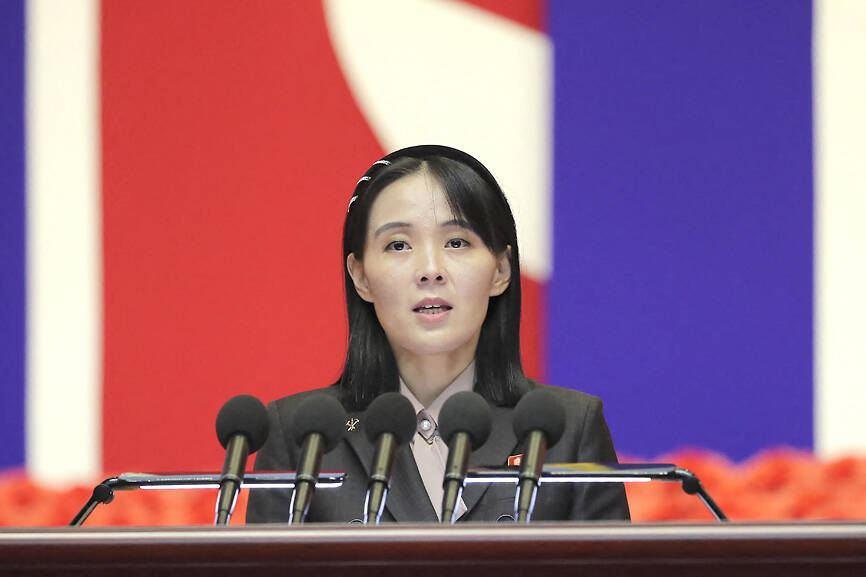
Photo: AFP / KCNA via KNS
However, such gestures do not mean Seoul should expect a thawing of icy ties, Kim Yo-jong said in an English dispatch carried by the North’s official Korean Central News Agency.
“If the ROK ... expected that it could reverse all the results it had made with a few sentimental words, nothing is more serious miscalculation than it,” she said, referring to South Korea by its official name.
“We clarify once again the official stand that no matter what policy is adopted and whatever proposal is made in Seoul, we have no interest in it and there is neither the reason to meet nor the issue to be discussed with the ROK,” she added.
“The DPRK-ROK relations have irreversibly gone beyond the time zone of the concept of homogeneous,” she said, using the North’s official acronym.
Kim Yo-jong called Lee’s steps “sincere efforts” to develop ties, but said the new government still plots to “stand in confrontation” with North Korea.
She mentioned the upcoming summertime South Korea-US military drills, which the North views as an invasion rehearsal.
Lee said it was important to restore trust between the Koreas, as he met South Korean Minister of Unification Chung Dong-young and asked about his thought on Pyongyang’s latest statement.
Chung later told reporters that he intended to propose to Lee that South Korea and the US “adjust” their military exercises.
Chung’s remarks, which could mean scaling back South Korea-US training as a way to get North Korea to return to talks, is likely to invite strong criticism from conservatives, who support expanded South Korea-US training to cope with North Korea’s advancing nuclear program.
Hong Min, a senior analyst at the Korea Institute for National Unification, said that Kim Yo-jong’s statement underscored Pyongyang’s entrenched anti-South stance.
“It declares that its hostile perception towards the South has become irreversible,” he said.
The two countries technically remain at war because the 1950-53 Korean War ended in an armistice, not a peace treaty.

A signaling system malfunction disrupted high-speed rail (HSR) services beginning at 8am today, with trains temporarily reduced to three northbound and three southbound trains per hour as authorities conduct inspections. The malfunction occurred on a section of track in Miaoli County during pre-operation checks early this morning, forcing northbound and southbound trains to use a single track, the HSR operator said. The regular schedule has been replaced with three hourly trains offering only nonreserved seating in each direction, stopping at every station, it said, adding that business class cars would still have reserved seating. Departures from terminal stations are scheduled at the top

Taiwan is still in the process of assessing the possibility of recruiting workers from Eswatini, the Ministry of Foreign Affairs said yesterday, adding that its goal is to help Eswatini upgrade its vocational training centers. If there are plans to recruit workers from Eswatini, safeguarding national security, protecting public health and ensuring the employment rights of Taiwanese would be prerequisites, Department of West Asian and African Affairs Director-General Yen Chia-liang (顏嘉良) told a news conference. Key considerations would also include filling labor shortages in specific industries, and fostering bilateral professional and technical exchanges, he said. Yen was asked about the progress of labor

A US uncrewed surface vessel (USV) encountered multiple Chinese warships during an autonomous transit of the Taiwan Strait, US defense company Seasats said in a statement on Wednesday. Seasats announced that a Lightfish USV had completed the first autonomous transit of the Taiwan Strait. Over five days, the USV traversed the entire length of the Strait while constantly monitoring surface vessel traffic, the company said. The Lightfish encountered multiple Chinese warships, one of which was a Chinese People’s Liberation Army Navy (PLAN) Type 056 corvette, it said. The Chinese vessels were operating “well within Taiwan’s exclusive economic zone without transmitting their identity via the

VERBOSE VESSELS: A CGA cutter and a China Coast Guard exchanged verbal barbs for more than a day in Taiwanese-controlled waters before the Chinese vessel left The Taiwanese and Chinese coast guards had a standoff near the strategically located Pratas Islands (Dongsha Islands, 東沙群島) in the north of the South China Sea, the Coast Guard Administration (CGA) said yesterday. The two sides engaged in intense radio exchanges over sovereignty claims during the 33-hour standoff. China Coast Guard vessel 3501 eventually left the restricted waters, 26.6 nautical miles (49.2km) west of the Pratas Islands, at 5pm yesterday, the CGA said. Lying approximately between southern Taiwan and Hong Kong, the Taiwan-controlled Pratas are seen by some security experts as vulnerable to Chinese attack due to their distance — more than


 RSS
RSS