


President William Lai (賴清德) yesterday condemned an alleged attempt by two Chinese to snatch a letter of congratulations handed to Taiwan’s taekwondo team after they won silver at the Summer World University Games in Germany on Wednesday.
A Chinese man and woman reportedly tried to snatch a congratulatory letter to athletes Hung Jiun-yi (洪俊義), Jung Jiun-jie (鍾俊傑) and Huang Cho-cheng (黃卓乘) from the Ministry of Education, and then argued with reporters.
“Why are you taking our things?” reporters asked the pair.
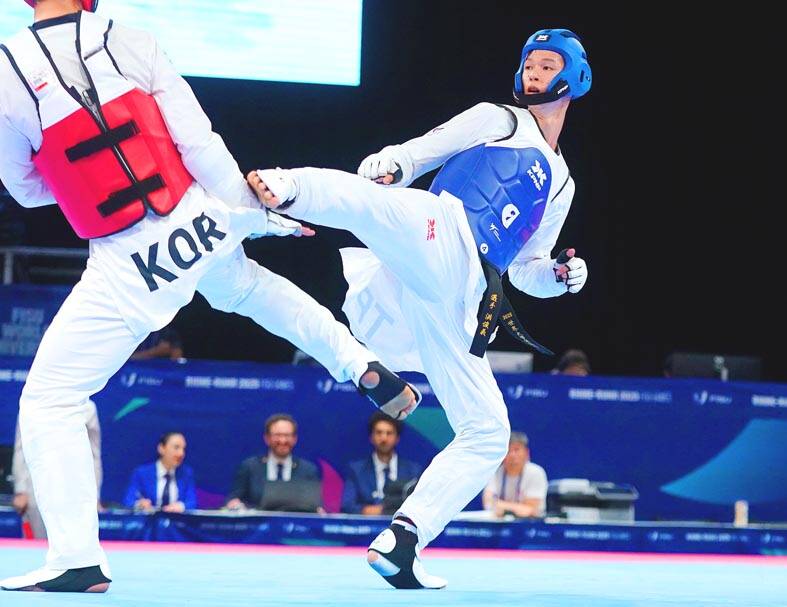
Photo courtesy of the Chinese Taipei University Sports Federation
“Does that say ‘Chinese Taipei’?” the two Chinese reportedly asked.
Following the incident, Sports Administration Director-General Cheng Shih-chung (鄭世忠) wrote on Threads about what he called “nonstop provocations” by the Chinese team.
The Chinese team also called officials to order that a Taiwanese flag be taken down from a doorway and told organizers that shouts of “go Taiwan” contravened the rules.
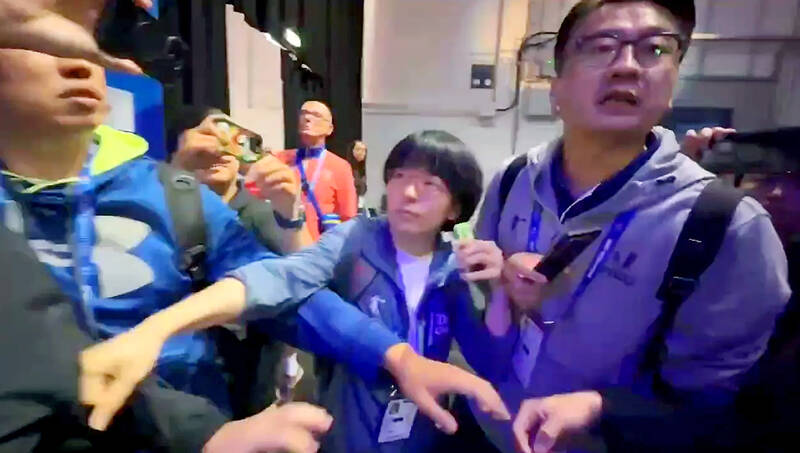
Photo courtesy of the Chinese Taipei University Sports Federation
With help from Representative to Germany Shieh Jhy-wey (謝志偉), the team sought an apology from the mayor’s office in Essen, Germany, Cheng said.
The mayor responded with an apology and emphasized the event’s values of openness and tolerance, he said.
“I strongly condemn the Chinese team’s brutal and violent behavior,” Cheng said.
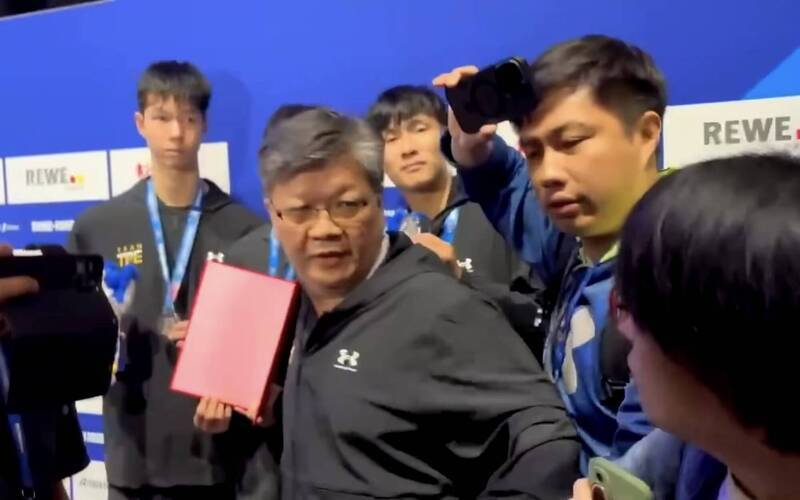
Photo courtesy of the Chinese Taipei University Sports Federation
“Presenting congratulatory messages to our athletes and cheering for Taiwan is not restricted by the Olympic model,” he said.
The core values of the World University Games are openness, tolerance and peace, Lai wrote on Facebook, adding that it is regrettable the incident went against the spirit of sporting behavior, openness and respect.
Top athletes from universities around the world gather at the event to compete and bond, transcending languages and borders, he said.
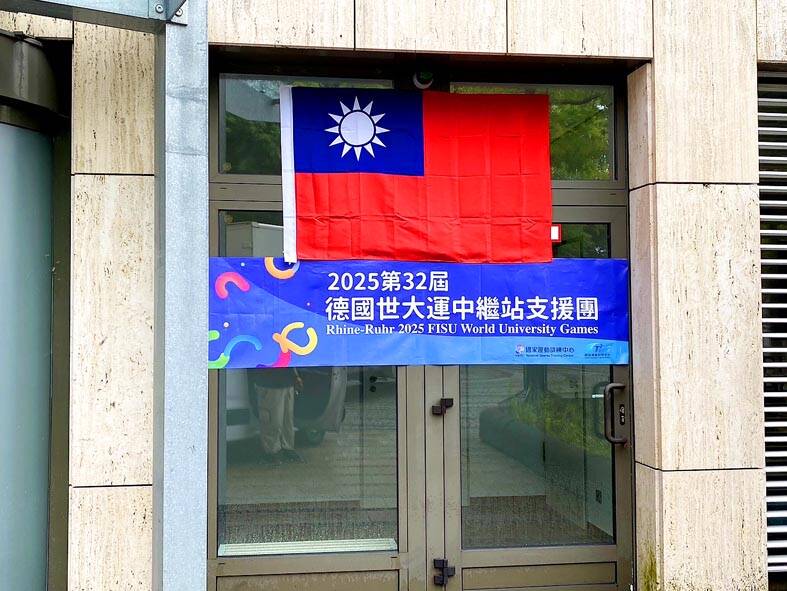
Photo: CNA
It is regrettable that China has repeatedly suppressed Taiwan during the Games, including asking the Essen City Government to take down Taiwan’s national flag and unreasonably protesting those in the audience who chanted slogans in support of Taiwan, he said.
Taiwan would continue to counter suppression with calmness and confidence to win understanding and respect in the international community, he added.
Lai also thanked athletes who proved their abilities and Taiwanese who strive for the nation’s sovereignty, encouraging athletes to excel and show the world their best.
“Taiwanese stand with you and are expecting you to make a triumphant return, safe and sound,” he said.
China has become a laughing stock in the international community, Premier Cho Jung-tai (卓榮泰) was quoted as saying by Executive Yuan spokeswoman Michelle Lee (李慧芝) at a news conference in Taipei.
The incident not only demonstrated political interference at sports events, but also exposed how China’s so-called “cross-strait integration” is a lie, Cho was quoted as saying.
In Taiwan, all three main political parties expressed outrage at the incident.
Chinese Nationalist Party (KMT) Chairman Eric Chu (朱立倫) said it was a “big attack on us,” and asked the public to support Taiwan’s athletes.
The KMT in a statement condemned the incident, expressing its disapproval of harassment by the Chinese Communist Party.
Democratic Progressive Party Secretary-General Lin Yu-chang (林右昌) said that everyone, regardless of party affiliation, should cheer for the athletes.
China’s behavior is inappropriate and must be condemned, he added.
The Taiwan People’s Party called on China to stop politically interfering with Taiwanese athletes at international competitions.
The Agreement between the International Olympic Committee, Lausanne and the Chinese Taipei Olympic Committee, Taipei, which was signed on March 23, 1981, ascertained Taiwan’s right to participate in the Olympic Games and other international sports events, provided that it compete under the name “Chinese Taipei” with a specially designed flag, Mainland Affairs Council deputy chairman and spokesman Liang Wen-chieh (梁文傑) told a news conference in Taipei.
However, the agreement does not prohibit audiences from cheering for Taiwanese athletes or shouting “go, Taiwan,” Liang said.
Liang displayed the congratulatory letter to demonstrate the reason for the dispute.
“As you can see, this is a letter prepared by the Ministry of Education to be given to Taiwanese athletes after winning medals. It shows the names of the athletes and the awards they receive, as well as the signature of the minister of education and date of issuance, which is written as July 23, 114th year of the Republic of China,” Liang said.
The two Chinese tried to take the letter because they saw “Republic of China” on it, he said.
The incident has made China a worldwide laughing stock, Liang said, adding that the Sports Administration also preserved national dignity by taking the proper course of action to resolve the dispute.
Liang defended the legitimacy of sports officials issuing congratulatory telegrams to athletes, as it neither disrupted the proceedings of the Games nor went against the agreement.
Additional reporting by Yu Chao-fu, Chou Min-hung and Shelley Shan

‘NO SECURITY RISK’: The Railway Bureau reassured the public that the technicians’ activities were limited to technical guidance and did not involve sensitive systems The Railway Bureau yesterday said it had invited eight Chinese technicians to assist with an airport MRT construction project. The bureau issued the confirmation after an Internet user said Chinese nationals had entered the construction zone of Taiwan Taoyuan International Airport’s Terminal 3 project. They asked why “individuals from an enemy state” were allowed access to such a major national infrastructure project, which raised serious concerns over Taiwan’s industrial safety, sensitive systems and information security. The bureau’s Northern Region Engineering Branch Office said subcontractor Taiwan Handle Industrial Co (台灣手把工業) of the Taoyuan airport MRT’s “Contract No. CU05 Project A14 Station Civil, MEP &

A US uncrewed surface vessel (USV) encountered multiple Chinese warships during an autonomous transit of the Taiwan Strait, US defense company Seasats said in a statement on Wednesday. Seasats announced that a Lightfish USV had completed the first autonomous transit of the Taiwan Strait. Over five days, the USV traversed the entire length of the Strait while constantly monitoring surface vessel traffic, the company said. The Lightfish encountered multiple Chinese warships, one of which was a Chinese People’s Liberation Army Navy (PLAN) Type 056 corvette, it said. The Chinese vessels were operating “well within Taiwan’s exclusive economic zone without transmitting their identity via the
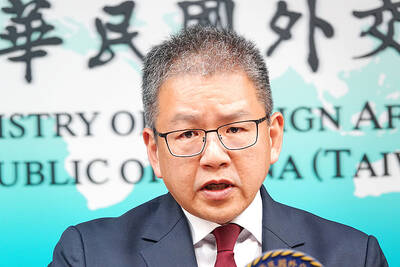
Taiwan is still in the process of assessing the possibility of recruiting workers from Eswatini, the Ministry of Foreign Affairs said yesterday, adding that its goal is to help Eswatini upgrade its vocational training centers. If there are plans to recruit workers from Eswatini, safeguarding national security, protecting public health and ensuring the employment rights of Taiwanese would be prerequisites, Department of West Asian and African Affairs Director-General Yen Chia-liang (顏嘉良) told a news conference. Key considerations would also include filling labor shortages in specific industries, and fostering bilateral professional and technical exchanges, he said. Yen was asked about the progress of labor
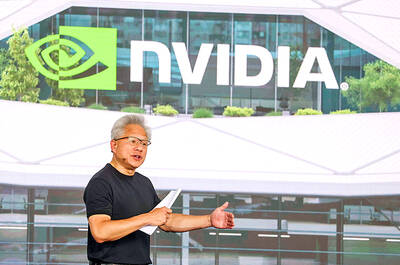
‘BOOMING’: ’ The number of partners we have here is incredible. You can see from their stock prices. They’re doing so well, they’re so happy,’ Jensen Huang said Nvidia Corp’s spending in Taiwan has ballooned to about US$150 billion a year, 10 times the US$10 billion to US$15 billion the company spent five years ago, Nvidia chief executive officer Jensen Huang (黃仁勳) said yesterday, suggesting Taiwan’s strategic importance in the global artificial intelligence (AI) supply chain. “Taiwan is the epicenter of the AI revolution. This is where the chips come, packaging comes. This is where the systems are made. This is where AI supercomputers were created,” Huang said at a meeting for the company’s employees in Beitou-Shilin Technology Park (北投士林科技園區) in Taipei, the planned site of Nvidia’s Taipei headquarters. “Taiwan


 RSS
RSS