


Taiwan is still hoping to reach a deal with the US in ongoing tariff talks after it was not among the first batch of 14 nations to receive tariff notification letters.
The US issued its first batch of tariff notification letters on Monday, but Executive Yuan spokeswoman Michelle Lee (李慧芝) yesterday confirmed that Taiwan has yet to receive one.
Vice Premier Cheng Li-chun (鄭麗君) and Minister Without Portfolio Yang Jen-ni (楊珍妮), who lead the Office of Trade Negotiations, are in the US negotiating the tariff issue, the Executive Yuan said yesterday.
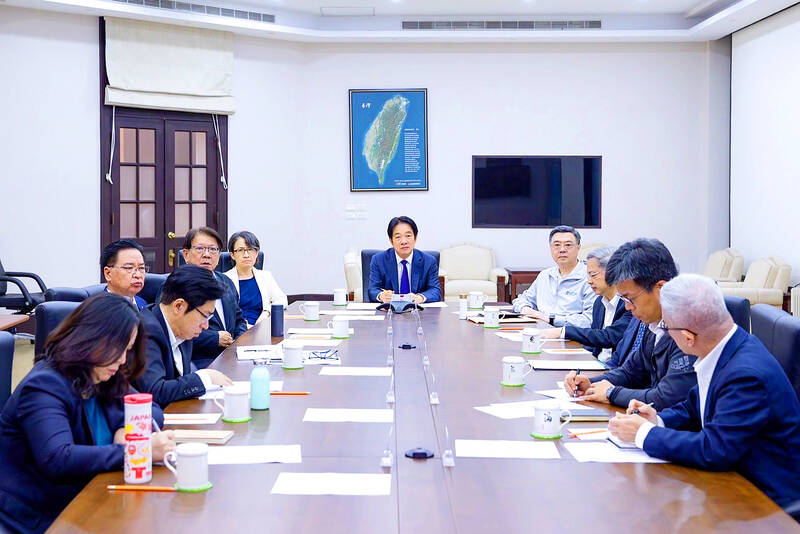
Photo courtesy of the Presidential Office
The US in early April announced sweeping tariffs on imported goods, including a 32 percent tariff on Taiwan, but it later announced a 90-day suspension for nations to negotiate a trade agreement.
Fourteen nations — most notably Japan, South Korea, Malaysia, Indonesia and Thailand — on Monday received letters notifying them of new tariff rates starting on Aug. 1, with the threat that retaliatory tariffs on US goods would lead to even higher rates.
Tariff rates for South Korea, Japan and Malaysia were set at 25 percent, 32 percent for Indonesia and 36 percent for Thailand.
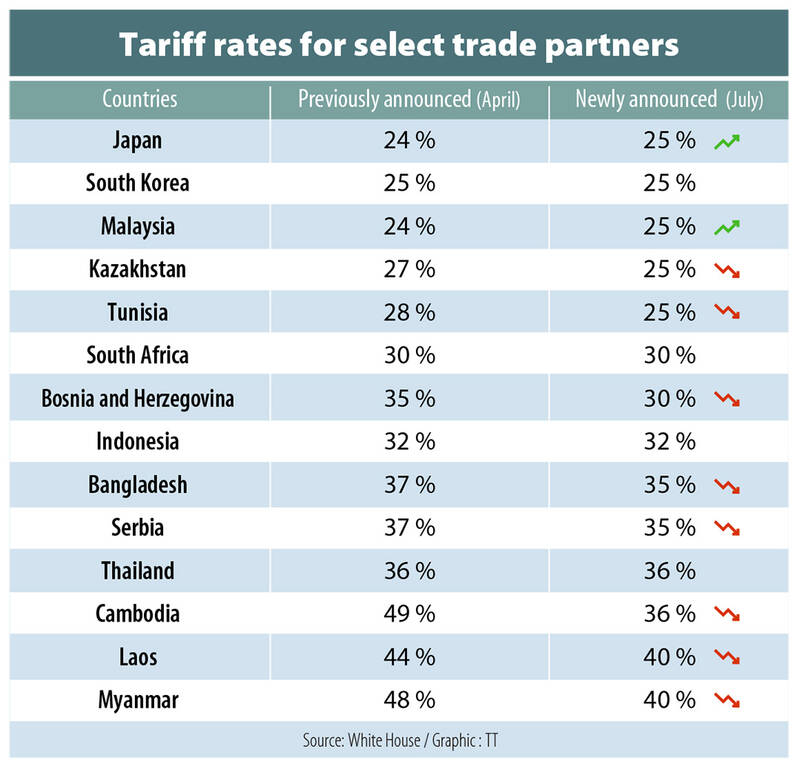
An anonymous source said that the high tariff rates for this first group of nations are examples of negotiations stalling, failing or having been deemed unnecessary to continue.
The US has reportedly indicated that negotiations with Taiwan are progressing positively, the source said.
In a statement issued yesterday, the Ministry of Foreign Affairs said that Taiwan and the US are engaged in discussions on tariffs and that negotiators continue to seek the best outcome.
Developments would be announced to the public when available, the ministry said.
Meanwhile, the Presidential Office yesterday said that President William Lai (賴清德) held a videoconference call with Taiwan’s negotiation team in the US at midnight on Monday.
In the 50-minute call, Lai expressed his gratitude for their months of work, Presidential Office spokesperson Karen Kuo (郭雅慧) said.
Lai emphasized that Taiwan has always sought to maintain positive relations with the US based on mutual benefit, and hope that the negotiations would balance trade and strengthen cooperation between the two nations, Kuo said.
The core mission of Taiwan’s negotiators is to safeguard the national interest, public health and food security, Lai told them, she said.
That Taiwan did not receive a letter could be an indication of positive developments in ongoing discussions between Taiwan and the US, political pundit Grace Woo (吳靜怡) said in a social media post yesterday.
Hopefully, lawmakers understand the importance of strengthening US-Taiwan relations, Woo said, adding that Taiwan’s status as a democratic partner should help it ensure that it is not “punished.”
Additional reporting by Huang Ching-hsuan and Chung Li-hua
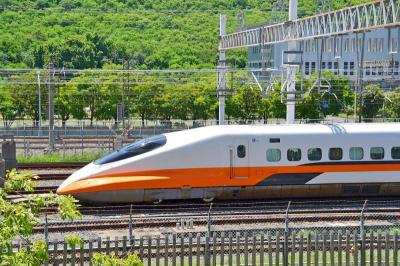
A signaling system malfunction disrupted high-speed rail (HSR) services beginning at 8am today, with trains temporarily reduced to three northbound and three southbound trains per hour as authorities conduct inspections. The malfunction occurred on a section of track in Miaoli County during pre-operation checks early this morning, forcing northbound and southbound trains to use a single track, the HSR operator said. The regular schedule has been replaced with three hourly trains offering only nonreserved seating in each direction, stopping at every station, it said, adding that business class cars would still have reserved seating. Departures from terminal stations are scheduled at the top
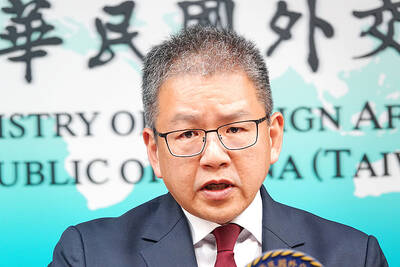
Taiwan is still in the process of assessing the possibility of recruiting workers from Eswatini, the Ministry of Foreign Affairs said yesterday, adding that its goal is to help Eswatini upgrade its vocational training centers. If there are plans to recruit workers from Eswatini, safeguarding national security, protecting public health and ensuring the employment rights of Taiwanese would be prerequisites, Department of West Asian and African Affairs Director-General Yen Chia-liang (顏嘉良) told a news conference. Key considerations would also include filling labor shortages in specific industries, and fostering bilateral professional and technical exchanges, he said. Yen was asked about the progress of labor
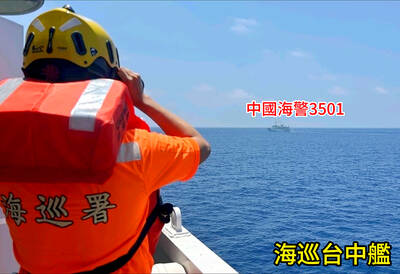
VERBOSE VESSELS: A CGA cutter and a China Coast Guard exchanged verbal barbs for more than a day in Taiwanese-controlled waters before the Chinese vessel left The Taiwanese and Chinese coast guards had a standoff near the strategically located Pratas Islands (Dongsha Islands, 東沙群島) in the north of the South China Sea, the Coast Guard Administration (CGA) said yesterday. The two sides engaged in intense radio exchanges over sovereignty claims during the 33-hour standoff. China Coast Guard vessel 3501 eventually left the restricted waters, 26.6 nautical miles (49.2km) west of the Pratas Islands, at 5pm yesterday, the CGA said. Lying approximately between southern Taiwan and Hong Kong, the Taiwan-controlled Pratas are seen by some security experts as vulnerable to Chinese attack due to their distance — more than
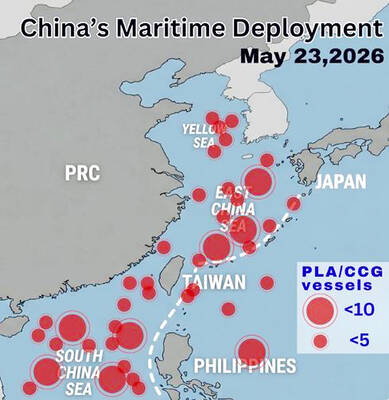
WARNING: China should stop engaging in actions that undermine regional peace and stability, as it would only build resentment among people across the Strait, the CGA said China has deployed more than 100 navy, coast guard and other vessels in waters from the Yellow Sea to the South China Sea and the western Pacific since US President Donald Trump and Chinese President Xi Jinping (習近平) met in Beijing, National Security Council Secretary-General Joseph Wu (吳釗燮) said yesterday. “In this part of the world, #China is the one & only PROBLEM wrecking the #StatusQuo & threatening regional peace & stability,” Wu wrote on X. In a separate post, he said Beijing was coercing Taiwan’s maritime domain, calling it illegal and provocative, after the Coast Guard Administration (CGA) expelled a


 RSS
RSS