


The Thai Constitutional Court has suspended Thai Prime Minister Paetongtarn Shinawatra from office until it rules on a petition seeking her ouster for alleged ethical violations — the biggest blow yet to her less-than-one-year-old government.
Paetongtarn’s powers have been suspended from yesterday while the nine-member court considers the petition by a group of senators, it said in a statement.
The decision to suspend her duties was backed by seven out of nine judges, it said.
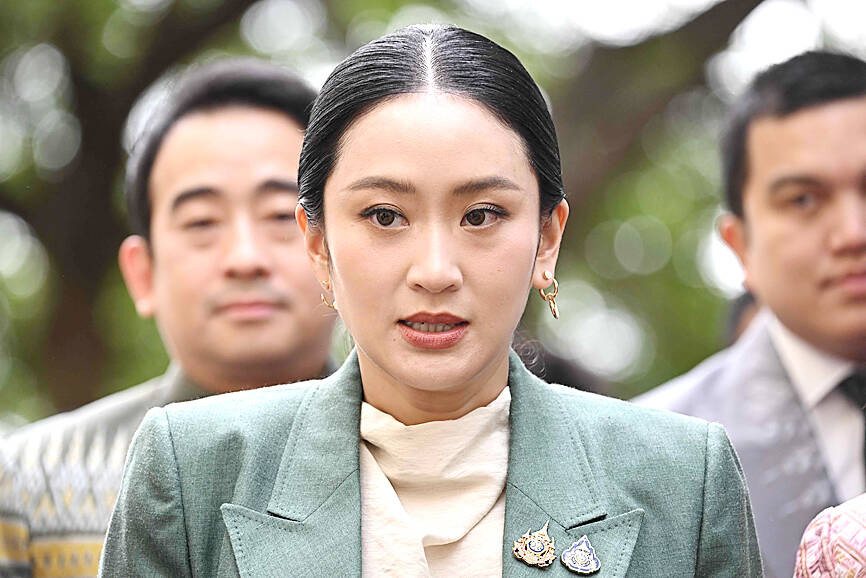
Photo: AFP
The petitioners alleged that the Thai prime minister’s comments in a leaked phone call with former Cambodian leader Hun Sen constituted a violation of ethical standards — grounds that could lead to her dismissal.
The embattled premier has 15 days to respond to the charges, the court said.
The baht fell on the news, while the yield on benchmark 10-year bonds edged lower. The benchmark stock index, among the world’s worst-performing major equity markets globally this year, rallied as much as 1.8 percent on expectation Paetongtarn’s suspension would help reduce politicial tension.
Thai Deputy Prime Minister and Minister of Transportation Suriya Juangroongruangkit would be the acting leader, officials said.
The suspension came just hours after Paetongtarn had unveiled a new Cabinet lineup that was meant to shore up support of allies in her coalition government.
The court blow is the biggest threat yet to Paetongtarn’s nascent political career after she came to power. Her predecessor, Srettha Thavisin, was ousted last year in a similar ethics-related case.
The youngest daughter of influential former Thai prime minister Thaksin Shinawatra, Paetongtarn had resisted calls to resign over the leaked phone call, in which she criticized the Thai army’s role in a border standoff with Cambodia.
She is the third member of the influential Shinawatra clan to lead the country.
“This could be the end of the Shinawatra dynasty,” said Titipol Phakdeewanich, a political science lecturer at Ubon Ratchathani University.
“The court’s decision is unsurprising given the opposition against the prime minister has been getting stronger and the nature of the allegations,” Titipol said.
The suspension came days after thousands of protesters rallied in Bangkok demanding her resignation. The political turmoil dented the 38-year-old prime minister’s popularity. Support for Paetongtarn fell to single digits in a recent opinion poll, with only 9.2 percent of respondents backing her, according to a survey from June 19 to Wednesday last week by the Thai National Institute of Development Administration.
Paetongtarn said she accepted the court decision, and her actions were with the country’s best interest at heart.
Her legal challenges are far from over. Her opponents have also approached the anti-graft agency and the Thai Election Commission to force her removal.
Meanwhile, the border dispute with Cambodia has intensified, with both countries enacting tit-for-tat measures to restrict trade and cross-border movement. Last week, Hun Sen — father of current Cambodian Prime Minister Hun Manet — called for a leadership change in Thailand, saying he doubted Paetongtarn’s ability to resolve the escalating conflict.
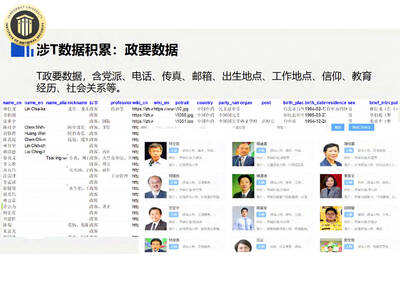
NETWORK-MAPPING PROJECT: The database contains 170 detailed files of Taiwanese politicians and about 23 million records of household registration data in Taiwan China has developed a network-mapping project targeting political figures and parties in Taiwan to monitor public opinion during elections and to craft tailored influence campaigns aimed at dividing Taiwanese society, according to documents leaked by Chinese technology firm GoLaxy (中科天璣). The documents, collected by Taipei-based Doublethink Lab, showed a database was specifically created to gather detailed information on Taiwanese political figures, including their political affiliations, job histories, birthplaces, residences, education, religion and a brief biography about them. Several notable Taiwanese politicians are in the database, including President William Lai (賴清德), former president Tsai Ing-wen (蔡英文), Minister of Foreign Affairs Lin Chia-lung (林佳龍),
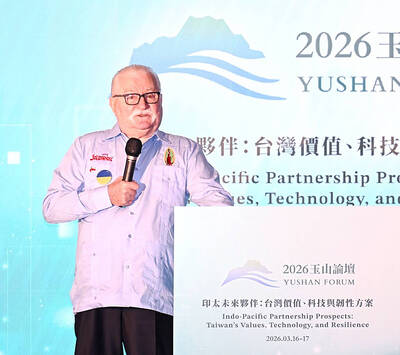
RECOGNITION: Former Fijian prime minister Mahendra Chaudhry said that Taiwan’s New Southbound Policy serves as a stabilizing force in the Indo-Pacific region Taiwan can lead the unification of the Chinese people, Nobel Peace Prize laureate and former Polish president Lech Walesa said in Taipei yesterday, adding that as the world order is changing, peaceful discussion would find good solutions, and that the use of force and coercion would always fail. Walesa made the remarks during his keynote address at a luncheon of the Yushan Forum in Taipei, titled “Indo-Pacific Partnership Prospects: Taiwan’s Values, Technology and Resilience,” organized by the Taiwan-Asia Exchange Foundation with the Ministry of Foreign Affairs. Walesa said that he had been at the forefront of a big peaceful revolution and “if
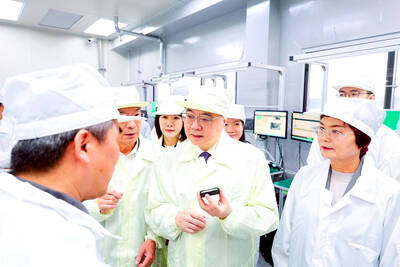
KEY INDUSTRY: The vice premier discussed a plan to create a non-red drone supply chain by next year, which has been allocated a budget of more than NT$7.2 billion The government has budgeted NT$44.2 billion (US$1.38 billion) to cultivate Taiwan’s uncrewed aerial vehicle (UAV) industry over the next five years, which would make the nation a major player in the industry’s democratic supply chain in the Asia-Pacific region, Premier Cho Jung-tai (卓榮泰) said yesterday. Cho made the remarks during a visit to the facilities of Cub Elecparts Inc (為升電裝). Democratic Progressive Party (DPP) Legislator Chen Su-yueh (陳素月) and Chinese Nationalist Party (KMT) Legislator Hsieh Yi-fong (謝依鳳) also participated in the trip. Cub Elecparts has transitioned from the automotive industry to the defense industry, which is the top priority among the nation’s
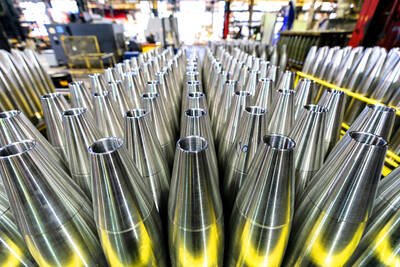
UPGRADED MISSILE: The Chungshan Institute of Science and Technology is reportedly to conduct a live-fire test of the Hsiung Feng III anti-ship missile on Thursday next week The US Army is planning to build new facilities to boost explosives production and strengthen its supply chain, a move aimed at addressing munitions shortages and supporting obligations to partners including Taiwan, Ukraine and Israel, Defense News reported. The army has issued a sources sought notice for a proposed Center of Excellence at the Blue Grass Army Depot in Kentucky, the report said. The facility would serve as a hub within the US industrial base for the production of key military explosives, including research department explosives (RDX) and high melting explosives (HMX), while also supporting research and development of next-generation materials. The proposed


 RSS
RSS