


An assistant to former legislative speaker You Si-kun (游錫?) when he served in the Legislative Yuan has been released on bail amid an investigation into allegations that he was recruited by Chinese intelligence agents during a trip to China.
The assistant, Sheng Chu-ying (盛礎纓), is suspected of handing over sensitive information from the Legislative Yuan in exchange for money.
The Taipei District Prosecutors’ Office on Tuesday last week deployed officers from the Ministry of Justice Investigation Bureau to conduct searches and summoned Sheng for questioning.
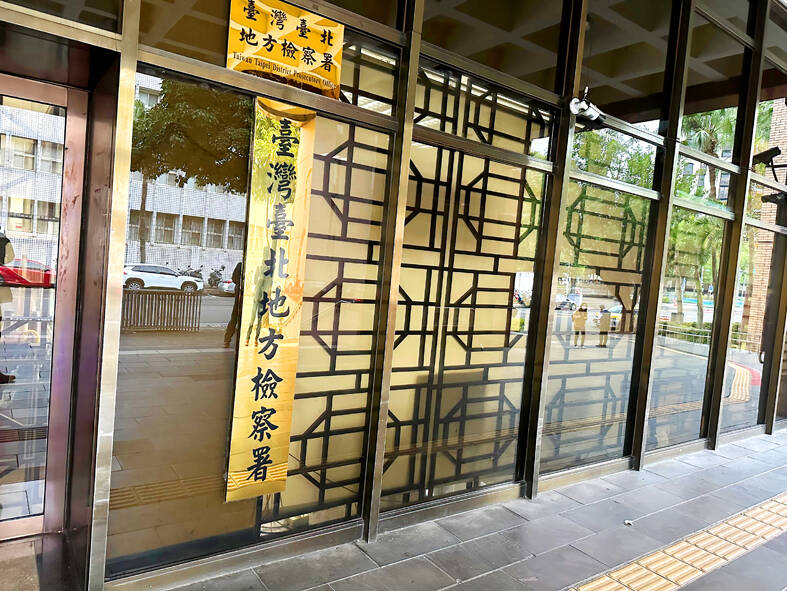
Photo: Wu Sheng-yu, Taipei Times
After questioning, prosecutors said they suspect Sheng contravened the National Security Act (國安法).
He was released on bail of NT$200,000, restricted from leaving the country and placed under electronic monitoring.
Sheng was a top graduate from National Taiwan University’s Department of Political Science.
He worked for about nine months for You, a veteran lawmaker and founding member of the Democratic Progressive Party (DPP) who once served as premier, during You’s term as legislative speaker from 2020 to last year.
After serving in You’s office, he transferred to the office of DPP Legislator Loh Meei-ling (羅美玲).
Sheng resigned from Loh’s office in February to “pursue other work,” Loh said.
He has also since deleted his Facebook account.
Sheng also worked as an aide to DPP Legislator Jean Kuo (郭昱晴) for less than two months last year and a year under DPP Legislator Hsu Chih-chieh (許智傑).
Sheng visited China in 2019, where a friend allegedly introduced him to Chinese intelligence officers.
Investigators suspect that Sheng handed over legislative information in exchange for cash payments in yuan and US dollars, later switching to cryptocurrency following the outbreak of the COVID-19 pandemic to obscure financial records, Chinese-language media reported.
Sheng traveled overseas multiple times, where he allegedly met with Chinese intelligence agents, they said.
Authorities reportedly found evidence that Sheng had attempted to delete information and phone records related to the case, including conversation logs and document transfers, which prompted the search.
During questioning, Sheng admitted to receiving the funds, but denied handing over classified information, claiming that the documents were publicly available, reports said.
Investigators found that Sheng had attempted to recruit a friend to join a scheme, leading to a whistle-blower reporting him to the authorities, reports said.
Due to the prolonged nature of the alleged offenses and the large volume of leaked data, authorities said they are to widen the ongoing investigation.
You did not state his opinion on the case, but hopes that Sheng would be treated as innocent unless proven guilty, the former legislative speaker’s office said in a statement.
Sheng was hired in April 2022 on recommendation, but due to unusual behavior, his contract was not renewed in January 2023, the statement said.
Sheng was removed from his position following the Lunar New Year of that year, it added.
The Presidential Office retains an unbiased and nonpartisan stance, and hopes that justice would be served in accordance with the law, spokesperson Karen Kuo (郭雅慧) said.
Additional reporting by Su Yung-yao, Chen Yun and Wang Ting-chuan

A signaling system malfunction disrupted high-speed rail (HSR) services beginning at 8am today, with trains temporarily reduced to three northbound and three southbound trains per hour as authorities conduct inspections. The malfunction occurred on a section of track in Miaoli County during pre-operation checks early this morning, forcing northbound and southbound trains to use a single track, the HSR operator said. The regular schedule has been replaced with three hourly trains offering only nonreserved seating in each direction, stopping at every station, it said, adding that business class cars would still have reserved seating. Departures from terminal stations are scheduled at the top

Taiwan is still in the process of assessing the possibility of recruiting workers from Eswatini, the Ministry of Foreign Affairs said yesterday, adding that its goal is to help Eswatini upgrade its vocational training centers. If there are plans to recruit workers from Eswatini, safeguarding national security, protecting public health and ensuring the employment rights of Taiwanese would be prerequisites, Department of West Asian and African Affairs Director-General Yen Chia-liang (顏嘉良) told a news conference. Key considerations would also include filling labor shortages in specific industries, and fostering bilateral professional and technical exchanges, he said. Yen was asked about the progress of labor

A US uncrewed surface vessel (USV) encountered multiple Chinese warships during an autonomous transit of the Taiwan Strait, US defense company Seasats said in a statement on Wednesday. Seasats announced that a Lightfish USV had completed the first autonomous transit of the Taiwan Strait. Over five days, the USV traversed the entire length of the Strait while constantly monitoring surface vessel traffic, the company said. The Lightfish encountered multiple Chinese warships, one of which was a Chinese People’s Liberation Army Navy (PLAN) Type 056 corvette, it said. The Chinese vessels were operating “well within Taiwan’s exclusive economic zone without transmitting their identity via the

VERBOSE VESSELS: A CGA cutter and a China Coast Guard exchanged verbal barbs for more than a day in Taiwanese-controlled waters before the Chinese vessel left The Taiwanese and Chinese coast guards had a standoff near the strategically located Pratas Islands (Dongsha Islands, 東沙群島) in the north of the South China Sea, the Coast Guard Administration (CGA) said yesterday. The two sides engaged in intense radio exchanges over sovereignty claims during the 33-hour standoff. China Coast Guard vessel 3501 eventually left the restricted waters, 26.6 nautical miles (49.2km) west of the Pratas Islands, at 5pm yesterday, the CGA said. Lying approximately between southern Taiwan and Hong Kong, the Taiwan-controlled Pratas are seen by some security experts as vulnerable to Chinese attack due to their distance — more than


 RSS
RSS