


Taiwan should be allowed to join the World Health Assembly (WHA) as an irreplaceable contributor to global health and disease prevention efforts, Minister of Foreign Affairs Lin Chia-lung (林佳龍) said yesterday.
He made the comment at a news conference in Taipei, hours before a Taiwanese delegation was to depart for Geneva, Switzerland, seeking to meet with foreign representatives for a bilateral meeting on the sidelines of the WHA, the WHO’s annual decisionmaking meeting, which would be held from Monday next week to May 27.
As of yesterday, Taiwan had yet to receive an invitation.
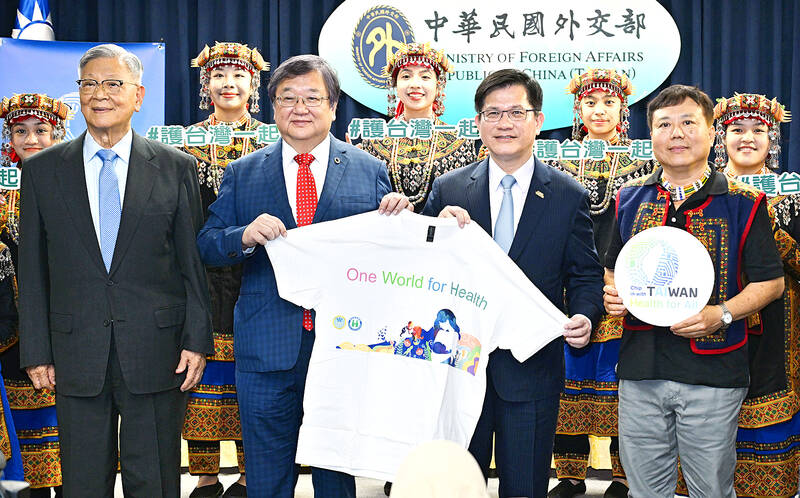
Photo: Laio Chen-hui, Taipei Times
Taiwan has much to offer to the international community’s efforts to protect the world’s collective health, and its exclusion from the WHA has been a loss to all nations, Lin said.
The nation’s healthcare system covers 99 percent of the population and has a proven record in providing for disadvantaged people and ethnic minorities, he said, adding that it could benefit the WHA’s Global Plan of Action for Health of Indigenous Peoples.
China has for years distorted UN Resolution 2758 to pressure the WHA into excluding Taiwan from its proceedings, but Taiwan’s democratically elected government should be the sole representative of its people, Lin said.
The resolution applies only to the representation of China in the UN, not Taiwan’s, and many have challenged the falsehoods perpetuated by Beijing’s legal and cognitive warfare, he said.
WHO Director-General Tedros Adhanom Ghebreyesus should heed the call of professionalism and political neutrality, and reject Beijing’s meddling, Lin said, adding the global common good should take precedence over other concerns.
Taiwan’s key role in global chip supply chains makes it a crucial partner in any worldwide public health initiative, he said, citing the nation’s participation in the Global Cooperation and Training Framework alongside Japan, Australia, Canada and other countries.
Minister of Health and Welfare Chiu Tai-yuan (邱泰源) said that Taiwan’s exclusion from the WHA is an injustice to the nation and robs the world of the benefits it could have obtained from one of the foremost practitioners of disease prevention and public health.
The government will not give up the fight for the Taiwanese whose universal right to health must not be denied, he said.
Asked about Washington’s pullout from the WHO, Lin said that the US’ support for Taiwan remains unchanged, as its membership in the organization is valid until the end of the year.
In February, the US envoy to the WHO again expressed Washington’s support for Taipei’s participation in the organization and criticized Beijing’s mischaracterization of the UN resolution, he said.
The US remains capable of wielding influence outside the WHO and Taiwan would be the first to join any alternative global health framework Washington creates, Lin said.
Taiwan can share information about health matters and be involved in deliberations on global health policy without being part of the WHO, he added.
Health is a human right and the government will not give that up with or without being invited to attend the assembly, Lin said.
Chiu said Taiwan’s delegation would host a forum on the nation’s experience in universal health coverage and in applying artificial intelligence to healthcare, adding that Japan, Thailand, the US, the UK, Germany and Switzerland would attend the event.
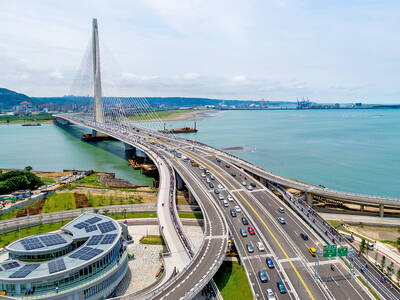
The Ministry of Transportation and Communications yesterday inaugurated the Danjiang Bridge across the Tamsui River in New Taipei City, saying that the structure would be an architectural icon and traffic artery for Taiwan. Feted as a major engineering achievement, the Danjiang Bridge is 920m long, 211m tall at the top of its pylon, and is the longest single-pylon asymmetric cable-stayed bridge in the world, the government’s Web site for the structure said. It was designed by late Iraqi-British architect Zaha Hadid. The structure, with a maximum deck of 70m, accommodates road and light rail traffic, and affords a 200m navigation channel for boats,
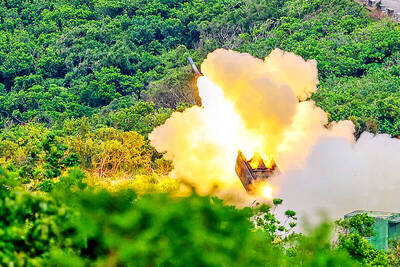
PRECISION STRIKES: The most significant reason to deploy HIMARS to outlying islands is to establish a ‘dead zone’ that the PLA would not dare enter, a source said A High Mobility Artillery Rocket System (HIMARS) would be deployed to Penghu County and Dongyin Island (東引) in Lienchiang County (Matsu) to force the Chinese military to retreat at least 100km from the coastline, a military source said yesterday. Taiwan has been procuring HIMARS and Army Tactical Missile Systems (ATACMS) from the US in batches. Once all batches have been delivered, Taiwan would possess 111 HIMARS units and 504 ATACMS, which have a range of 300km. Considering that “offense is the best defense,” the military plans to forward-deploy the systems to outlying islands such as Penghu and Dongyin so that

Taiwan Semiconductor Manufacturing Co (TSMC, 台積電), the world’s largest foundry service provider, yesterday said that global semiconductor revenue is projected to hit US$1.5 trillion in 2030, after the figure exceeds US$1 trillion this year, as artificial intelligence (AI) demand boosts consumption of token and compute power. “We are still at the beginning of the AI revolution, but we already see a significant impact across the whole semiconductor ecosystem,” TSMC deputy cochief operating officer Kevin Zhang (張曉強) said at the company’s annual technology symposium in Hsinchu City. “It is fair to say that in the past decade, smartphones and other mobile devices were
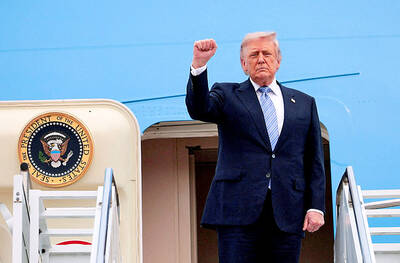
US-CHINA SUMMIT: MOFA welcomed US reassurance of no change in its Taiwan policy; Trump said he did not comment when Xi talked of opposing independence US President Donald Trump yesterday said he has not made a decision on whether to move forward with a major arms package for Taiwan after hearing concerns about it from Chinese President Xi Jinping (習近平). Trump’s comments on Taiwan came as he flew back to Washington after wrapping up critical talks in which both leaders said important progress was made in stabilizing US-China relations even as deep differences persist between the world’s two biggest powers on Iran and Taiwan. “I will make a determination,” Trump said, adding: “I’ll be making decisions. But, you know, I think the last thing we need right


 RSS
RSS