


People yesterday scoured collapsed buildings searching for survivors as aftershocks rattled the devastated city of Mandalay, two days after a massive earthquake killed at least 1,700 people in Myanmar and at least 18 in neighboring Thailand.
The initial magnitude 7.7 quake struck near the central Myanmar city of Mandalay early on Friday afternoon, followed minutes later by a magnitude 6.7 aftershock.
The tremors collapsed buildings, downed bridges and buckled roads, with mass destruction seen in the city of more than 1.7 million people.
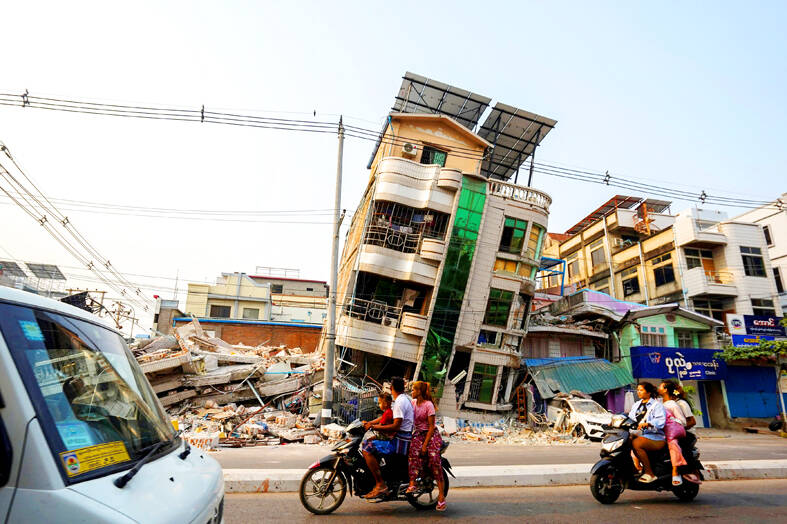
Photo: Reuters
Tea shop owner Win Lwin picked his way through the remains of a collapsed restaurant on a main road in his neighborhood early yesterday, tossing bricks aside one by one.
“About seven people died here” when the quake struck, he said. “I’m looking for more bodies, but I know there cannot be any survivors.”
About an hour later, a small aftershock struck, sending people scurrying out of a hotel for safety, following a similar tremor felt late on Saturday evening.
At about 2pm, a magnitude 5.1 aftershock sent people into the streets in alarm once again, temporarily halting rescue work.
The night before, rescuers had pulled a woman out alive from the wreckage of a collapsed apartment building, with applause ringing out as she was carried by stretcher to an ambulance.
Myanmar’s ruling junta in a statement yesterday afternoon said that about 1,700 people were confirmed dead so far, about 3,400 injured and about 300 more missing.
However, the true scale of the disaster remains unclear in the isolated military-ruled state, and the toll is expected to rise significantly.
At a destroyed Buddhist examination hall in Mandalay, Chinese responders yesterday worked to find buried victims.
So far, 21 people have been rescued, while 13 bodies have been recovered, but at least two more people were still believed alive in the rubble, rescuers said.
San Nwe Aye, sister of a 46-year-old monk missing in the collapsed hall, appeared in deep distress, and said that she has heard no news about his status.
“I want to hear the sound of him preaching,” she said. “The whole village looked up to him.”
Burmese State Administration Council Chairman Min Aung Hlaing on Friday issued an exceptionally rare appeal for international aid, indicating the severity of the calamity.
Previous military governments have shunned foreign assistance, even after major natural disasters.
Myanmar has already been ravaged by four years of civil war sparked by a military coup in 2021.
Reports have emerged of sporadic fighting even after the quake, with one rebel group yesterday saying that seven of its fighters were killed in an aerial attack soon after the tremors hit.

A signaling system malfunction disrupted high-speed rail (HSR) services beginning at 8am today, with trains temporarily reduced to three northbound and three southbound trains per hour as authorities conduct inspections. The malfunction occurred on a section of track in Miaoli County during pre-operation checks early this morning, forcing northbound and southbound trains to use a single track, the HSR operator said. The regular schedule has been replaced with three hourly trains offering only nonreserved seating in each direction, stopping at every station, it said, adding that business class cars would still have reserved seating. Departures from terminal stations are scheduled at the top

Taiwan is still in the process of assessing the possibility of recruiting workers from Eswatini, the Ministry of Foreign Affairs said yesterday, adding that its goal is to help Eswatini upgrade its vocational training centers. If there are plans to recruit workers from Eswatini, safeguarding national security, protecting public health and ensuring the employment rights of Taiwanese would be prerequisites, Department of West Asian and African Affairs Director-General Yen Chia-liang (顏嘉良) told a news conference. Key considerations would also include filling labor shortages in specific industries, and fostering bilateral professional and technical exchanges, he said. Yen was asked about the progress of labor

A US uncrewed surface vessel (USV) encountered multiple Chinese warships during an autonomous transit of the Taiwan Strait, US defense company Seasats said in a statement on Wednesday. Seasats announced that a Lightfish USV had completed the first autonomous transit of the Taiwan Strait. Over five days, the USV traversed the entire length of the Strait while constantly monitoring surface vessel traffic, the company said. The Lightfish encountered multiple Chinese warships, one of which was a Chinese People’s Liberation Army Navy (PLAN) Type 056 corvette, it said. The Chinese vessels were operating “well within Taiwan’s exclusive economic zone without transmitting their identity via the

VERBOSE VESSELS: A CGA cutter and a China Coast Guard exchanged verbal barbs for more than a day in Taiwanese-controlled waters before the Chinese vessel left The Taiwanese and Chinese coast guards had a standoff near the strategically located Pratas Islands (Dongsha Islands, 東沙群島) in the north of the South China Sea, the Coast Guard Administration (CGA) said yesterday. The two sides engaged in intense radio exchanges over sovereignty claims during the 33-hour standoff. China Coast Guard vessel 3501 eventually left the restricted waters, 26.6 nautical miles (49.2km) west of the Pratas Islands, at 5pm yesterday, the CGA said. Lying approximately between southern Taiwan and Hong Kong, the Taiwan-controlled Pratas are seen by some security experts as vulnerable to Chinese attack due to their distance — more than


 RSS
RSS