

Taiwan plays a critical role in “non-red” supply chains, because it is trusted by democratic countries and has technology important to the semiconductor industry, Minister of Foreign Affairs Lin Chia-lung (林佳龍) said on Saturday.
In a post on Facebook, Lin shared takeaways from his speech at recent forum on global power and US leadership, innovative revolution and artificial intelligence (AI), and the financial market.
He said geopolitical changes, supply chain restructuring, and innovative technology driven by semiconductors and AI are all associated with US President Donald Trump’s administration.

Photo: CNA
Lin said he believes the Trump administration’s policies can be understood using “4Rs”: “reciprocity,” as Trump stresses reciprocal tariffs and “trade balance”; “reindustrialization” for his emphasis on bringing relocating manufacturing to the US to create job opportunities; “respect”; and “real estate” for his focus on strategic land interests.
Many of Trump’s policies show continuity from his first term in the White House, such as continuing the US Indo-Pacific Strategy, and reconfirming it in a summit with Japan, a meeting of the foreign ministers of Quadrilateral Security Dialogue members Australia, India, Japan and the US, and the US-Japan-South Korea ministers’ meeting last month, Lin said.
However, Trump is placing greater emphasis on the “shared responsibility of allies” and “peace through strength” in his second term, he said.
“Therefore, countries in the first island chain, including Taiwan, Japan and the Philippines must demonstrate their self-defense determination,” he said, adding that President William Lai (賴清德) has already announced that Taiwan would increase national defense spending to at least 3 percent of GDP and strengthen the nation’s whole-of-society defense resilience.
Trump is continuing the “desinicization” of global supply chains to protect national critical infrastructure, and using tariffs as a measure to pressure nations to build “non-red” supply chains, he said.
Many people in Taiwan are worried about Taiwan Semiconductor Manufacturing Co’s (TSMC, 台積電) plan to significantly increase its investments in the US, but people should trust in the company’s plans, he said, adding that TSMC’s investment in other countries allows Taiwan to expand its economic horizons.
The US is also competing with China in technology to establish a lead in AI, Lin said.
“Taiwan is trusted by democratic countries and holds important technology for semiconductor production, thus playing a critical role in non-red supply chains,” he added.
Taiwan should understand the common interests it has with the US and seek to implement those that benefit both countries, Lin said.
Taiwan should also realize that it plays a critical role in the first island chain, “non-red supply chains” and the promotion of democracy, he said.
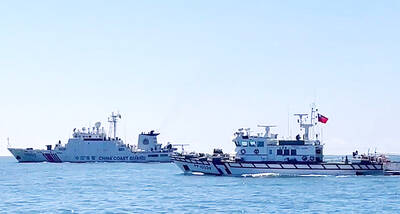
China deployed a record number of coast guard, scientific research and other ships near Taiwan’s waters last month, the Coast Guard Administration (CGA) said, as Beijing dials up pressure on Taipei. The coast guard warned of an increasingly severe situation, as analysts say the increased activity is part of China’s bid to map the region for submarine warfare. The number of Chinese ships detected around Taiwan proper soared to a record 244 last month — an average of nearly eight every day, official data showed. That compares with 55 ships detected in June and 30 in May, and 58 in July last year. In
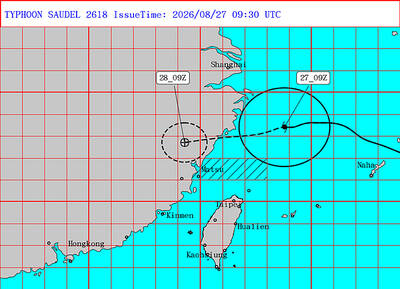
Taiwan is bracing for heavy rain in the south and rough seas around outlying Lienchiang County (Matsu), as Typhoon Saudel passes north toward eastern China, with forecasters yesterday warning of localized flooding over the next two days. Saudel is expected to pass closest to Taiwan today, when its outer rain bands are forecast to brush past Matsu, before making landfall at about noon in China’s Zhejiang Province and weakening significantly, the Central Weather Administration said. The storm’s outer bands, combined with strengthening southwesterly winds, are expected to bring heavy rain to southern and southeastern Taiwan today, it said. As the storm approaches Matsu,

The Hualien District Prosecutors’ Office yesterday launched an investigation following allegations by a former foreign correspondent in Taiwan of widespread vote-buying in Hualien County. In an interview with Formosa TV (FTV, 民視) aired on Saturday, former Financial Times Taiwan correspondent Kathrin Hille spoke about Taiwan’s democracy and said that she now lives in rural Hualien, where “all the votes are bought.” Neighbors would talk about who had come by and leave cash on the table showing “how much each vote was worth that year,” Hille said. The practice needs to be addressed, considering Taiwan has been a democracy for many
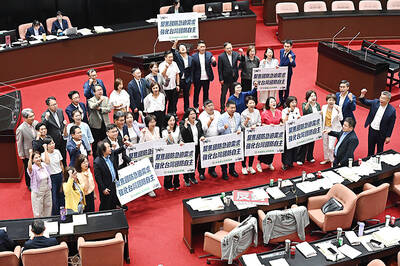
LIMITED: The bill’s NT$40bn annual spending cap would prevent Taiwan from effectively building up its drone combat capabilities, National Defense Minister Wellington Koo said The legislature yesterday rejected the Executive Yuan’s NT$210 billion (US$6.62 billion) special budget proposal to buy military drones and instead passed its own plan, which earmarks NT$40 billion per year over six consecutive years. The Executive Yuan said its plan to buy about 210,000 drones by 2031 could not wait, as the wars in Ukraine and Iran showed the importance of uncrewed systems in modern warfare amid a rising threat from China. However, the Chinese Nationalist Party (KMT) and Taiwan People’s Party (TPP) used their opposition majority to pass a bill providing NT$240 billion through annual budgets over six years, with annual


 RSS
RSS