


US President Donald Trump’s proposal that the US “take over” the Gaza Strip and permanently resettle its Palestinian residents was swiftly rejected and denounced yesterday by Washington’s allies and adversaries alike.
Trump’s suggestion came at a White House news conference with Israeli Prime Minister Benjamin Netanyahu, who smiled several times as the president detailed a plan to build new settlements for Palestinians outside the Gaza Strip, and for the US to take “ownership” in redeveloping the war-torn territory into “the Riviera of the Middle East.”
“The US will take over the Gaza Strip, and we will do a job with it, too,” Trump said. “We’ll own it and be responsible for dismantling all of the dangerous unexploded bombs and other weapons on the site, level the site, and get rid of the destroyed buildings, level it out, create an economic development that will supply unlimited numbers of jobs.”
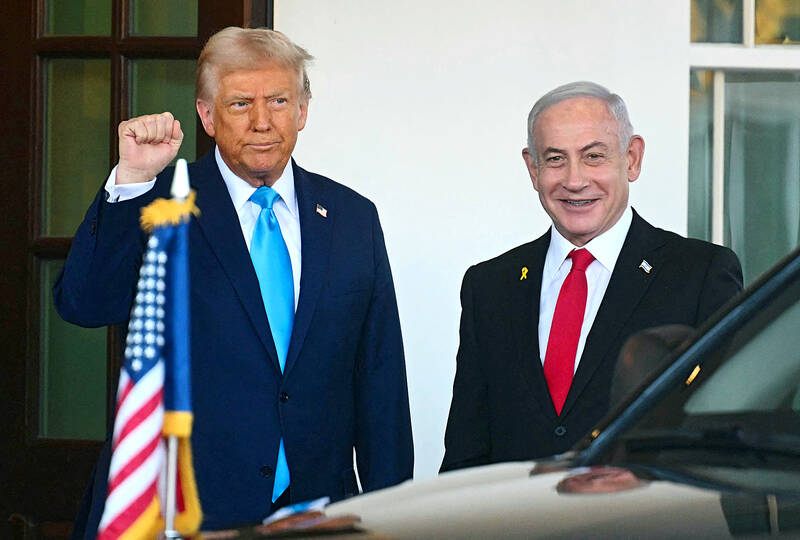
Photo: AFP
The comments came amid a fragile ceasefire between Israel and Hamas, during which the militant group has been turning over hostages in exchange for the release of prisoners held by Israel.
Egypt, Jordan and other US allies in the Middle East have already rejected the idea of relocating more than 2 million Palestinians from Gaza elsewhere in the region.
Following Trump’s remarks, the Egyptian Ministry of Foreign Affairs issued a statement stressing the need for rebuilding “without moving the Palestinians out of the Gaza Strip.”
Saudi Arabia, an important US ally, weighed in quickly on Trump’s expanded idea to take over the Gaza Strip in a sharply worded statement, saying that its long call for an independent Palestinian state was a “firm, steadfast and unwavering position.”
“The kingdom of Saudi Arabia also stresses what it had previously announced regarding its absolute rejection of infringement on the legitimate rights of the Palestinian people, whether through Israeli settlement policies, annexation of Palestinian lands or efforts to displace the Palestinian people from their land,” the statement said.
Similarly, Australian Prime Minister Anthony Albanese told reporters in Canberra that his country has long supported a two-state solution in the Middle East and that nothing had changed.
The New Zealand Ministry of Foreign Affairs and Trade said in a statement that its “long-standing support for a two-state solution is on the record” and added that it “won’t be commenting on every proposal that is put forward.”
Chinese Ministry of Foreign Affairs spokesman Lin Jian (林劍) also underscored Beijing’s longstanding support for a two-state solution.
“We oppose the forced relocation of people in Gaza and hope that the relevant parties will take the ceasefire and post-war governance in Gaza as an opportunity to push the Palestinian issue back on the right track,” he said.
Palestinian President Mahmoud Abbas called for the UN to “protect the Palestinian people and their inalienable rights,” saying that what Trump wanted to do would be “a serious violation of international law.”
Hamas, which sparked the war with its Oct. 7, 2023, attack on Israel, said Trump’s proposal was a “recipe for creating chaos and tension in the region.”

Right-wing political scientist Laura Fernandez on Sunday won Costa Rica’s presidential election by a landslide, after promising to crack down on rising violence linked to the cocaine trade. Fernandez’s nearest rival, economist Alvaro Ramos, conceded defeat as results showed the ruling party far exceeding the threshold of 40 percent needed to avoid a runoff. With 94 percent of polling stations counted, the political heir of outgoing Costa Rican President Rodrigo Chaves had captured 48.3 percent of the vote compared with Ramos’ 33.4 percent, the Supreme Electoral Tribunal said. As soon as the first results were announced, members of Fernandez’s Sovereign People’s Party
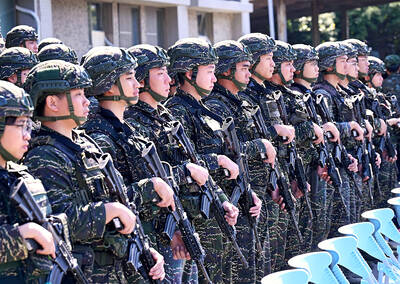
MORE RESPONSIBILITY: Draftees would be expected to fight alongside professional soldiers, likely requiring the transformation of some training brigades into combat units The armed forces are to start incorporating new conscripts into combined arms brigades this year to enhance combat readiness, the Executive Yuan’s latest policy report said. The new policy would affect Taiwanese men entering the military for their compulsory service, which was extended to one year under reforms by then-president Tsai Ing-wen (蔡英文) in 2022. The conscripts would be trained to operate machine guns, uncrewed aerial vehicles, anti-tank guided missile launchers and Stinger air defense systems, the report said, adding that the basic training would be lengthened to eight weeks. After basic training, conscripts would be sorted into infantry battalions that would take

GROWING AMBITIONS: The scale and tempo of the operations show that the Strait has become the core theater for China to expand its security interests, the report said Chinese military aircraft incursions around Taiwan have surged nearly 15-fold over the past five years, according to a report released yesterday by the Democratic Progressive Party’s (DPP) Department of China Affairs. Sorties in the Taiwan Strait were previously irregular, totaling 380 in 2020, but have since evolved into routine operations, the report showed. “This demonstrates that the Taiwan Strait has become both the starting point and testing ground for Beijing’s expansionist ambitions,” it said. Driven by military expansionism, China is systematically pursuing actions aimed at altering the regional “status quo,” the department said, adding that Taiwan represents the most critical link in China’s
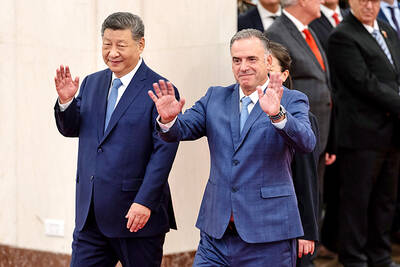
EMERGING FIELDS: The Chinese president said that the two countries would explore cooperation in green technology, the digital economy and artificial intelligence Chinese President Xi Jinping (習近平) yesterday called for an “equal and orderly multipolar world” in the face of “unilateral bullying,” in an apparent jab at the US. Xi was speaking during talks in Beijing with Uruguayan President Yamandu Orsi, the first South American leader to visit China since US special forces captured then-Venezuelan president Nicolas Maduro last month — an operation that Beijing condemned as a violation of sovereignty. Orsi follows a slew of leaders to have visited China seeking to boost ties with the world’s second-largest economy to hedge against US President Donald Trump’s increasingly unpredictable administration. “The international situation is fraught


 RSS
RSS