


US representatives Young Kim and Al Green have proposed a bipartisan bill, the Taiwan non-discrimination act, calling for Taiwan’s membership in the IMF.
The bill calls for Taiwan’s participation in IMF activities, employment opportunities at the IMF for its citizens and for Taiwan to receive IMF assistance.
“We cannot allow the CCP [Chinese Communist Party] to silence Taiwan’s voice and suppress Taiwan’s freedoms any longer,” Kim, a Republican from California, said in a news release issued on Tuesday.
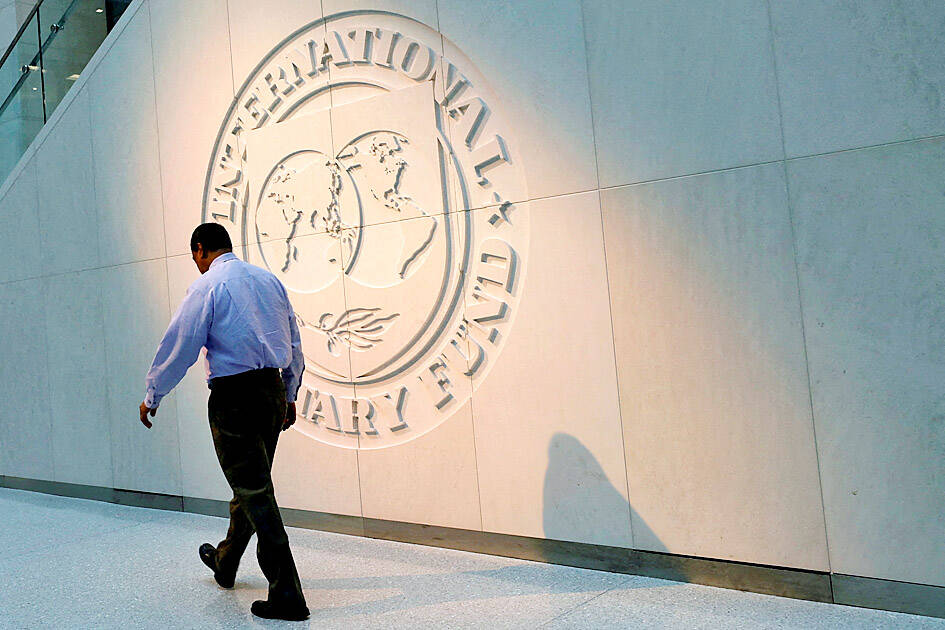
Photo: Reuters
‘KEY PLAYER’
“Taiwan has long been a key player in the global economy, and its return to the IMF would benefit all nations involved. This bipartisan measure underscores our commitment to Taiwan’s growth and to strengthening democratic values worldwide,” said Green, a Texas Democrat.
As part of the rationale for supporting Taiwan’s inclusion in the IMF, the bill cites Taiwan’s status as the world’s 21st-largest economy and the US’ 10th-largest trading partner in goods, as well as Taiwan’s participation in the WTO, Asian Development Bank and APEC forum, and its substantial foreign reserves.
Taiwan has been unjustly excluded from the IMF, as the Taiwan Relations Act of 1979 states that “nothing in this act may be construed as a basis for supporting the exclusion or expulsion of Taiwan from continued membership in any international financial institution or any other international organization,” the proposed bill says.
Furthermore, Taiwan maintained its IMF membership for nine years after the US formally recognized the People’s Republic of China and admitted it to the IMF in 1980.
Kosovo, also not a member of the UN, has been a member of the IMF and the World Bank since June 2009, the proposed bill says.
US SUPPORT
For the bill to become a law, it must pass a vote in the US House of Representatives, then the US Senate and finally be signed into law by US President Donald Trump.
This is not the first time the two representatives have proposed such a bill. In January last year, the House passed a similar proposal regarding Taiwan’s IMF participation.
Prior to that, Kim led a bill that called for the US secretary of state to develop a strategy to restore Taiwan’s observer status in the WHO and the World Health Assembly.
The IMF, which has 191 members, promotes global financial stability and economic growth by providing financial assistance, policy advice and economic surveillance to members.

‘NO SECURITY RISK’: The Railway Bureau reassured the public that the technicians’ activities were limited to technical guidance and did not involve sensitive systems The Railway Bureau yesterday said it had invited eight Chinese technicians to assist with an airport MRT construction project. The bureau issued the confirmation after an Internet user said Chinese nationals had entered the construction zone of Taiwan Taoyuan International Airport’s Terminal 3 project. They asked why “individuals from an enemy state” were allowed access to such a major national infrastructure project, which raised serious concerns over Taiwan’s industrial safety, sensitive systems and information security. The bureau’s Northern Region Engineering Branch Office said subcontractor Taiwan Handle Industrial Co (台灣手把工業) of the Taoyuan airport MRT’s “Contract No. CU05 Project A14 Station Civil, MEP &

A signaling system malfunction disrupted high-speed rail (HSR) services beginning at 8am today, with trains temporarily reduced to three northbound and three southbound trains per hour as authorities conduct inspections. The malfunction occurred on a section of track in Miaoli County during pre-operation checks early this morning, forcing northbound and southbound trains to use a single track, the HSR operator said. The regular schedule has been replaced with three hourly trains offering only nonreserved seating in each direction, stopping at every station, it said, adding that business class cars would still have reserved seating. Departures from terminal stations are scheduled at the top

Taiwan is still in the process of assessing the possibility of recruiting workers from Eswatini, the Ministry of Foreign Affairs said yesterday, adding that its goal is to help Eswatini upgrade its vocational training centers. If there are plans to recruit workers from Eswatini, safeguarding national security, protecting public health and ensuring the employment rights of Taiwanese would be prerequisites, Department of West Asian and African Affairs Director-General Yen Chia-liang (顏嘉良) told a news conference. Key considerations would also include filling labor shortages in specific industries, and fostering bilateral professional and technical exchanges, he said. Yen was asked about the progress of labor

A US uncrewed surface vessel (USV) encountered multiple Chinese warships during an autonomous transit of the Taiwan Strait, US defense company Seasats said in a statement on Wednesday. Seasats announced that a Lightfish USV had completed the first autonomous transit of the Taiwan Strait. Over five days, the USV traversed the entire length of the Strait while constantly monitoring surface vessel traffic, the company said. The Lightfish encountered multiple Chinese warships, one of which was a Chinese People’s Liberation Army Navy (PLAN) Type 056 corvette, it said. The Chinese vessels were operating “well within Taiwan’s exclusive economic zone without transmitting their identity via the


 RSS
RSS