


The Financial Supervisory Commission (FSC) is mulling legislation to regulate the cryptocurrency industry, or virtual assets, and demanding that virtual asset service providers (VASPs) secure permits within 15 months of the legislation’s promulgation.
The planned legislation would set different capital requirements based on which aspect of VASPs are involved in, the FSC said.
All VASPs would be considered financial institutions, and personal trading would not be legal after the legislation is promulgated, it said.

Photo: CNA
Stablecoins, cryptocurrencies whose values are pegged to a reference asset, are currently not considered under FSC jurisdiction, but would be regulated by the committee once the legislation is promulgated.
FSC Chairman Peng Jin-lung (彭金隆) in a news conference on Wednesday last week said that stablecoins would help bridge fiat money and cryptocurrency, adding that the FSC and the central bank would jointly oversee the stablecoin market.
The FSC said it would enforce previous demands that operators keep their assets separate from those of clients and observe information transparency to uphold client interests and rights.
Once control and oversight measures for cryptocurrencies have been established, cryptocurrencies would serve as alternative investment channels, it said.
After crypto exchange FTX Trading Ltd went bankrupt in November 2022, in which many people worldwide suffered losses, the Executive Yuan in March 2023 designated the FSC as the competent authority in Taiwan to avoid similar risks.
The FSC said it has implemented oversight gradually.
The committee said it would hold a public hearing this month involving industry members and academics to get their feedback on the draft legislation.
The draft legislation is expected to be revealed next month and be forwarded to the Executive Yuan in June, after which it would head to the Legislative Yuan, the committee said.
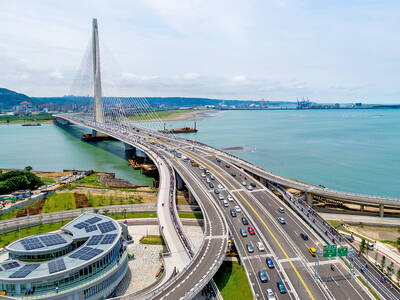
The Ministry of Transportation and Communications yesterday inaugurated the Danjiang Bridge across the Tamsui River in New Taipei City, saying that the structure would be an architectural icon and traffic artery for Taiwan. Feted as a major engineering achievement, the Danjiang Bridge is 920m long, 211m tall at the top of its pylon, and is the longest single-pylon asymmetric cable-stayed bridge in the world, the government’s Web site for the structure said. It was designed by late Iraqi-British architect Zaha Hadid. The structure, with a maximum deck of 70m, accommodates road and light rail traffic, and affords a 200m navigation channel for boats,
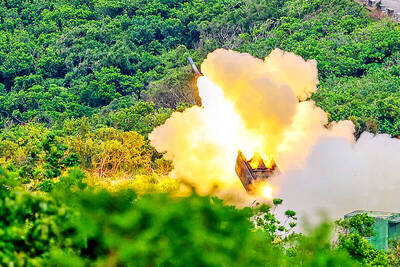
PRECISION STRIKES: The most significant reason to deploy HIMARS to outlying islands is to establish a ‘dead zone’ that the PLA would not dare enter, a source said A High Mobility Artillery Rocket System (HIMARS) would be deployed to Penghu County and Dongyin Island (東引) in Lienchiang County (Matsu) to force the Chinese military to retreat at least 100km from the coastline, a military source said yesterday. Taiwan has been procuring HIMARS and Army Tactical Missile Systems (ATACMS) from the US in batches. Once all batches have been delivered, Taiwan would possess 111 HIMARS units and 504 ATACMS, which have a range of 300km. Considering that “offense is the best defense,” the military plans to forward-deploy the systems to outlying islands such as Penghu and Dongyin so that

Taiwan Semiconductor Manufacturing Co (TSMC, 台積電), the world’s largest foundry service provider, yesterday said that global semiconductor revenue is projected to hit US$1.5 trillion in 2030, after the figure exceeds US$1 trillion this year, as artificial intelligence (AI) demand boosts consumption of token and compute power. “We are still at the beginning of the AI revolution, but we already see a significant impact across the whole semiconductor ecosystem,” TSMC deputy cochief operating officer Kevin Zhang (張曉強) said at the company’s annual technology symposium in Hsinchu City. “It is fair to say that in the past decade, smartphones and other mobile devices were
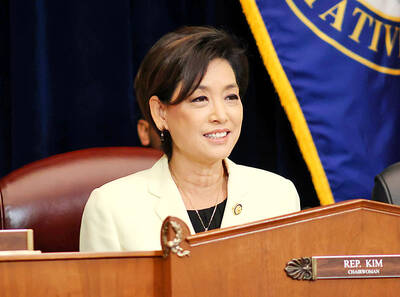
‘CLEAR MESSAGE’: The bill would set up an interagency ‘tiger team’ to review sanctions tools and other economic options to help deter any Chinese aggression toward Taiwan US Representative Young Kim has introduced a bill to deter Chinese aggression against Taiwan, calling for an interagency “tiger team” to preplan coordinated sanctions and economic measures in response to possible Chinese military or political action against Taiwan. “[Chinese President] Xi Jinping [習近平] has directed the People’s Liberation Army to be ready to invade Taiwan by 2027. China has a plan. America should have one too,” Kim said in a news release on Thursday last week. She introduced the “Deter PRC [People’s Republic of China] aggression against Taiwan act” to “ensure the US has a coordinated sanctions strategy ready should


 RSS
RSS