


US Secretary of State Marco Rubio on Wednesday said that Washington under US President Donald Trump remained committed to the Philippines’ defense, as tensions simmer with Beijing in the South China Sea.
In a call with Philippine Secretary of Foreign Affairs Enrique Manalo, Rubio “underscored the United States’ ironclad commitments to the Philippines under our Mutual Defense Treaty,” US Department of State spokeswoman Tammy Bruce said.
Rubio, a longtime hawk on China, discussed the “dangerous and destabilizing actions in the South China Sea” by the People’s Republic of China.
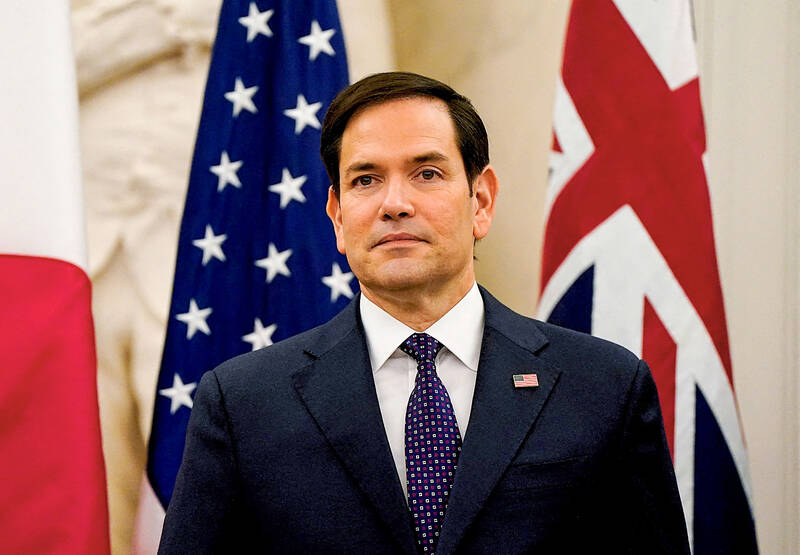
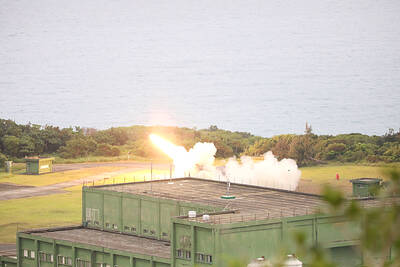
Photo: Reuters
“Secretary Rubio conveyed that the PRC’s behavior undermines regional peace and stability, and is inconsistent with international law,” Bruce said.
US leaders have repeatedly stood by the Philippines, a treaty ally and former US colony, but Trump is known for questioning alliances, including NATO, claiming allied nations treat the US unfairly by not paying more for defense.
Rubio made the call with his Philippine counterpart a day after a veiled warning to Beijing on the South China Sea during a four-way meeting with his counterparts from India, Japan and Australia.
The Philippines has engaged in increasingly tense confrontations with China over disputed South China Sea waters and reefs over the past year.
China claims most of the strategic waterway, despite an international tribunal ruling that its claim lacked any legal basis.
Manila and Washington have deepened their defense cooperation since Philippine President Ferdinand Marcos Jr took office in 2022 and began pushing back on Beijing’s claims to the South China Sea.
Philippine Secretary of National Defense Gilberto Teodoro also met with US National Security Adviser Mike Waltz at the White House on Wednesday to “discuss critical security matters,” the Philippine Department of National Defense said in a statement.
Teodoro “highlighted the importance of strengthening bilateral defense ties in addressing emerging geopolitical challenges,” the statement said.
“Waltz and his team underscored the need to enhance cooperation with the Philippines and looked forward to increasing mutual security activities in support of a free and global Indo-Pacific [region],” it added.
LEVERAGE: China did not ‘need to fire a shot’ to deny Taiwan airspace over Africa when it owns ‘half the continent’s debt,’ a US official said, calling it economic warfare The EU has raised concerns about overflight rights following the delay of President William Lai’s (賴清德) planned state visit to the Kingdom of Eswatini after three African nations denied overflight clearance for his charter at the last minute. Taiwanese allies Paraguay and Saint Kitts and Nevis, as well as several US lawmakers and the Inter-Parliamentary Alliance on China (IPAC) condemned China for allegedly pressuring the countries. Lai was scheduled to fly directly to Taiwan’s only African ally from yesterday to Sunday to celebrate the 40th anniversary of King Mswati III’s accession and his 58th birthday, but Seychelles, Mauritius and Madagascar suddenly revoked
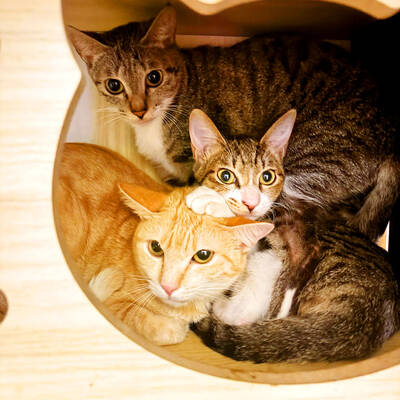
The number of pet cats in Taiwan surpassed that of pet dogs for the first time last year, reaching 1,742,033, a 32.8 percent increase from 2023, the Ministry of Agriculture said yesterday, citing a survey. By contrast, the number of pet dogs declined slightly by 1.2 percent over the same period to 1,462,528, the ministry said. Despite the shift, households with dogs still slightly outnumber those with cats by 1.2 percent. However, while the number of households with multiple dogs has remained relatively stable, households keeping more than two cats have increased, contributing to the overall rise in the feline population. The trend
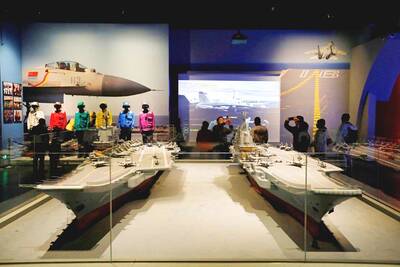
China on Wednesday teased in a video an aircraft carrier that could be its fourth, and the first using nuclear power, while making an allusion to Taiwan and vowing to further build up its islands, as it looks to boost maritime power, secure resources and bolster territorial claims. The video, issued on the eve of the 77th founding anniversary of the Chinese People’s Liberation Army Navy, featured fictional officers with names that are homophones of three commissioned aircraft carriers, the Liaoning (遼寧), Shandong (山東) and Fujian (福建). Titled Into the Deep, it showed a 19-year-old named “Hejian” (何劍) joining the group, sparking
Taiwan has signed six arms procurement offers from the US totaling more than NT$208 billion (US$6.59 billion) covering long-range precision strike systems, missile stockpile replenishment and joint production of large-caliber ammunition, the Ministry of National Defense said yesterday. The government’s proposed NT$1.25 trillion special defense budget has been stalled in the Legislative Yuan as opposition lawmakers question the amount and procurement items, while the Presidential Office and defense ministry say that the full amount is necessary to safeguard Taiwan. Minister of National Defense Wellington Koo (顧立雄) on Monday briefed the legislature’s Foreign Affairs and National Defense Committee on the defense budget for


 RSS
RSS