

The US Department of State has expressed concern over the recent severance of undersea cables in the Baltic Sea and near Taiwan, urging all sides involved to collaborate with investigators.
The US is closely following reports of undersea cables being damaged in multiple areas, including in the Baltic Sea and around Taiwan, a US Department of State spokesperson said on Friday in response to queries from the Central News Agency.
The spokesperson cited the New York Principles on Undersea Cables, which laid out the US’ commitment to working with allies and partners to maintain and increase the security and resilience of undersea cable infrastructure, which is indispensable to global commerce and digital development.
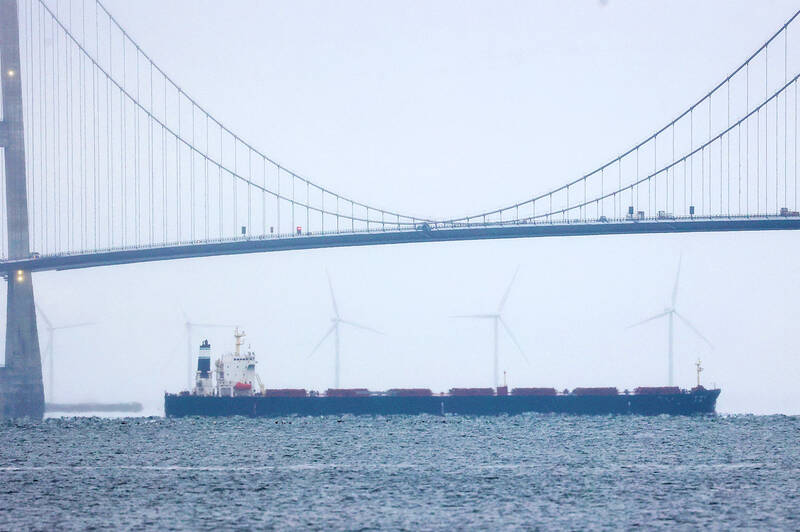
Photo: Reuters
On Nov. 17 and 18 last year, the C-Lion1 cable between Finland and Germany, and the BCS East-West Interlink cable between Lithuania and Sweden were cut. The following month, the Estlink 2 electricity cable connecting Estonia and Finland, along with four data cables, were cut in the Finnish exclusive economic zone.
The Chinese bulk carrier Yi Peng 3 (伊鵬3) was seen near the damaged section of the Estlink 2 cable in Swedish territorial waters.
The US is also looking into incidents in which investigators are unable to obtain necessary access or transparent information, the spokesperson said.
The Financial Times on Dec. 23 reported that China had allowed Swedish, German, Finnish and Danish representatives to board the ship as observers, but had refused access to Swedish public prosecutor Henrik Soderman.
On Jan. 3, Taiwan reported undersea cable damage in waters off Yehliu (野柳), which was allegedly caused by the Cameroon-registered freighter Shunxing-39 (順興39號), owned by a company in Hong Kong.
The Ministry of National Defense on Wednesday said that special monitoring zones would be established around undersea cables to prevent possible “gray zone” tactics by China.
Ministry officials have met with Coast Guard Administration (CGA) representatives and other agencies to collaborate on potential preventive action and intelligence sharing, Colonel Hu Chung-hua (胡中華) said.
The National Security Bureau on Thursday said that it is working with the ministry and the CGA to monitor ships flying flags of convenience.
CGA officers should board and inspect the Maritime Mobile Service Identity and automatic identification systems of such ships once they are within 24 nautical miles (44km) of Taiwan, near special monitoring zones or have asked to enter Taiwanese ports, it said.
In a separate incident in October 2023, the Newnew Polar Bear, a Hong Kong-registered ship, was accused of damaging the Balticconnector natural gas pipeline in the Gulf of Finland by dragging its anchor for several hundred nautical miles.
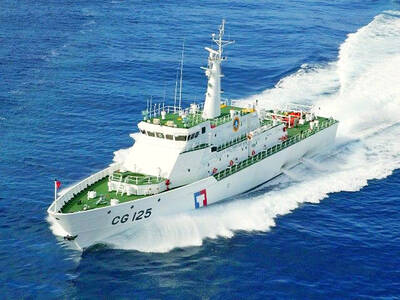
GEOPOLITICAL SIGNIFICANCE: The CGA’s nonmilitary role makes it a tool to avert diplomatic issues, an official said, while confirming the donation of a ship to Manila Coast Guard Administration (CGA) ships are scheduled to sail to the Philippines bearing the words “Taiwan Coast Guard” in a high-profile visit in October next year, the first such visit by a Taiwanese maritime law enforcement vessel to the Southeast Asian nation, the agency said yesterday. The CGA also confirmed that it had donated one of its decommissioned patrol vessels to the Philippines in a rare transfer of a retired ship to a nondiplomatic ally. The Republic of China (ROC) Navy last made such a visit in 1974, shortly before the Philippines switched diplomatic recognition to the People’s Republic of China in

‘GLOBAL WARNING’: The infiltration is not just a local problem, as Beijing has been deploying the same tactics worldwide against Western democracies, a report said Between 50,000 and 100,000 Chinese spies are operating in Taiwan, far more than the National Security Bureau’s previous estimate of 5,000, German journalist and author Jurgen Kremb said on Monday. Kremb presented his research, titled “The War of Spies: How China’s Intelligence Services Are Infiltrating Taiwan — and What Europe Must Learn from It,” at a joint event held by the Taiwan offices of the Friedrich Naumann Foundation and the European Values Center for Security Policy. The report was published in June in the Ministry of Justice Investigation Bureau’s Prospect & Exploration Monthly (展望與探索月刊). By spies, he said he was referring to informants,
CALL FOR CHANGE: They urged the UN to facilitate Taiwan’s involvement in the body, recognize its peace efforts and to work with members in preventing military conflict Representatives to the UN from five of Taiwan’s diplomatic allies sent a joint letter to UN Secretary-General Antonio Guterres on Friday, calling for the country’s inclusion in the body. Allies in the letter sent ahead of the 81st session of the UN General Assembly General Debate made three demands in support of Taiwan: inclusion, recognition and camaraderie. They implored the UN to seek an appropriate way to facilitate Taiwan’s meaningful involvement in the world governing body, saying that UN Resolution 2758, which accepted the People’s Republic of China (PRC) as a member of the UN, does not exclude Taiwan. Beijing claims that the
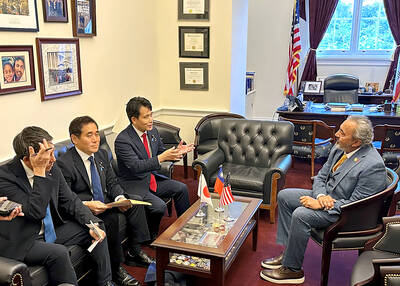
WASHINGTON MEETING: Japan’s Hirofumi Takinami said participants rejected the idea that the US should limit its defensive perimeter to the Second Island Chain US and Japanese lawmakers agree that the US must defend the First Island Chain, including Taiwan, and should not fall back to the Second Island Chain, while “a Taiwan contingency is a Japan contingency and therefore a US-Japan alliance contingency,” media reported after a meeting between officials of the two nations in Washington on Tuesday. A delegation of Japanese lawmakers from the Liberal Democratic Party met with US Senator Thom Tillis, co-chair of the Senate Taiwan Caucus, and US Representative Ami Bera, co-chair of the US Congressional Taiwan caucus, to discuss issues concerning East Asia and the Taiwan Strait. The Japanese and


 RSS
RSS