


The Legislative Yuan yesterday passed an amendment to the Employment Service Act (就業服務法) allowing people aged 80 and older to bypass Barthel Index-based health evaluations.
The revisions to the Employment Service Act also extend the waiver to people aged 70 to 79 with stage two or more advanced cancer.
The Barthel Index is a widely used tool in Taiwan to assess an individual’s ability to perform daily activities in clinical practice and research.
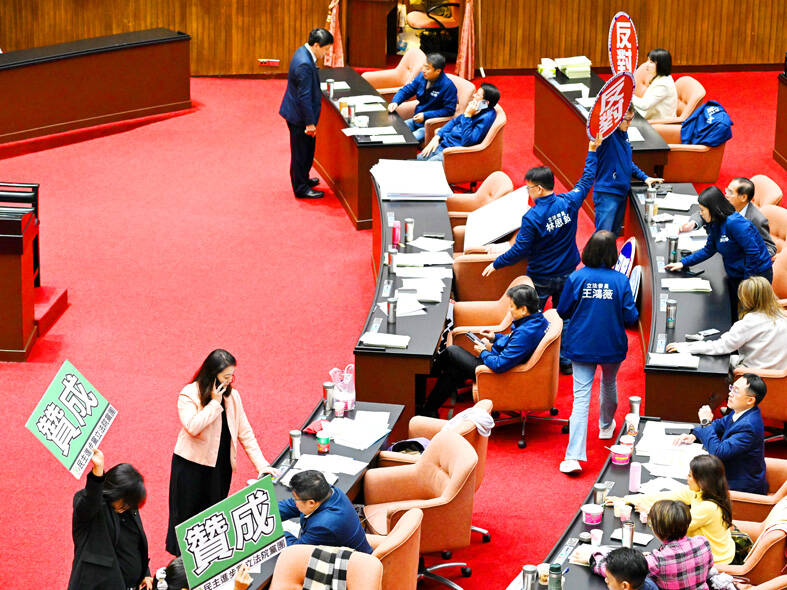
Photo: Chen Yi-kuan, Taipei Times
Under the amendment, which passed by 52 to 49 votes, evaluation and determination methods for care recipients with indigenous status would be jointly established by the Ministry of Health and Welfare and the Council of Indigenous Peoples.
The Barthel Index requirement has been waived for specific groups, including those receiving long-term care for at least six consecutive months, individuals with early-stage dementia, and those with severe breathing or swallowing difficulties.
In response to the bill’s passage, the Ministry of Labor and Ministry of Health and Welfare expressed concern that it could undermine the long-term care system. As the main source nations for migrant workers cannot immediately increase the labor supply, and the recruitment, training and introduction process could take several months, the current shortage could be exacerbated, driving up hiring costs.

Photo: CNA
The amendment could lead to a significant rise in demand for migrant caregivers, as an additional 530,000 Taiwanese would now be eligible to hire live-in caregivers, the labor ministry said in a statement.
Taiwan had approximately 227,000 migrant caregivers as of November last year, with the number growing by about 10,000 per year, according to government data.
However, the labor ministry cautioned that the bill could potentially make it more challenging for critically ill families to hire or retain migrant caregivers, limiting their access to care.
The health ministry said that as about 60 percent of people older than 80 in Taiwan are not disabled, round-the-clock care could speed up their physical decline, and place additional strain on the healthcare and caregiving system.
The Chinese Nationalist Party (KMT) said that the current policy does not take account of unexpected situations, and with a declining birthrate, the amendment would also help alleviate the burden on younger families.
Meanwhile, amendments to the Spatial Planning Act (國土計畫法) also passed yesterday that extended the period to draw zoning maps by six years.
According to Article 45 of the act, the competent authorities must complete their maps within four years after the act goes into effect, or by April 30.
Once the maps are complete, the Regional Plan Act (區域計畫法) would no longer be valid and the Spatial Planning Act would be fully implemented.
However, all three parties proposed lengthening the timeline, voting to extend the original four-year timeline by another six years.

‘NO SECURITY RISK’: The Railway Bureau reassured the public that the technicians’ activities were limited to technical guidance and did not involve sensitive systems The Railway Bureau yesterday said it had invited eight Chinese technicians to assist with an airport MRT construction project. The bureau issued the confirmation after an Internet user said Chinese nationals had entered the construction zone of Taiwan Taoyuan International Airport’s Terminal 3 project. They asked why “individuals from an enemy state” were allowed access to such a major national infrastructure project, which raised serious concerns over Taiwan’s industrial safety, sensitive systems and information security. The bureau’s Northern Region Engineering Branch Office said subcontractor Taiwan Handle Industrial Co (台灣手把工業) of the Taoyuan airport MRT’s “Contract No. CU05 Project A14 Station Civil, MEP &

The National Chungshan Institute of Science and Technology yesterday showcased its locally developed variants of the Vision 60 robotic patrol dog, which it plans to deploy on the nation’s outlying territories in the South China Sea. The variants were produced under the Joint Lab project — created by the institute and domestic companies — and assembled with domestically produced motors, lenses and artificial intelligence (AI) systems alongside licensed tech from the US, Missile and Rocket Systems Research Division deputy director Jen Kuo-kang (任國光) told the media event at a military base in Taipei’s Dazhi (大直) area. Taiwan has built up its strengths

NOT IMMEDIATE: Taiwan has a chance to appeal the proposed 10 percent tariff before it starts, while other countries face a 12.5 percent tariff from the trade office Taiwan is among 60 economies determined by the US to have failed to impose or enforce a ban on the importation of goods produced with forced labor, according to a notice released on Tuesday by the Office of the US Trade Representative (USTR), which proposed imposing an additional 10 percent or more tariff on them. The USTR in a statement said that following an investigation, it had determined under Section 301 of the Trade Act of 1974 that the failure of the 60 economies to impose and effectively enforce a prohibition on the importation of goods produced with forced labor is

TIT-FOR-TAT: The US allegedly revoked the visa of a Chinese national working at Xinhua News Agency in the US in response to Beijing’s expulsion of Vivian Wang The Presidential Office yesterday condemned China for expelling a New York Times correspondent from Beijing following the newspaper’s interview with President William Lai (賴清德), saying the move highlighted Beijing’s suppression of press freedom and its threat to international news media. Taiwan has noted a series of recent incidents in which Beijing used similar tactics to “threaten and pressure international media outlets and journalists,” Presidential Office spokeswoman Karen Kuo (郭雅慧) said in a statement. “This concerns not only press freedom and freedom of expression, but also the safety of journalists, and Taiwan and relevant partners are paying close attention to the situation,” she


 RSS
RSS