


Gisele Pelicot, the French woman whose ex-husband was handed a prison sentence of 20 years for orchestrating and committing mass rapes against her with dozens of strangers, has no fear of a new trial if defendants appeal, her lawyer said yesterday.
Pelicot, 72, has been hailed as a hero and feminist icon for her courage and dignity in the three-month trial that ended on Thursday, with all 51 defendants, including her ex-husband Dominique Pelicot, being convicted.
However, after she described the process as a “difficult ordeal,” she risks having to go through another trial with two defendants already lodging an appeal and the lawyer of her ex-husband not ruling out doing the same.

Photo: AP
“In any case, she is not afraid of it. If it were to happen, she has already indicated to us that she would face it — if she is healthy, obviously, since she is a lady who is now 72,” Stephane Babonneau, one of her lawyers, told France Inter radio.
Asked about his client’s state of mind, Babonneau said: “She was very happy to go home. She is very relieved.”
“What she doesn’t want is for other victims to think ‘this lady has extraordinary strength, I couldn’t do that’,” he said. “She doesn’t want to be seen as an icon. She doesn’t want to be seen as someone extraordinary. And in reality, she is someone who remains very simple and who has decided to try to live her life in the most normal way.”
Dozens of other defendants — the men who visited the Pelicot family home to rape Gisele Pelicot as she lay unconscious after being drugged by her husband — were handed terms of between three and 15 years.
Dominique Pelicot would not be eligible for parole until he has served two-thirds of his sentence.
However, that was in all cases less than what prosecutors had sought. Six of the defendants had their jail terms partly suspended, including two of the defendants who received the lowest terms of three years.
Only the sentence given to Dominique Pelicot was fully in line with prosecutors’ requests.
Six accused were allowed to walk free from the court, having served their time during pre-trial detention.
Women’s rights groups and the three Pelicot children, expressed disappointment, saying that the sentences were too lenient, sources said.
However, Gisele Pelicot said: “I respect the court and the decision of its verdict.”
She also said that she “never regretted” opening the trial to the public and was now thinking of the “unrecognized victims whose stories often remain in the shadows.”
“I now have confidence in our capacity to find a better future where everyone — women and men alike — can live in harmony with respect and mutual understanding,” she said.
“The court has proved Gisele Pelicot right: shame can change sides,” the Women’s Foundation said.

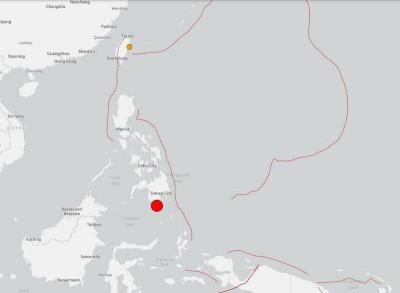
A magnitude 7.8 earthquake struck off the southern coast of Mindanao in the Philippines at 7:38am today, prompting the US Tsunami Warning System to issue an alert for neighboring countries, including Taiwan. The system issued a purple alert indicating a "tsunami threat." The potential threat zone includes Taiwan, the Philippines, Papua New Guinea, Yap and Palau. Philippine authorities were assessing the damage from the quake, with the office of civil defense seeking to verifying initial reports that 15 people had been killed and 129 injured in the region, mostly from falling debris. Arlene Hollero, disaster chief of Maasim town in the Philippines' Sarangani Province,

RESILIENCE: Taiwan plays a key role in semiconductors, energy, information infrastructure and advanced manufacturing, AIT Director Raymond Greene said Taiwan’s continued investment in deterrence and resilience remains vital, especially in uncrewed systems and other emerging technologies, American Institute in Taiwan (AIT) Director Raymond Greene said yesterday. Greene made the remarks at the annual National Strategic Summit on Supply Chain Resilience held by the Research Institute for Democracy, Society and Emerging Technology (DSET), a government-backed think tank. As Taiwan last year became the US’ fourth-largest trading partner and supply chain security is becoming more important, cooperation in emerging technologies continues to deepen between the two countries, he said. The US is committed to accelerating innovation, building key infrastructure, strengthening cooperation

The National Chungshan Institute of Science and Technology yesterday showcased its locally developed variants of the Vision 60 robotic patrol dog, which it plans to deploy on the nation’s outlying territories in the South China Sea. The variants were produced under the Joint Lab project — created by the institute and domestic companies — and assembled with domestically produced motors, lenses and artificial intelligence (AI) systems alongside licensed tech from the US, Missile and Rocket Systems Research Division deputy director Jen Kuo-kang (任國光) told the media event at a military base in Taipei’s Dazhi (大直) area. Taiwan has built up its strengths

RIGHT DIRECTION: Taiwan’s efforts to prevent forced labor include a proposal to ‘fully prohibit’ employers from withholding workers’ documents, an official said Taiwan is to establish a mechanism to restrict imports of goods linked to forced labor, the Executive Yuan said yesterday, after the US proposed imposing additional tariffs on Taiwanese goods over labor concerns. “The Ministry of Labor and the Ministry of Economic Affairs are to establish an interministerial review procedure,” Executive Yuan spokesperson Michelle Lee (李慧芝) said at a news briefing in Taipei. “The government is to use the Foreign Trade Act [貿易法] as the legal basis to restrict imports of goods produced with forced labor” and bring its supply chain governance more in line with international standards on human rights, resilience


 RSS
RSS