


Thousands of people joined the “Bluebird wintertime” protests outside the Legislative Yuan in Taipei today, calling for controversial amendments proposed by the Chinese Nationalist Party (KMT) to be withdrawn.
The KMT is planning to pass amendments to the Public Officials Election and Recall Act (公職人員選舉罷免法), the Constitutional Court Procedure Act (憲法訴訟法) and the Act Governing the Allocation of Government Revenues and Expenditures (財政收支劃分法) today.
The “Bluebird wintertime” protest activities are being organized by civil society groups, including the Economic Democracy Union (EDU) and Taiwan Citizen Front, and have been going on for several days.
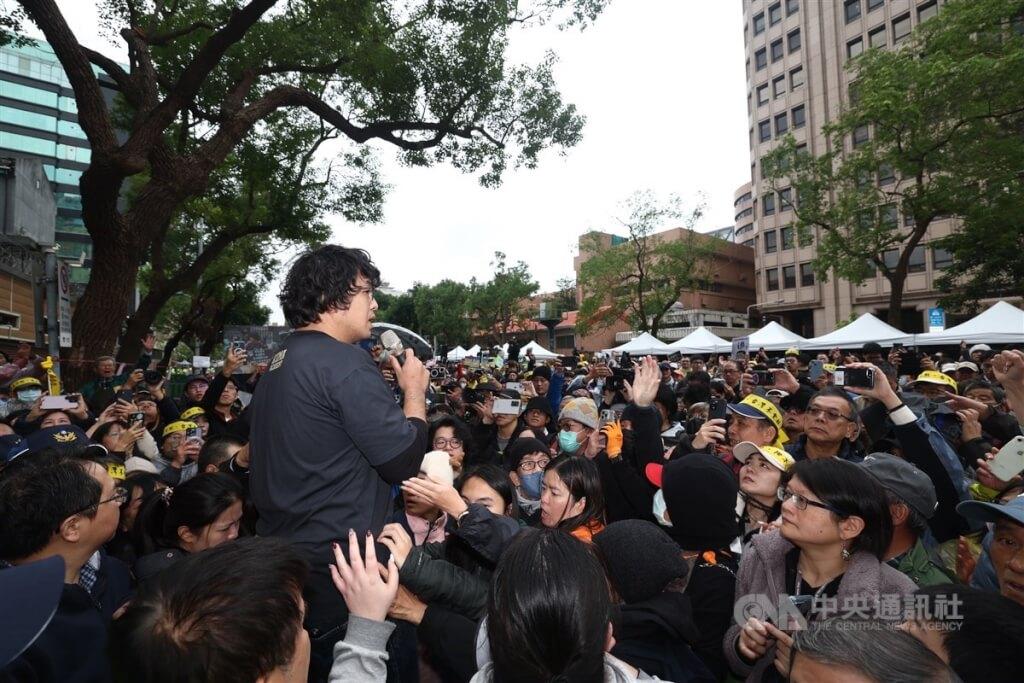
Photo: CNA
Today, organizers called for supporters to gather outside the Legislative Yuan on section one of Jinan Road to protest the three amendments that they claimed would “seriously harm Taiwan’s democracy.”
“Surround the Legislative Yuan and rally more supporters,” EDU convener Lai Chung-chiang (賴中強) said.
Democratic Progressive Party (DPP) Taipei City councilors Chien Shu-pei (簡舒培), Chen E-jun (陳怡君) and others also arrived to show their support.
As KMT legislators were clearing the chamber at 11am, DPP caucus whip Ker Chien-ming (柯建銘), as well as legislators Wang Shih-chien (王世堅), Chiu Yi-ying (邱議瑩) and others, stepped outside to greet the protestors.
Some members of the crowd attempted to break through the police blockade and rush into the building at that moment, but the police reinforcements immediately arrived to prevent the crowd from entering.
Protesters continued to shout, “stop the meeting,” amid the conflict.
An ambulance tried to approach the entrance during the incident, but could not get through due to the chaotic situation.
DPP legislators Puma Shen (沈伯洋), Wang Ting-yu (王定宇) and others intervened to calm the crowd, but pushing and shoving between both sides lasted for about 40 minutes.
The Legislative Yuan should not use police power, as legislators are elected by the people and sovereignty belongs to the people, Wang Shih-chien said.
“It is crucial to stop the proceedings now, but we really don’t have enough people at the moment,” said Shen, emphasizing the need for everyone’s support.
As of 12pm, over 5,000 people had gathered outside the Legislative Yuan to join the protest, organizers said.
Premier Cho Jung-tai (卓榮泰) appreciates that people took to the streets to safeguard democracy and hopes that Legislative Speaker Han Kuo-yu (韓國瑜) could put aside controversial bills that make people anxious, Cabinet spokesperson Michelle Lee (李慧芝) said today.
Cho believes the police’s priority is to protect the people and has asked the National Police Agency to monitor the gathering outside the Legislative Yuan to ensure protesters’ safety, Lee said.
Additional reporting by Chung Li-hua and Fion Khan

‘NO SECURITY RISK’: The Railway Bureau reassured the public that the technicians’ activities were limited to technical guidance and did not involve sensitive systems The Railway Bureau yesterday said it had invited eight Chinese technicians to assist with an airport MRT construction project. The bureau issued the confirmation after an Internet user said Chinese nationals had entered the construction zone of Taiwan Taoyuan International Airport’s Terminal 3 project. They asked why “individuals from an enemy state” were allowed access to such a major national infrastructure project, which raised serious concerns over Taiwan’s industrial safety, sensitive systems and information security. The bureau’s Northern Region Engineering Branch Office said subcontractor Taiwan Handle Industrial Co (台灣手把工業) of the Taoyuan airport MRT’s “Contract No. CU05 Project A14 Station Civil, MEP &

The National Chungshan Institute of Science and Technology yesterday showcased its locally developed variants of the Vision 60 robotic patrol dog, which it plans to deploy on the nation’s outlying territories in the South China Sea. The variants were produced under the Joint Lab project — created by the institute and domestic companies — and assembled with domestically produced motors, lenses and artificial intelligence (AI) systems alongside licensed tech from the US, Missile and Rocket Systems Research Division deputy director Jen Kuo-kang (任國光) told the media event at a military base in Taipei’s Dazhi (大直) area. Taiwan has built up its strengths

NOT IMMEDIATE: Taiwan has a chance to appeal the proposed 10 percent tariff before it starts, while other countries face a 12.5 percent tariff from the trade office Taiwan is among 60 economies determined by the US to have failed to impose or enforce a ban on the importation of goods produced with forced labor, according to a notice released on Tuesday by the Office of the US Trade Representative (USTR), which proposed imposing an additional 10 percent or more tariff on them. The USTR in a statement said that following an investigation, it had determined under Section 301 of the Trade Act of 1974 that the failure of the 60 economies to impose and effectively enforce a prohibition on the importation of goods produced with forced labor is

TIT-FOR-TAT: The US allegedly revoked the visa of a Chinese national working at Xinhua News Agency in the US in response to Beijing’s expulsion of Vivian Wang The Presidential Office yesterday condemned China for expelling a New York Times correspondent from Beijing following the newspaper’s interview with President William Lai (賴清德), saying the move highlighted Beijing’s suppression of press freedom and its threat to international news media. Taiwan has noted a series of recent incidents in which Beijing used similar tactics to “threaten and pressure international media outlets and journalists,” Presidential Office spokeswoman Karen Kuo (郭雅慧) said in a statement. “This concerns not only press freedom and freedom of expression, but also the safety of journalists, and Taiwan and relevant partners are paying close attention to the situation,” she


 RSS
RSS