


A powerful earthquake hit the Pacific nation of Vanuatu yesterday, smashing buildings in the capital, Port Vila, including one used by foreign embassies, with a witness telling of bodies lying in the city.
The magnitude 7.3 quake struck at a depth of 57km, about 30km off the coast of Efate, Vanuatu’s main island, at 12:47pm, the US Geological Survey said.
A magnitude 5.5 aftershock struck minutes later, followed by a string of lesser tremors — shaking the low-lying archipelago of 320,000 people that lies in the quake-prone Pacific Rim of Fire.
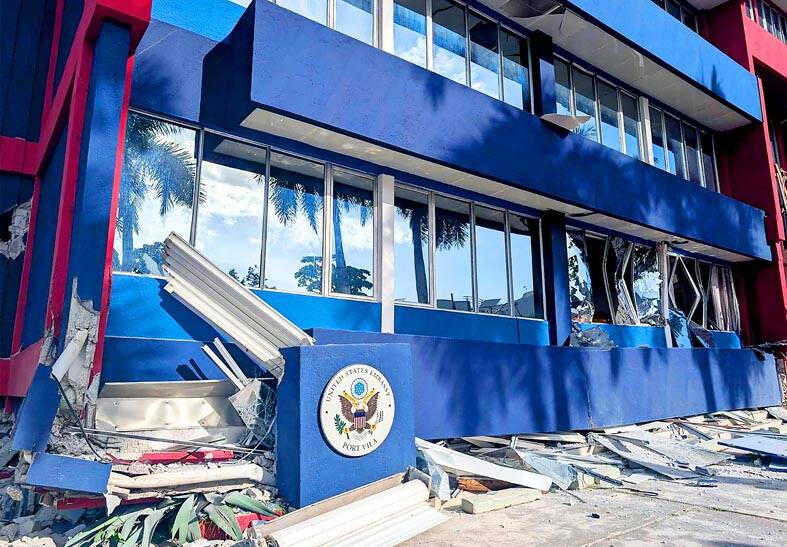
Photo: AFP
The first floor of a four-story concrete block in Port Vila — used by US, French, British, Australian and New Zealand diplomatic missions — was flattened, photographs showed. US and French embassy staff are safe, the two nations said.
The US closed its embassy until further notice. France said its mission was “destroyed.”
“There’s people in the buildings in town. There were bodies there when we walked past,” resident Michael Thompson said by satellite phone after posting images of the destruction on social media.
A landslide on one road had covered a bus, he said, “so there’s obviously some deaths there.”
As well as destroying the first floor of the diplomatic building, the quake also knocked down at least two bridges and toppled other buildings, Thompson said.
The first floor of the embassy block “no longer exists,” he said.
“It is just completely flat. The top three floors are still holding, but they have dropped. If there was anyone in there at the time, then they’re gone,” said Thompson, who runs a zipline adventure business in Vanuatu.
Some people injured in the quake were driven in flat-bed trucks to a Port Vila hospital where others lay in stretchers outside or sat on plastic chairs, their arms and heads wrapped in bandages, image from public television VBTC showed.
Landslips sent tonnes of earth and large rocks tumbling down a steep hill over the international shipping terminal, images showed.
The port buildings did not appear to be damaged.
Australian and other regional airlines — including Qantas, Jetstar, Virgin Australia and Fiji Airways — diverted or suspended flights, some citing reports of possible damage to the facilities and runway.
The quake cut off most mobile networks on the Pacific island, Thompson said.
“They’re just cracking on with a rescue operation. The support we need from overseas is medical evacuation and skilled rescue, kind of people that can operate in earthquakes,” he said.
Video posted by Thompson showed uniformed rescuers working on a building that had collapsed, with crushed parked cars and trucks below. The streets of the city were strewn with broken glass and other debris from cracked buildings.
Nibhay Nand, a Sydney-based pharmacist with businesses across the South Pacific, said staff in Port Vila reported that most of the store there had been “destroyed” and other buildings nearby had “collapsed.”
“We are waiting for everyone to get online to know how devastating and traumatic this will be,” Nand said.
A tsunami warning was issued after the quake, with waves of up to 1m forecast for some areas of Vanuatu, but it was soon lifted by the Pacific Tsunami Warning Center.

RESILIENCE: Taiwan plays a key role in semiconductors, energy, information infrastructure and advanced manufacturing, AIT Director Raymond Greene said Taiwan’s continued investment in deterrence and resilience remains vital, especially in uncrewed systems and other emerging technologies, American Institute in Taiwan (AIT) Director Raymond Greene said yesterday. Greene made the remarks at the annual National Strategic Summit on Supply Chain Resilience held by the Research Institute for Democracy, Society and Emerging Technology (DSET), a government-backed think tank. As Taiwan last year became the US’ fourth-largest trading partner and supply chain security is becoming more important, cooperation in emerging technologies continues to deepen between the two countries, he said. The US is committed to accelerating innovation, building key infrastructure, strengthening cooperation

The National Chungshan Institute of Science and Technology yesterday showcased its locally developed variants of the Vision 60 robotic patrol dog, which it plans to deploy on the nation’s outlying territories in the South China Sea. The variants were produced under the Joint Lab project — created by the institute and domestic companies — and assembled with domestically produced motors, lenses and artificial intelligence (AI) systems alongside licensed tech from the US, Missile and Rocket Systems Research Division deputy director Jen Kuo-kang (任國光) told the media event at a military base in Taipei’s Dazhi (大直) area. Taiwan has built up its strengths

RIGHT DIRECTION: Taiwan’s efforts to prevent forced labor include a proposal to ‘fully prohibit’ employers from withholding workers’ documents, an official said Taiwan is to establish a mechanism to restrict imports of goods linked to forced labor, the Executive Yuan said yesterday, after the US proposed imposing additional tariffs on Taiwanese goods over labor concerns. “The Ministry of Labor and the Ministry of Economic Affairs are to establish an interministerial review procedure,” Executive Yuan spokesperson Michelle Lee (李慧芝) said at a news briefing in Taipei. “The government is to use the Foreign Trade Act [貿易法] as the legal basis to restrict imports of goods produced with forced labor” and bring its supply chain governance more in line with international standards on human rights, resilience

NOT IMMEDIATE: Taiwan has a chance to appeal the proposed 10 percent tariff before it starts, while other countries face a 12.5 percent tariff from the trade office Taiwan is among 60 economies determined by the US to have failed to impose or enforce a ban on the importation of goods produced with forced labor, according to a notice released on Tuesday by the Office of the US Trade Representative (USTR), which proposed imposing an additional 10 percent or more tariff on them. The USTR in a statement said that following an investigation, it had determined under Section 301 of the Trade Act of 1974 that the failure of the 60 economies to impose and effectively enforce a prohibition on the importation of goods produced with forced labor is


 RSS
RSS