


It is up to the US to decide what to do with Taiwan’s decommissioned Hawk anti-aircraft missiles, Minister of National Defense Wellington Koo (顧立雄) said yesterday, when asked if they would be transferred to Ukraine.
The US and its allies have provided billions of dollars of arms to Ukraine since Russia attacked the country more than two years ago in what Moscow calls a “special military operation.”
That has included weapons being phased out by some Western nations, such as F-16 jets from the Netherlands.
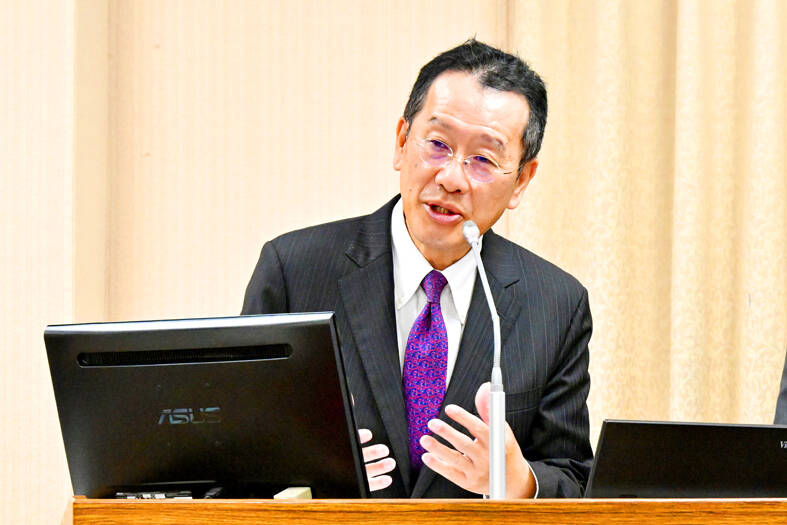
Photo: George Tsorng, Taipei Times
Speaking to reporters at the Legislative Yuan and responding to a question on whether Taiwan’s decades-old Hawk missiles could go to Ukraine, Koo said the nation no longer needed the weapons and their decommissioning was being handled in accordance with regulations.
DONATION CLAIM
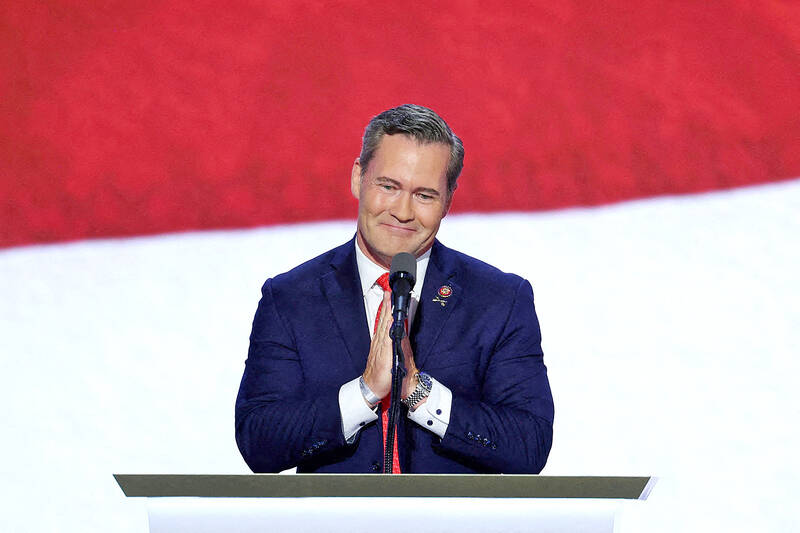
Photo: Reuters
Forbes magazine, citing former Pentagon official Tony Hu (胡振東), on Tuesday reported that Taiwan has donated its surplus Hawk surface-to-air missile batteries to the Ukrainian Air Force.
“If the US side requests that we transfer them back, we will do so in accordance with the regulations and return them, and then the US would decide what to do with them,” Koo said, without elaborating.
Taiwan has offered strong moral support to Ukraine since the beginning of the invasion, seeing parallels with the threat Taipei says it faces from China.
Taiwan has not made any public announcements about directly sending weapons to Ukraine.
The defense ministry told the Central News Agency that Koo was referring to specific regulations on the management of military items and equipment, and obsolete military equipment.
Taiwan is in the process of upgrading its own missile defenses, including inking a US$2 billion deal with the US for National Advanced Surface-to-Air Missile System (NASAMS) medium-range air defense solutions that includes the Advanced Medium-Range Air-to-Air Missiles Extended Range surface-to-air missiles.
WEAPON PURCHASE
The NASAMS has been battle tested in Ukraine and represents a significant increase in air defense capabilities. The US is exporting it to Taiwan as demand for the system surges.
Koo was also asked about a recent Financial Times report saying that Taiwan might be considering a large-scale weapons purchase, including Aegis destroyers, E-2D Advanced Hawkeyes, Patriot missiles and F-35 jets, to “show that they are serious” about defending the nation to US president-elect Donald Trump.
Taipei is open to all available options to meet its defensive needs, Koo said.
However, he did not identify any specific weapons systems.
When asked by a lawmaker to comment on Trump’s pick of Fox News host and US Army veteran Pete Hegseth as US secretary of defense, Koo said that Hegseth is relatively young and a strong supporter of “America first.”
The US and Taiwan have a common fundamental interest, he said, adding that with the Russia-Ukraine and Israel-Hamas wars going on, conflict in the Taiwan Strait would be unacceptable.
The continuity of the “status quo” in the Taiwan Strait is in both countries’ interest, and Taipei and Washington have common ground in their discussions, Koo said.
Asked by a reporter to comment on Trump having picked Republican Representative Mike Waltz as national security adviser, Koo said he respects the personnel changes in democratic politics.
However, he also wants to express gratitude to Waltz for having led the Foreign Military Sales Technical, Industrial and Governmental Engagement for Readiness (TIGER) Task Force in the House of Representatives last year, which helped accelerate the delivery of weapons purchases to Taiwan, he said.

‘NO SECURITY RISK’: The Railway Bureau reassured the public that the technicians’ activities were limited to technical guidance and did not involve sensitive systems The Railway Bureau yesterday said it had invited eight Chinese technicians to assist with an airport MRT construction project. The bureau issued the confirmation after an Internet user said Chinese nationals had entered the construction zone of Taiwan Taoyuan International Airport’s Terminal 3 project. They asked why “individuals from an enemy state” were allowed access to such a major national infrastructure project, which raised serious concerns over Taiwan’s industrial safety, sensitive systems and information security. The bureau’s Northern Region Engineering Branch Office said subcontractor Taiwan Handle Industrial Co (台灣手把工業) of the Taoyuan airport MRT’s “Contract No. CU05 Project A14 Station Civil, MEP &

Taiwan is still in the process of assessing the possibility of recruiting workers from Eswatini, the Ministry of Foreign Affairs said yesterday, adding that its goal is to help Eswatini upgrade its vocational training centers. If there are plans to recruit workers from Eswatini, safeguarding national security, protecting public health and ensuring the employment rights of Taiwanese would be prerequisites, Department of West Asian and African Affairs Director-General Yen Chia-liang (顏嘉良) told a news conference. Key considerations would also include filling labor shortages in specific industries, and fostering bilateral professional and technical exchanges, he said. Yen was asked about the progress of labor

A US uncrewed surface vessel (USV) encountered multiple Chinese warships during an autonomous transit of the Taiwan Strait, US defense company Seasats said in a statement on Wednesday. Seasats announced that a Lightfish USV had completed the first autonomous transit of the Taiwan Strait. Over five days, the USV traversed the entire length of the Strait while constantly monitoring surface vessel traffic, the company said. The Lightfish encountered multiple Chinese warships, one of which was a Chinese People’s Liberation Army Navy (PLAN) Type 056 corvette, it said. The Chinese vessels were operating “well within Taiwan’s exclusive economic zone without transmitting their identity via the
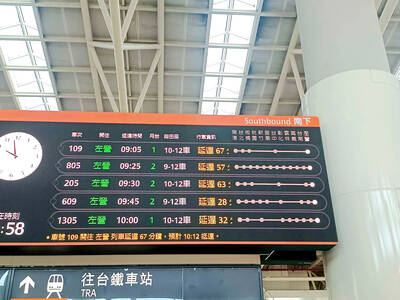
The nation’s usually punctual high-speed rail system yesterday was hit by major disruptions after all scheduled services were canceled and replaced with three hourly trains offering only non-reserved seating, affecting more than 200,000 passengers. Preliminary findings indicate the disruption was caused by a faulty power module in a track switch control cabinet, Taiwan High-Speed Rail Corp (THSRC) said, adding that as a full system inspection could only be conducted after operations end for the day, a decision on whether normal service would resume today would be announced before the first train departs. During a routine inspection early yesterday, a switch signal abnormality


 RSS
RSS