


Chinese spouses of Taiwanese who make videos about their lives in Taiwan have been facing online threats from people in China, a source said yesterday.
Some young Chinese spouses of Taiwanese make videos about their lives in Taiwan, often speaking favorably about their living conditions in the nation compared with those in China, the source said.
However, the videos have caught the attention of Chinese officials, causing the spouses to come under attack by Beijing’s cyberarmy, they said.

Photo: Screen grab from YouTube
“People have been messing with the YouTube channels of these Chinese spouses and have been harassing their family members back in China,” they said.
There are about 380,000 Chinese spouses of Taiwanese living in Taiwan, and some of them demonstrate great support for Taiwan, they said.
“For example, they talk about the nation’s public healthcare system, rule of law and governmental efficiency, which they say are all better than those in China,” they said. “Authorities in Beijing have expressed discontent over those videos.”
The source said that such YouTubers could suddenly find their channels flooded with negative comments accusing the YouTuber of being bribed by the Democratic Progressive Party, questioning their credibility or making threats.
“There are about 80 Chinese spouses in Taiwan who are YouTubers, all of whom are young and highly educated and want to live more freely,” they said.
“Taiwan’s democratic and free way of life is enticing to them, and they want to share their experiences here — but the Chinese Communist Party (CCP) is threatened by that and launches attacks.”
The government would continue to monitor the situation and would take action if any laws are broken, they said.
“The videos that these YouTubers make do not touch on politics. They are simply videos made to share their experiences of everyday life in Taiwan,” National Cheng Kung University political science professor Hung Chin-fu (洪敬富) said.
However, because democratic elections and easy access to healthcare are things that the average person in China has no experience of, the CCP is threatened by Chinese seeing such content, he said.
“This type of content is especially impactful amid China’s sluggish economy. Seeing a Chinese living freely and happily in Taiwan could cause a reactionary force in China,” he said.
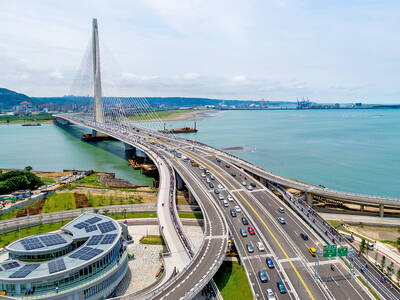
The Ministry of Transportation and Communications yesterday inaugurated the Danjiang Bridge across the Tamsui River in New Taipei City, saying that the structure would be an architectural icon and traffic artery for Taiwan. Feted as a major engineering achievement, the Danjiang Bridge is 920m long, 211m tall at the top of its pylon, and is the longest single-pylon asymmetric cable-stayed bridge in the world, the government’s Web site for the structure said. It was designed by late Iraqi-British architect Zaha Hadid. The structure, with a maximum deck of 70m, accommodates road and light rail traffic, and affords a 200m navigation channel for boats,
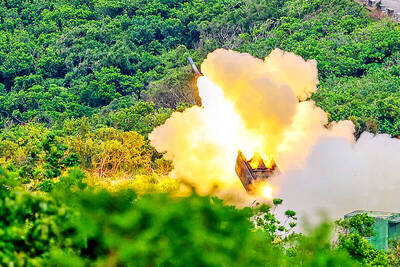
PRECISION STRIKES: The most significant reason to deploy HIMARS to outlying islands is to establish a ‘dead zone’ that the PLA would not dare enter, a source said A High Mobility Artillery Rocket System (HIMARS) would be deployed to Penghu County and Dongyin Island (東引) in Lienchiang County (Matsu) to force the Chinese military to retreat at least 100km from the coastline, a military source said yesterday. Taiwan has been procuring HIMARS and Army Tactical Missile Systems (ATACMS) from the US in batches. Once all batches have been delivered, Taiwan would possess 111 HIMARS units and 504 ATACMS, which have a range of 300km. Considering that “offense is the best defense,” the military plans to forward-deploy the systems to outlying islands such as Penghu and Dongyin so that

Taiwan Semiconductor Manufacturing Co (TSMC, 台積電), the world’s largest foundry service provider, yesterday said that global semiconductor revenue is projected to hit US$1.5 trillion in 2030, after the figure exceeds US$1 trillion this year, as artificial intelligence (AI) demand boosts consumption of token and compute power. “We are still at the beginning of the AI revolution, but we already see a significant impact across the whole semiconductor ecosystem,” TSMC deputy cochief operating officer Kevin Zhang (張曉強) said at the company’s annual technology symposium in Hsinchu City. “It is fair to say that in the past decade, smartphones and other mobile devices were

‘CLEAR MESSAGE’: The bill would set up an interagency ‘tiger team’ to review sanctions tools and other economic options to help deter any Chinese aggression toward Taiwan US Representative Young Kim has introduced a bill to deter Chinese aggression against Taiwan, calling for an interagency “tiger team” to preplan coordinated sanctions and economic measures in response to possible Chinese military or political action against Taiwan. “[Chinese President] Xi Jinping [習近平] has directed the People’s Liberation Army to be ready to invade Taiwan by 2027. China has a plan. America should have one too,” Kim said in a news release on Thursday last week. She introduced the “Deter PRC [People’s Republic of China] aggression against Taiwan act” to “ensure the US has a coordinated sanctions strategy ready should


 RSS
RSS