


The giant tree valley of Mount Tao (桃山) has the highest density of carbon in the world, the research team Taiwan Champion Trees said on Friday.
The team’s research showed that Taiwan’s giant trees store an estimated 2,220 tonnes per hectare, said Taiwan Forestry Research Institute assistant researcher Rebecca Hsu (徐嘉君), who founded the group with National Cheng Kung University to search for trees taller than 65m using light detection and ranging (LiDAR) imaging.
In 2020, the team found a 79.1m tall Taiwania cryptomerioides on Mount Tao, a mountain of the Syueshan Range (雪山山脈) spanning across Taichung and Hsinchu County.
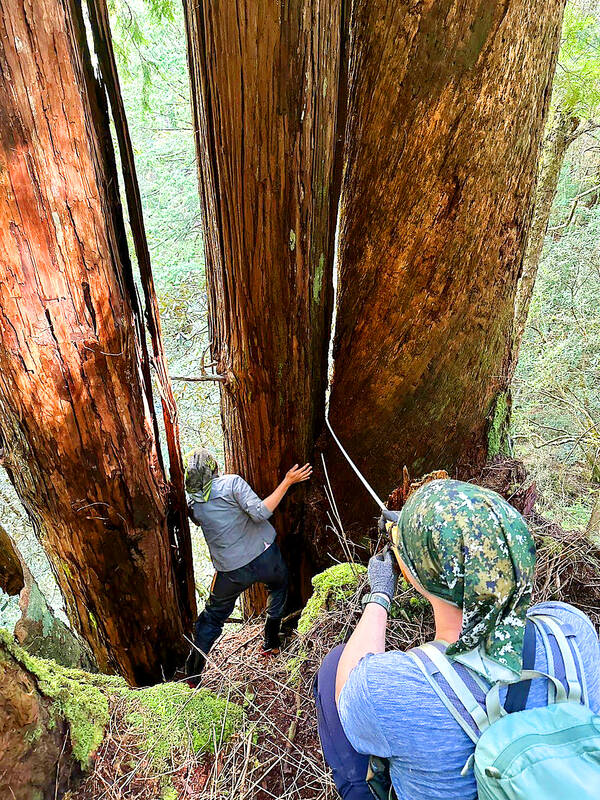
Photo courtesy of Taiwan Champion Trees
Dubbed “Taoshan sacred tree,” it was thought to be Taiwan’s tallest tree until the team found an 82m tall T cryptomerioides in 2022, before discovering an 84.1m tree of the same species last year.
In August, Hsu led a team of 36 people, in collaboration with the Trust in Nature Foundation, to investigate the amount of carbon stored in 133 giant trees that had previously been located using LiDAR.
In the course of their research, they found that 196 trees in the area had grown in diameter, most of which were Chamaecyparis formosensis, Chamaecyparis taiwanensis, T cryptomerioides, Tsuga chinensis var formosana, Cunninghamia konishii and Pinus armandii, Hsu said.
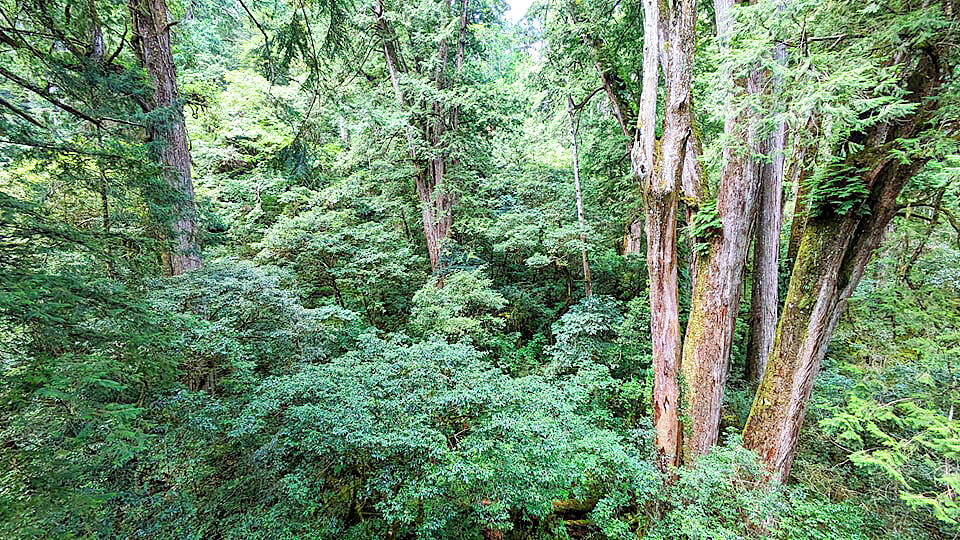
Photo courtesy of Taiwan Champion Trees
The total carbon storage of the giant tree valley was calculated using the sample area of about 1.17 hectares, the spreading coefficients announced by the UN Intergovernmental Panel on Climate Change and the carbon conversion factors for tree species, with tree strata, deadwood and six soil sampling points taken into account, she said.
The results showed the carbon storage of Mount Tao’s giant trees was up to 2,220 tonnes per hectare, surpassing the 1,867 tonnes per hectare of the mountain ash forests of the Central Highlands of Australia’s Victoria state, she said.
Citing research published in the scientific journal Nature, Hsu said that a tree’s carbon sequestration rate increases with its age, countering the myth that old trees could not efficiently store carbon.
Other research showed that about 70 percent of a forest’s carbon is stored in trees of at least 70cm in diameter at breast height (DBH), she added.
The total carbon storage of Mount Tao’s giant tree valley is the most in the world, as most of its trees have a DBH of more than 60cm, the collective carbon storage of which account for about 80 percent of the entire woods, she said.
That attests to the significance of conserving giant trees, she said.
Only carbon sinks of afforested land can be converted into carbon credits and traded on emissions markets, as required by regulations in Taiwan and abroad, Hsu said.
However, the team’s research demonstrated that primary forests can substantially boost carbon sinks with good carbon fixation rates, she said, adding that carbon sinks of primary forests should also be included in credit calculations to encourage the conservation of giant trees.
Director Arthur Mai (麥覺明) filmed Hsu and her team’s investigation for a short documentary, which is to be released on YouTube and the foundation’s Facebook page at 8:30pm on Nov. 11.
The documentary would prove that Taiwan has one of the most valuable millennium forests in the world, the foundation said.

A signaling system malfunction disrupted high-speed rail (HSR) services beginning at 8am today, with trains temporarily reduced to three northbound and three southbound trains per hour as authorities conduct inspections. The malfunction occurred on a section of track in Miaoli County during pre-operation checks early this morning, forcing northbound and southbound trains to use a single track, the HSR operator said. The regular schedule has been replaced with three hourly trains offering only nonreserved seating in each direction, stopping at every station, it said, adding that business class cars would still have reserved seating. Departures from terminal stations are scheduled at the top

Taiwan is still in the process of assessing the possibility of recruiting workers from Eswatini, the Ministry of Foreign Affairs said yesterday, adding that its goal is to help Eswatini upgrade its vocational training centers. If there are plans to recruit workers from Eswatini, safeguarding national security, protecting public health and ensuring the employment rights of Taiwanese would be prerequisites, Department of West Asian and African Affairs Director-General Yen Chia-liang (顏嘉良) told a news conference. Key considerations would also include filling labor shortages in specific industries, and fostering bilateral professional and technical exchanges, he said. Yen was asked about the progress of labor

A US uncrewed surface vessel (USV) encountered multiple Chinese warships during an autonomous transit of the Taiwan Strait, US defense company Seasats said in a statement on Wednesday. Seasats announced that a Lightfish USV had completed the first autonomous transit of the Taiwan Strait. Over five days, the USV traversed the entire length of the Strait while constantly monitoring surface vessel traffic, the company said. The Lightfish encountered multiple Chinese warships, one of which was a Chinese People’s Liberation Army Navy (PLAN) Type 056 corvette, it said. The Chinese vessels were operating “well within Taiwan’s exclusive economic zone without transmitting their identity via the

VERBOSE VESSELS: A CGA cutter and a China Coast Guard exchanged verbal barbs for more than a day in Taiwanese-controlled waters before the Chinese vessel left The Taiwanese and Chinese coast guards had a standoff near the strategically located Pratas Islands (Dongsha Islands, 東沙群島) in the north of the South China Sea, the Coast Guard Administration (CGA) said yesterday. The two sides engaged in intense radio exchanges over sovereignty claims during the 33-hour standoff. China Coast Guard vessel 3501 eventually left the restricted waters, 26.6 nautical miles (49.2km) west of the Pratas Islands, at 5pm yesterday, the CGA said. Lying approximately between southern Taiwan and Hong Kong, the Taiwan-controlled Pratas are seen by some security experts as vulnerable to Chinese attack due to their distance — more than


 RSS
RSS