


The Ministry of Foreign Affairs (MOFA) yesterday congratulated Japan on the completion of its general elections and expressed the hope of deepening relations with the new government and the opposition parties.
Taiwan and Japan maintain a close and friendly relationship, sharing mutual values such as freedom, democracy, human rights and the rule of law, it said, adding that through joint efforts, these important partners have steadily deepened their value-based, economic and allied diplomacy.
Taiwan looks forward to Japan’s continued socioeconomic development following the elections and deepening their cooperation with the new government and all political parties, the ministry said.
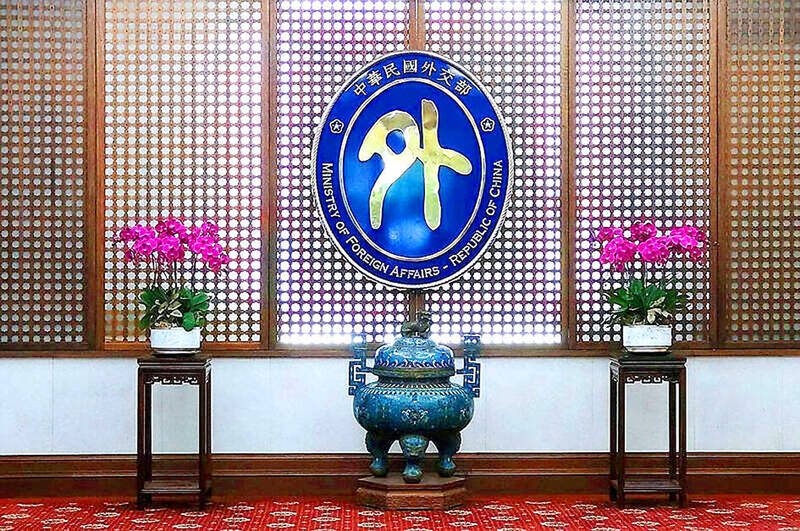
Photo: Yang Cheng-yu, Taipei Times
It also hopes to continue working with Tokyo to safeguard a free and open international order, and contribute to peace, stability and prosperity in the Indo-Pacific region, it said.
Separately, Democratic Progressive Party Legislator Kuo Kuo-wen (郭國文), speaking at a seminar, urged the government to make friends with all major Japanese political parties after the long-ruling Liberal Democratic Party’s (LDP) lost its majority in the lower house for the first time in 15 years.
The LDP and its coalition partner, Komeito, secured just 215 of the lower house’s 465 seats, short of the 233 needed to command a majority, Japanese public broadcaster NHK said.
Japanese Prime Minister Shigeru Ishiba described the result as a “severe judgement” to his party amid public anger over a series of political scandals.
Japan’s political situation faces uncertainty and instability, National University of Kaohsiung political science professor Yang Chun-chih (楊鈞池) told the seminar.
“The election result is having a huge impact on Japanese politics,” Yang said.
Without a majority, the ruling coalition under Ishiba would face a difficult time in the legislature, making it harder to push through major policies.
Under Japan’s Constitution, a special session in the National Diet, Japan’s legislature, must be held within 30 days of the election to select a prime minister, but whether Ishiba would be chosen to lead again is uncertain, Yang said.
If selected, Ishiba would have to come up with new policies in the coming months to continue in the post, Yang said.
Despite the latest election setback, Kuo said he believed Ishiba would do his best to remain as prime minister given that the former defense minister only succeeded in his fifth bid to become Japan’s top leader late last month.
He also noted that veteran lawmaker Akira Amari from the LDP’s legislative caucus on semiconductors lost his re-election bid.
Amari was behind Japan’s decision to invite Taiwan Semiconductor Manufacturing Co (台積電) to open a wafer fab in Kumamoto, Kuo said.
Whether Amari’s failure to be re-elected and the LDP’s overall loss would affect Japan’s ruling coalition’s policy of promoting Taiwan-Japan semiconductor cooperation remains to be seen, he added.
Kuo Yu-jen (郭育仁), deputy head of Taipei-based think tank the Institute for National Policy Research, predicted that Taiwan-Japan relations would not see a major breakthrough or improvement in the years to come given a minority government in Tokyo.
Additional reporting by Huang Chin-hsuan

Right-wing political scientist Laura Fernandez on Sunday won Costa Rica’s presidential election by a landslide, after promising to crack down on rising violence linked to the cocaine trade. Fernandez’s nearest rival, economist Alvaro Ramos, conceded defeat as results showed the ruling party far exceeding the threshold of 40 percent needed to avoid a runoff. With 94 percent of polling stations counted, the political heir of outgoing Costa Rican President Rodrigo Chaves had captured 48.3 percent of the vote compared with Ramos’ 33.4 percent, the Supreme Electoral Tribunal said. As soon as the first results were announced, members of Fernandez’s Sovereign People’s Party
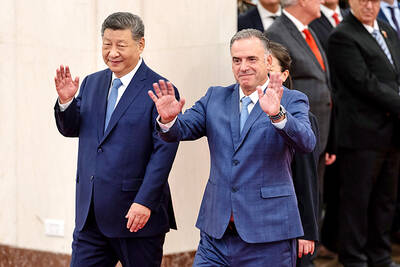
EMERGING FIELDS: The Chinese president said that the two countries would explore cooperation in green technology, the digital economy and artificial intelligence Chinese President Xi Jinping (習近平) yesterday called for an “equal and orderly multipolar world” in the face of “unilateral bullying,” in an apparent jab at the US. Xi was speaking during talks in Beijing with Uruguayan President Yamandu Orsi, the first South American leader to visit China since US special forces captured then-Venezuelan president Nicolas Maduro last month — an operation that Beijing condemned as a violation of sovereignty. Orsi follows a slew of leaders to have visited China seeking to boost ties with the world’s second-largest economy to hedge against US President Donald Trump’s increasingly unpredictable administration. “The international situation is fraught
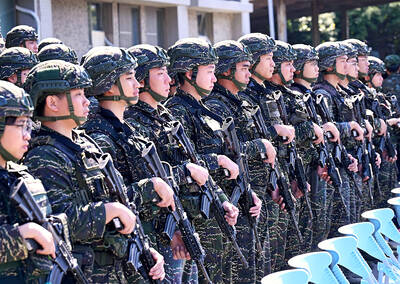
MORE RESPONSIBILITY: Draftees would be expected to fight alongside professional soldiers, likely requiring the transformation of some training brigades into combat units The armed forces are to start incorporating new conscripts into combined arms brigades this year to enhance combat readiness, the Executive Yuan’s latest policy report said. The new policy would affect Taiwanese men entering the military for their compulsory service, which was extended to one year under reforms by then-president Tsai Ing-wen (蔡英文) in 2022. The conscripts would be trained to operate machine guns, uncrewed aerial vehicles, anti-tank guided missile launchers and Stinger air defense systems, the report said, adding that the basic training would be lengthened to eight weeks. After basic training, conscripts would be sorted into infantry battalions that would take
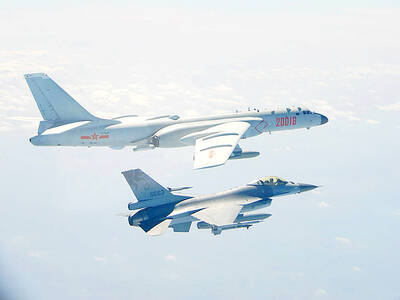
GROWING AMBITIONS: The scale and tempo of the operations show that the Strait has become the core theater for China to expand its security interests, the report said Chinese military aircraft incursions around Taiwan have surged nearly 15-fold over the past five years, according to a report released yesterday by the Democratic Progressive Party’s (DPP) Department of China Affairs. Sorties in the Taiwan Strait were previously irregular, totaling 380 in 2020, but have since evolved into routine operations, the report showed. “This demonstrates that the Taiwan Strait has become both the starting point and testing ground for Beijing’s expansionist ambitions,” it said. Driven by military expansionism, China is systematically pursuing actions aimed at altering the regional “status quo,” the department said, adding that Taiwan represents the most critical link in China’s


 RSS
RSS