


Taiwanese athletes yesterday and on Saturday edged closer to winning a medal in a strong showing in the first two days of the Paris Olympics.
Taiwanese badminton ace Tai Tzu-ying (戴資穎) defeated Belgium’s Lianne Tan in the group stage of the women’s singles yesterday.
Although Tai has not played in any professional competitions in the past three months due to injuries and Olympic preparations, the Taiwanese dispatched Tan in a swift 38 minutes, winning 21-15, 21-14.

Photo: CNA
It was Tai’s third consecutive career victory over Tan.
The 30-year-old Taiwanese was next to play longtime friend and rival, Thailand’s Ratchanok Intanon, in the group stage.
Per Olympic rules, the first-place athlete in each group advances, but because Tai is in a group with other top-seeded players, the winner of her group advances directly to the quarter-finals.

Photo: AP
In other badminton competition, Tokyo Olympic gold medalists Wang Chi-lin (王齊麟) and Lee Yang (李洋) opened their men’s doubles campaign with a 21-16, 21-10 victory over Japan’s Takuro Hoki and Yugo Kobayashi.
The Taiwanese are today to play Denmark’s Anders Skaarup Rasmussen and Kim Astrup in the next group game.
Meanwhile, Ye Hong-wei (葉宏蔚) and Lee Chia-hsin (李佳馨) lost their mixed doubles opener 21-13, 21-13 to Hong Kong’s Tang Chun Man (鄧俊文) and Tse Ying Suet (謝影雪).

Photo: Reuters
They would have to beat Japan’s Yuta Watanabe and Arisa Higashino after press time last night to have a chance of advancing to the next round.
Taiwan’s female archery delegation yesterday defeated the US 5-1 to advance to the quarter-finals.
However, last night, archers Chiu Yi-ching (邱意晴), Lei Chien-ying (雷千瑩) and Li Tsai-chi (李彩綺) lost to South Korea.

Photo: Reuters
On Saturday, despite having a home advantage, French paddlers Alexis Lebrun and Yuan Jianan (袁嘉楠) fell 4-2 to Taiwan’s Lin Yun-ju (林昀儒) and Chen Szu-yu (陳思羽) in mixed-doubles table tennis.
Taiwan won 11-9, 9-11, 11-5, 12-10, 11-2, 11-7 to advance to the quarter-finals.
In the men’s gymnastics qualifying round for the Olympics, Taiwan’s “King of Cat,” the nation’s horizontal bar standout Tang Chia-hung (唐嘉鴻), advanced to the “all-around finals” after achieving the second-highest score of 14.933.

Photo: Chen Chih-chu, Taipei Times
He was awarded 6.3 for degree of difficulty and 8.633 for execution.
Tokyo bronze medalist Huang Hsiao-wen (黃筱雯) advanced to the round of 16 in the women’s 54kg (bantamweight) boxing division after defeating Montenegro’s Bojana Gojkovic by unanimous decision.
However, Tokyo Olympics judo silver medalist Yang Yung-wei (楊勇緯) lost out on the chance to vie for Olympic bronze in the men’s under-60kg event after being defeated by Japan’s Ryuju Nagayama by waza-ari in the repechage.
As the No. 1 seed, Yang passed the round of 32 on a bye and outlasted Italy’s Andrea Carlino in the “golden score,” before heading into the repechage following his loss to Yeldos Smetov of Kazakhstan in the quarter-final.
However, the 26-year-old Yang failed to secure victory over Nagayama, whom he had lost to in all their previous four matches.
Judoka Lin Chen-hao (林真豪) was also knocked out in the round of 16 in the women’s under-48kg division by Abiba Abuzhakynova of Kazakhstan.
Lin Chen-hao, 26, who finished seventh in Tokyo, left the court with tears in her eyes.
Taiwan’s last chance of winning a medal in the sport lies with veteran Lien Chen-ling (連珍羚). The Hangzhou Asian Games gold medalist is to compete in the women’s under-57kg event today.
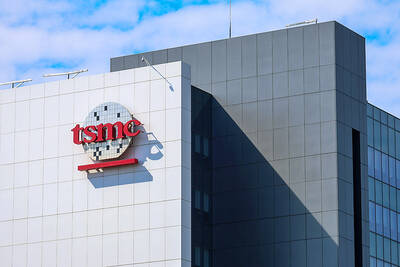
Taiwan Semiconductor Manufacturing Co (TSMC, 台積電), the world’s largest foundry service provider, yesterday said that global semiconductor revenue is projected to hit US$1.5 trillion in 2030, after the figure exceeds US$1 trillion this year, as artificial intelligence (AI) demand boosts consumption of token and compute power. “We are still at the beginning of the AI revolution, but we already see a significant impact across the whole semiconductor ecosystem,” TSMC deputy cochief operating officer Kevin Zhang (張曉強) said at the company’s annual technology symposium in Hsinchu City. “It is fair to say that in the past decade, smartphones and other mobile devices were
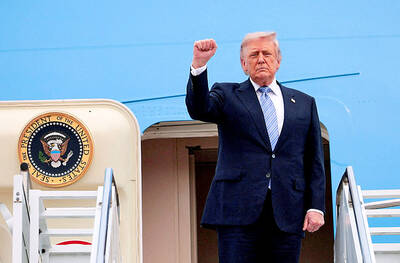
US-CHINA SUMMIT: MOFA welcomed US reassurance of no change in its Taiwan policy; Trump said he did not comment when Xi talked of opposing independence US President Donald Trump yesterday said he has not made a decision on whether to move forward with a major arms package for Taiwan after hearing concerns about it from Chinese President Xi Jinping (習近平). Trump’s comments on Taiwan came as he flew back to Washington after wrapping up critical talks in which both leaders said important progress was made in stabilizing US-China relations even as deep differences persist between the world’s two biggest powers on Iran and Taiwan. “I will make a determination,” Trump said, adding: “I’ll be making decisions. But, you know, I think the last thing we need right
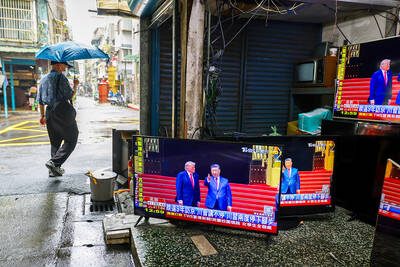
TAIWAN ISSUE: US treasury secretary Scott Bessent said on the first day of meetings that ‘it wouldn’t be a US-China summit without the Taiwan issue coming up’ There were no surprises on the first day of the summit between US President Donald Trump and Chinese President Xi Jinping (習近平), the Mainland Affairs Council (MAC) said yesterday, as the government reiterated that cross-strait stability is crucial to the Asia-Pacific region, as well as the world. As the two presidents met for a highly anticipated summit yesterday, Chinese state media reported that Xi warned Trump that missteps regarding Taiwan could push their two countries into “conflict.” Trump arrived in China with accolades for his host, calling Xi a “great leader” and “friend,” and extending an invitation to visit the White House
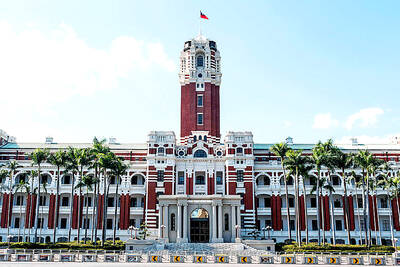
SECURITY: Taipei presses the US for arms supplies, saying the arms sales are not only a reflection of the US security commitment to Taiwan but also serve as a mutual deterrent against regional threats Taiwan is committed to preserving the cross-strait “status quo” and contributing to regional peace and stability, the Presidential Office said yesterday. “It is an undeniable fact that the Republic of China is a sovereign and independent democratic nation,” Presidential Office spokeswoman Karen Kuo (郭雅慧) reiterated, adding that Beijing has no right to claim sovereignty over Taiwan. The statements came after US President Donald Trump warned against Taiwanese independence. Trump wrapped up a state visit to Beijing on Friday, during which Chinese President Xi Jinping (習近平) had pressed him not to support Taiwan. Taiwan depends heavily on US security backing to deter China from carrying


 RSS
RSS