


The Legislative Yuan on Friday night passed the third reading of amendments to the Child and Youth Sexual Exploitation Prevention Act (兒童及少年性剝削防制條例), raising the maximum jail term to seven years for those who pay to watch sexually explicit images involving minors.
Under the amendments, passed at about 11pm on Friday night, those who pay to watch sexually explicit images or videos of minors would no longer be allowed to avoid jail time by paying a fine, and instead would be subject to prison terms ranging from one to seven years, and could concurrently be fined up to NT$1 million (US$30,712).
Prior to the revisions, the act only imposed either a jail term of up to one year or a fine of NT$30,000 to NT$300,000, while those convicted of filming or producing sexual images or videos of minors, or creating drawings, audio recordings or any other sexually explicit content of a minor could receive a jail sentence of one to seven years, and be concurrently fined up to NT$1 million.

Photo: CNA
The amendments stipulate that people caught in possession of sexual images of a minor without any legitimate reason would face imprisonment of up to three years and a fine of NT$60,000 to NT$600,000.
Under the revisions, those who download or copy sexual images of minors without any legitimate reason can be fined NT$100,000 to NT$1 million, in addition to receiving a jail term of up to seven years.
The heavier penalties follow public outcry after television presenter Mickey Huang (黃子佼) avoided prosecution for possession of sexually explicit videos involving minors by paying a fine. He was in April given two years of deferred indictment.
The deferred indictment led to calls to revise the law to better protect minors from sexual exploitation.
The Taipei District Prosecutors’ Office indicted Huang in May after the High Prosecutors’ Office found deficiencies in its initial probe and returned the case for further investigation.
The legislature’s Social Welfare and Environmental Hygiene Committee on April 29 and May 1 reviewed the amendments to the act proposed by the Ministry of Health and Welfare (MOHW), and lawmakers last month held cross-party negotiations on the revisions.
In addition to the heavier penalties, the amendments also say that the health ministry should use technological assistance provided by the Ministry of Digital Affairs to investigate possible contraventions online to better protect minors, while digital business operators cannot reject or ignore any investigation by the MOHW.
Considering the rapid speed at which images can spread online, the amendments stipulate that the health ministry set up a task force or entrust the private sector to establish an organization to quickly deal with sexual images involving minors by asking Web site operators to remove them or impose restrictions.
The MOHW task force or the entrusted organization should also accept complaints from victims and provide consultation services to them, the amendments say.
The changes also state that the police should establish a digital image data center to prevent the spread of sexual images involving minors and help solve crimes more quickly.
Whenever Web site operators suspect any possible contravention resulting from child pornography or have been notified of an incident by the MOHW or other agencies, they should restrict access or remove the images within 24 hours, the amendments say.
The health ministry’s task force or the entrusted organization should inform Web site operators and the police as soon as they become aware of any suspected crime involving a minor.
In addition, senior high schools and other schools should provide courses of at least two hours each semester to educate students on how to avoid becoming a victim of sexual exploitation, the amendments say.
All levels of schools and preschools should provide training to their staff to raise awareness of child and youth protection from sexual exploitation, they say.
The amendments also request that judiciary and police personnel enhance their knowledge on how to protect minors from sexual exploitation.
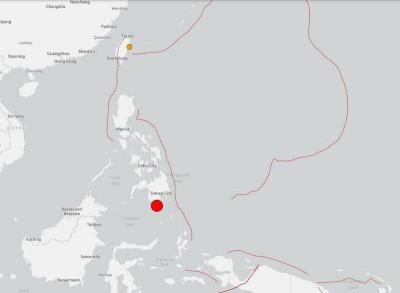
A magnitude 7.8 earthquake struck off the southern coast of Mindanao in the Philippines at 7:38am today, prompting the US Tsunami Warning System to issue an alert for neighboring countries, including Taiwan. The system issued a purple alert indicating a "tsunami threat." The potential threat zone includes Taiwan, the Philippines, Papua New Guinea, Yap and Palau. Philippine authorities were assessing the damage from the quake, with the office of civil defense seeking to verifying initial reports that 15 people had been killed and 129 injured in the region, mostly from falling debris. Arlene Hollero, disaster chief of Maasim town in the Philippines' Sarangani Province,

‘GRAY ZONE’ PRESSURE: Beijing’s activities are intended to create the deceitful impression that China has jurisdiction over the area around Taiwan, the CGA said Taiwan’s rights over its territorial waters and exclusive economic zone must not be violated by any country, the Mainland Affairs Council said yesterday, adding that it will not accept any unprovoked actions. The council issued the remarks in response to the China Coast Guard conducting maritime enforcement drills near eastern Taiwan and claiming to fully exercise China’s maritime administrative law enforcement authority. The Coast Guard Administration (CGA) has been closely monitoring the situation and is taking concrete steps to defend the nation’s sovereignty and secure its waters, the council said. China has no sovereign rights over the waters off eastern

RESILIENCE: Taiwan plays a key role in semiconductors, energy, information infrastructure and advanced manufacturing, AIT Director Raymond Greene said Taiwan’s continued investment in deterrence and resilience remains vital, especially in uncrewed systems and other emerging technologies, American Institute in Taiwan (AIT) Director Raymond Greene said yesterday. Greene made the remarks at the annual National Strategic Summit on Supply Chain Resilience held by the Research Institute for Democracy, Society and Emerging Technology (DSET), a government-backed think tank. As Taiwan last year became the US’ fourth-largest trading partner and supply chain security is becoming more important, cooperation in emerging technologies continues to deepen between the two countries, he said. The US is committed to accelerating innovation, building key infrastructure, strengthening cooperation

The National Chungshan Institute of Science and Technology yesterday showcased its locally developed variants of the Vision 60 robotic patrol dog, which it plans to deploy on the nation’s outlying territories in the South China Sea. The variants were produced under the Joint Lab project — created by the institute and domestic companies — and assembled with domestically produced motors, lenses and artificial intelligence (AI) systems alongside licensed tech from the US, Missile and Rocket Systems Research Division deputy director Jen Kuo-kang (任國光) told the media event at a military base in Taipei’s Dazhi (大直) area. Taiwan has built up its strengths


 RSS
RSS