


The Rim of the Pacific Exercise (RIMPAC) does not single out any particular nation, but is aimed at deterring invasions, and maintaining peace and security in the Indo-Pacific region, a top US commander said on Thursday.
Vice Admiral John Wade, commander of the US 3rd Fleet, told a news conference at the launch of the multinational naval drills off Hawaii that RIMPAC aims to allow like-minded nations to operate together to handle crises ranging from natural disasters to armed conflict.
Wade, who heads this year’s RIMPAC joint forces, declined multiple requests for comment on Taiwan and its relationship with China.
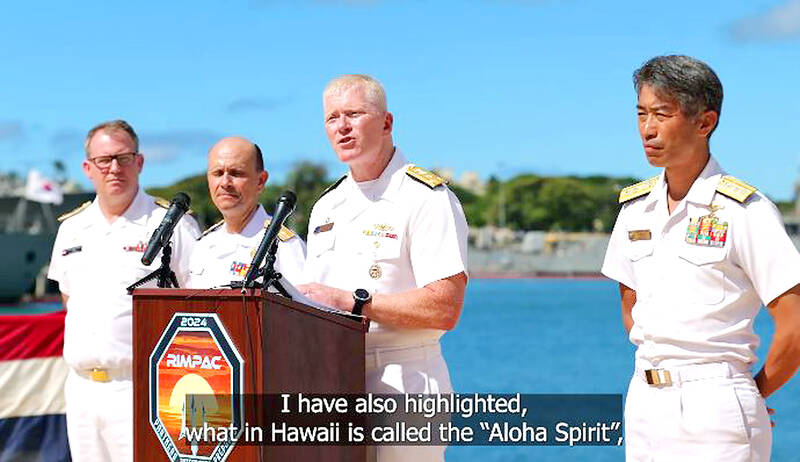
Photo: screen grab from a video on Defense Visual Information Distribution System’s Web site
“RIMPAC does not single out a particular nation or send messages to anybody,” US military newspaper Stars and Stripes quoted him as saying. “We are really focused on enduring maritime force capabilities to ensure peace and prosperity in the vital Indo-Pacific region.”
However, the Chinese People’s Liberation Army was not invited to this year’s exercises due to Beijing’s “reluctance to adhere to international rules or norms and standards,” he said.
RIMPAC, which began in 1971 and is held every two years, is the world’s largest international maritime exercises.
This year it involves 29 nations, which have collectively deployed 40 warships, three submarines, 150 aircraft, 14 land-based armies and 25,000 personnel, the US Navy said in a news release.
Participating militaries are from Australia, Belgium, Brazil, Brunei, Canada, Chile, Colombia, Denmark, Ecuador, France, Germany, India, Indonesia, Israel, Italy, Japan, Malaysia, Mexico, the Netherlands, New Zealand, Peru, the Philippines, Singapore, South Korea, Sri Lanka, Thailand, Tonga, the UK and the US, the US Navy said.
Aircraft including Lockheed Martin F-35 Lightning IIs, Boeing V-22 Ospreys and Boeing P-8 Poseidons would operate out of Joint Base Pearl Harbor-Hickam and US Marine Corps Base Hawaii on Oahu, it added.
In other news, Taiwan’s Tuo Chiang-class guided missile corvettes the An Chiang and the Wan Chiang are expected to be activated next week, a source familiar with the matter said yesterday.
The ships would increase the nation’s Tuo-Chiang fleet from five to seven, concluding the navy’s plans for a prototype followed by an initial production run of six ships, the source said.
Chinese military drills near Taiwan have caused strain in the Taiwanese navy, the source said, adding that it might be forced into changing its plan for replacing the aging Ching Chiang-class with the Tuo Chiang-class on a one-for-one basis.
The Tuo Chiang, the lead ship of the fleet, and the prototype are armed with eight Hsiung Feng II and Hsiung III anti-ship missiles each, while the “flight one” corvettes utilize 16 Hai Chien II anti-aircraft missiles, eight Hsiung Feng II anti-ship missiles and four Hsiung Feng III anti-ship missiles.
The planned “flight two” corvettes, to be completed in 2026, would each have four Hsiung Feng II and eight Hisung Feng III anti-ship missiles due to their envisioned role in surface warfare.
Additional reporting by Lo Tien-pin

The National Chungshan Institute of Science and Technology yesterday showcased its locally developed variants of the Vision 60 robotic patrol dog, which it plans to deploy on the nation’s outlying territories in the South China Sea. The variants were produced under the Joint Lab project — created by the institute and domestic companies — and assembled with domestically produced motors, lenses and artificial intelligence (AI) systems alongside licensed tech from the US, Missile and Rocket Systems Research Division deputy director Jen Kuo-kang (任國光) told the media event at a military base in Taipei’s Dazhi (大直) area. Taiwan has built up its strengths

RIGHT DIRECTION: Taiwan’s efforts to prevent forced labor include a proposal to ‘fully prohibit’ employers from withholding workers’ documents, an official said Taiwan is to establish a mechanism to restrict imports of goods linked to forced labor, the Executive Yuan said yesterday, after the US proposed imposing additional tariffs on Taiwanese goods over labor concerns. “The Ministry of Labor and the Ministry of Economic Affairs are to establish an interministerial review procedure,” Executive Yuan spokesperson Michelle Lee (李慧芝) said at a news briefing in Taipei. “The government is to use the Foreign Trade Act [貿易法] as the legal basis to restrict imports of goods produced with forced labor” and bring its supply chain governance more in line with international standards on human rights, resilience

NOT IMMEDIATE: Taiwan has a chance to appeal the proposed 10 percent tariff before it starts, while other countries face a 12.5 percent tariff from the trade office Taiwan is among 60 economies determined by the US to have failed to impose or enforce a ban on the importation of goods produced with forced labor, according to a notice released on Tuesday by the Office of the US Trade Representative (USTR), which proposed imposing an additional 10 percent or more tariff on them. The USTR in a statement said that following an investigation, it had determined under Section 301 of the Trade Act of 1974 that the failure of the 60 economies to impose and effectively enforce a prohibition on the importation of goods produced with forced labor is
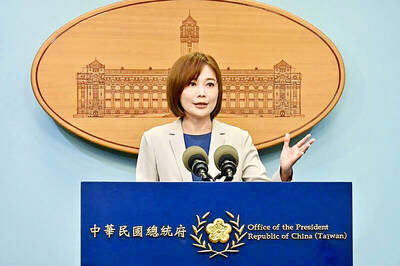
TIT-FOR-TAT: The US allegedly revoked the visa of a Chinese national working at Xinhua News Agency in the US in response to Beijing’s expulsion of Vivian Wang The Presidential Office yesterday condemned China for expelling a New York Times correspondent from Beijing following the newspaper’s interview with President William Lai (賴清德), saying the move highlighted Beijing’s suppression of press freedom and its threat to international news media. Taiwan has noted a series of recent incidents in which Beijing used similar tactics to “threaten and pressure international media outlets and journalists,” Presidential Office spokeswoman Karen Kuo (郭雅慧) said in a statement. “This concerns not only press freedom and freedom of expression, but also the safety of journalists, and Taiwan and relevant partners are paying close attention to the situation,” she


 RSS
RSS