


Russia yesterday said that a Swiss-hosted conference on the Ukraine war had produced negligible results and showed the futility of holding talks without Moscow.
The Kremlin was commenting on a weekend summit where Western powers and their allies denounced Russia’s invasion of Ukraine, but failed to persuade major nonaligned states to join their final statement.
Kremlin spokesman Dmitry Peskov said the results of the meeting, to which Russia was not invited, were “close to zero.”
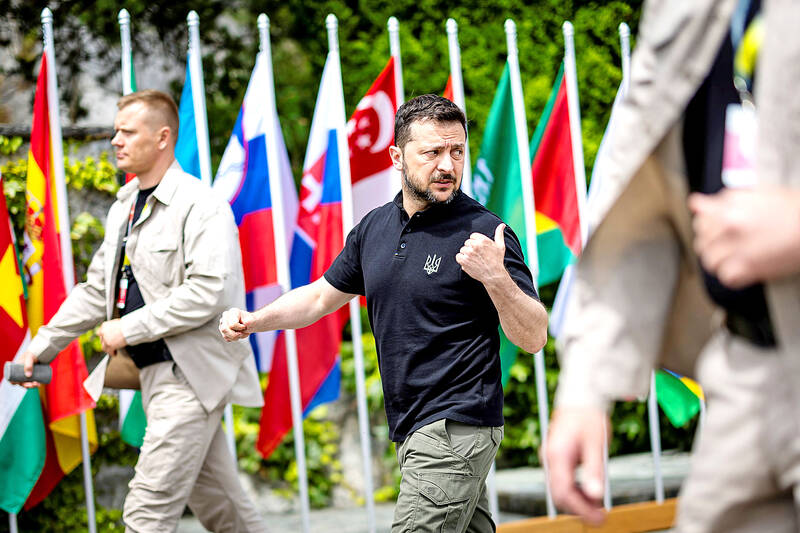
Photo: Reuters
At a daily news briefing with reporters, Peskov was asked if the fact that nations such as Hungary, Serbia and Turkey had taken part in the meeting and signed the statement would spoil Russia’s relations with them.
“No, it won’t spoil them. We will, of course, take into account the position that these countries have taken. This is important to us and we will continue to explain our reasoning to them,” Peskov said.
“Many of them, and this was a common point of view on this event, confirmed their understanding of the absence of prospects for any serious, substantive discussions without the presence of our country... If we talk about the overall effectiveness of this meeting, it is close to zero,” he said.
Russian President Vladimir Putin last week said that Russia was willing to end the war, but he set out conditions for Ukraine — renouncing its NATO ambitions and withdrawing troops from four regions claimed by Russia — that Kyiv rejected as tantamount to capitulation.
“Of course we ... understand perfectly that a time will come when it will be necessary to talk to Russia, but our position is very clear: We will not allow Russia to speak in the language of ultimatums like it is speaking now,” Ukrainian Minister of Foreign Affairs Dmytro Kuleba said.
Peskov said that what he called Putin’s peace initiative remained on the agenda, and reaffirmed Moscow’s position that it was open to dialogue.
State news agency TASS quoted Russian Foreign Intelligence Service Director Sergei Naryshkin as saying that if Putin’s conditions were rejected, they would be replaced by new and tougher terms.
Well into the war’s third year, Russia controls nearly one-fifth of Ukraine and has advanced gradually on several fronts since February.
More than 90 nations attended the two-day talks in Switzerland, but a decision by China to stay away all but assured that the summit would fail to achieve Ukraine’s goal of persuading major nations from the global south to join in isolating Russia.
The summit’s final declaration called for Ukraine’s control over the Zaporizhzhia nuclear power plant and its Azov Sea ports to be restored, but in line with the conference’s more modest stated aims, it omitted tougher issues of what a post-war settlement for Ukraine might look like, whether Ukraine could join NATO or how troop withdrawals by both sides might work.

RESILIENCE: Taiwan plays a key role in semiconductors, energy, information infrastructure and advanced manufacturing, AIT Director Raymond Greene said Taiwan’s continued investment in deterrence and resilience remains vital, especially in uncrewed systems and other emerging technologies, American Institute in Taiwan (AIT) Director Raymond Greene said yesterday. Greene made the remarks at the annual National Strategic Summit on Supply Chain Resilience held by the Research Institute for Democracy, Society and Emerging Technology (DSET), a government-backed think tank. As Taiwan last year became the US’ fourth-largest trading partner and supply chain security is becoming more important, cooperation in emerging technologies continues to deepen between the two countries, he said. The US is committed to accelerating innovation, building key infrastructure, strengthening cooperation

The National Chungshan Institute of Science and Technology yesterday showcased its locally developed variants of the Vision 60 robotic patrol dog, which it plans to deploy on the nation’s outlying territories in the South China Sea. The variants were produced under the Joint Lab project — created by the institute and domestic companies — and assembled with domestically produced motors, lenses and artificial intelligence (AI) systems alongside licensed tech from the US, Missile and Rocket Systems Research Division deputy director Jen Kuo-kang (任國光) told the media event at a military base in Taipei’s Dazhi (大直) area. Taiwan has built up its strengths

RIGHT DIRECTION: Taiwan’s efforts to prevent forced labor include a proposal to ‘fully prohibit’ employers from withholding workers’ documents, an official said Taiwan is to establish a mechanism to restrict imports of goods linked to forced labor, the Executive Yuan said yesterday, after the US proposed imposing additional tariffs on Taiwanese goods over labor concerns. “The Ministry of Labor and the Ministry of Economic Affairs are to establish an interministerial review procedure,” Executive Yuan spokesperson Michelle Lee (李慧芝) said at a news briefing in Taipei. “The government is to use the Foreign Trade Act [貿易法] as the legal basis to restrict imports of goods produced with forced labor” and bring its supply chain governance more in line with international standards on human rights, resilience

NOT IMMEDIATE: Taiwan has a chance to appeal the proposed 10 percent tariff before it starts, while other countries face a 12.5 percent tariff from the trade office Taiwan is among 60 economies determined by the US to have failed to impose or enforce a ban on the importation of goods produced with forced labor, according to a notice released on Tuesday by the Office of the US Trade Representative (USTR), which proposed imposing an additional 10 percent or more tariff on them. The USTR in a statement said that following an investigation, it had determined under Section 301 of the Trade Act of 1974 that the failure of the 60 economies to impose and effectively enforce a prohibition on the importation of goods produced with forced labor is


 RSS
RSS