


Outgoing President Tsai Ing-wen (蔡英文) expressed optimism about maintaining peace in the Taiwan Strait by working together with international friends in an interview with the BBC released on Saturday.
“If we deal with the matter very carefully, there’s still a great possibility for us to maintain peace as we all need,” Tsai said.
A military conflict with China is possible and Chinese President Xi Jinping (習近平) might have “a plan of some sort, but I don’t think that is a definitive plan,” she said.
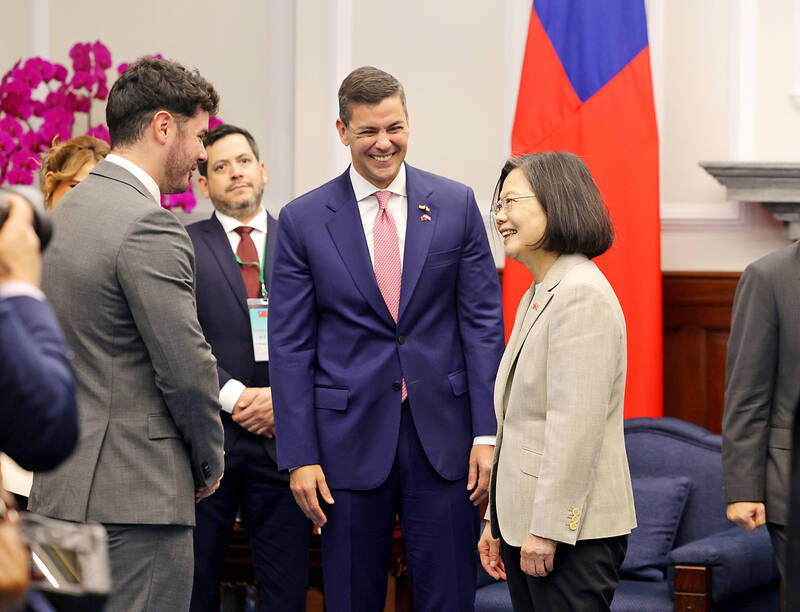
Photo: CNA
Xi would have to adjust his plans as the world is changing, especially after the war in Ukraine, which demonstrated that democracies around the globe are capable of cooperating “to form a meaningful deterrent whenever there is an invasion contemplated,” she said.
“The cost of taking over Taiwan is going to be enormous,” she said, adding that Taiwan is focusing on increasing that cost by bolstering the nation’s self-defense capabilities and working with international partners.
Taiwan has made an “unprecedented” investment into its military capacity-building, with a focus on using that funding efficiently “to build our capacity at a speed that can match with the expansion of the Chinese” military’s capabilities, she said.
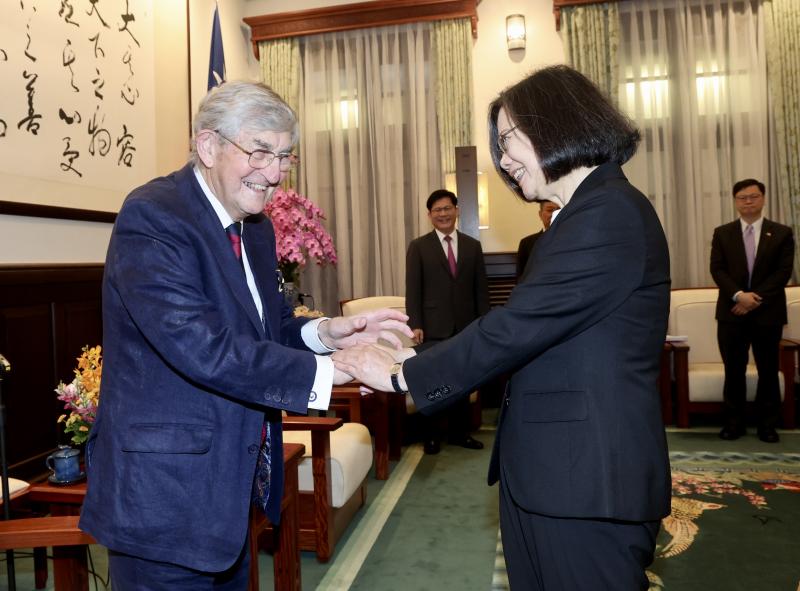
Photo: CNA
China has to look beyond the military expenses to the economic costs, as launching an invasion of Taiwan “may probably delay the development of China for years, even for decades,” she said.
Aggressive Chinese behavior in the region has also alarmed neighboring countries, which have repeatedly voiced opposition against any unilateral change of the “status quo,” she said.
Asked what the “status quo” means to her, Tsai said that Taiwanese “enjoy freedom and democracy and progressive values, and we are a group of people that are very proud of ourselves.”
One of the most satisfying achievements of her two terms in office is Taiwan’s relationships with other countries, she said.
“This is a time that we feel that we are actually part of the world rather than part of the cross-strait” situation, she said.
“We need friends, and we need people to come and express their concerns for us,” she said, adding that working with other nations has lessened the effects of cross-strait tensions.
Tsai disputed arguments that say the US should shift its support from Ukraine to Taiwan, considering the latter’s critical role in the global supply chain and geopolitics.
“You have to support Ukraine until the very end, because the determination is the most important thing as far as we are concerned,” she said.
The world’s support for Ukraine offers vital confidence for Taiwanese, she added.
Meanwhile, on her last day in office yesterday before president-elect William Lai (賴清德) is sworn in today, Tsai at the Presidential Office met with several delegations, including from the UK, Japan and Singapore, who are to attend the inauguration.
During her separate meetings with each delegation, Tsai expressed hope that they could support Taiwan’s participation in the Comprehensive and Progressive Agreement for Trans-Pacific Partnership.
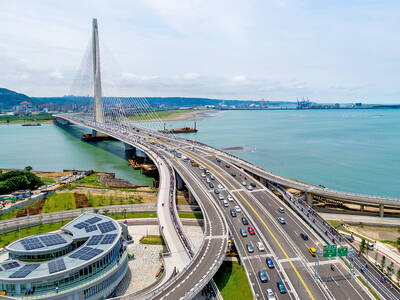
The Ministry of Transportation and Communications yesterday inaugurated the Danjiang Bridge across the Tamsui River in New Taipei City, saying that the structure would be an architectural icon and traffic artery for Taiwan. Feted as a major engineering achievement, the Danjiang Bridge is 920m long, 211m tall at the top of its pylon, and is the longest single-pylon asymmetric cable-stayed bridge in the world, the government’s Web site for the structure said. It was designed by late Iraqi-British architect Zaha Hadid. The structure, with a maximum deck of 70m, accommodates road and light rail traffic, and affords a 200m navigation channel for boats,
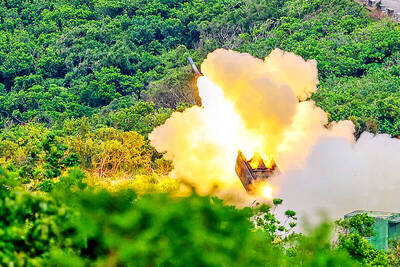
PRECISION STRIKES: The most significant reason to deploy HIMARS to outlying islands is to establish a ‘dead zone’ that the PLA would not dare enter, a source said A High Mobility Artillery Rocket System (HIMARS) would be deployed to Penghu County and Dongyin Island (東引) in Lienchiang County (Matsu) to force the Chinese military to retreat at least 100km from the coastline, a military source said yesterday. Taiwan has been procuring HIMARS and Army Tactical Missile Systems (ATACMS) from the US in batches. Once all batches have been delivered, Taiwan would possess 111 HIMARS units and 504 ATACMS, which have a range of 300km. Considering that “offense is the best defense,” the military plans to forward-deploy the systems to outlying islands such as Penghu and Dongyin so that

Taiwan Semiconductor Manufacturing Co (TSMC, 台積電), the world’s largest foundry service provider, yesterday said that global semiconductor revenue is projected to hit US$1.5 trillion in 2030, after the figure exceeds US$1 trillion this year, as artificial intelligence (AI) demand boosts consumption of token and compute power. “We are still at the beginning of the AI revolution, but we already see a significant impact across the whole semiconductor ecosystem,” TSMC deputy cochief operating officer Kevin Zhang (張曉強) said at the company’s annual technology symposium in Hsinchu City. “It is fair to say that in the past decade, smartphones and other mobile devices were
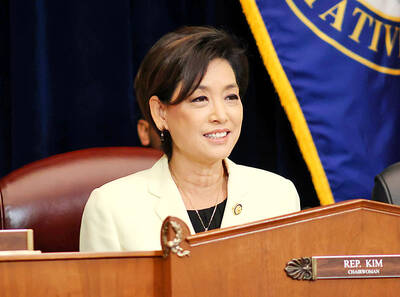
‘CLEAR MESSAGE’: The bill would set up an interagency ‘tiger team’ to review sanctions tools and other economic options to help deter any Chinese aggression toward Taiwan US Representative Young Kim has introduced a bill to deter Chinese aggression against Taiwan, calling for an interagency “tiger team” to preplan coordinated sanctions and economic measures in response to possible Chinese military or political action against Taiwan. “[Chinese President] Xi Jinping [習近平] has directed the People’s Liberation Army to be ready to invade Taiwan by 2027. China has a plan. America should have one too,” Kim said in a news release on Thursday last week. She introduced the “Deter PRC [People’s Republic of China] aggression against Taiwan act” to “ensure the US has a coordinated sanctions strategy ready should


 RSS
RSS