


Taiwan will continue to strengthen its self-defense capabilities, the Ministry of Foreign Affairs said yesterday after US Indo-Pacific Commander Admiral John Aquilino issued a warning about Beijing’s ambition of being able to invade Taipei by 2027.
Asked about Aquilino’s comment on Tuesday that China aims to have the capability to invade Taiwan by 2027, ministry spokesman Jeff Liu (劉永健) said that the government “would not speculate or comment on whether or when China would attack Taiwan.”
Taiwan would strive to maintain peace and stability across the Taiwan Strait, he said, adding that the nation does not provoke or succumb to pressure.
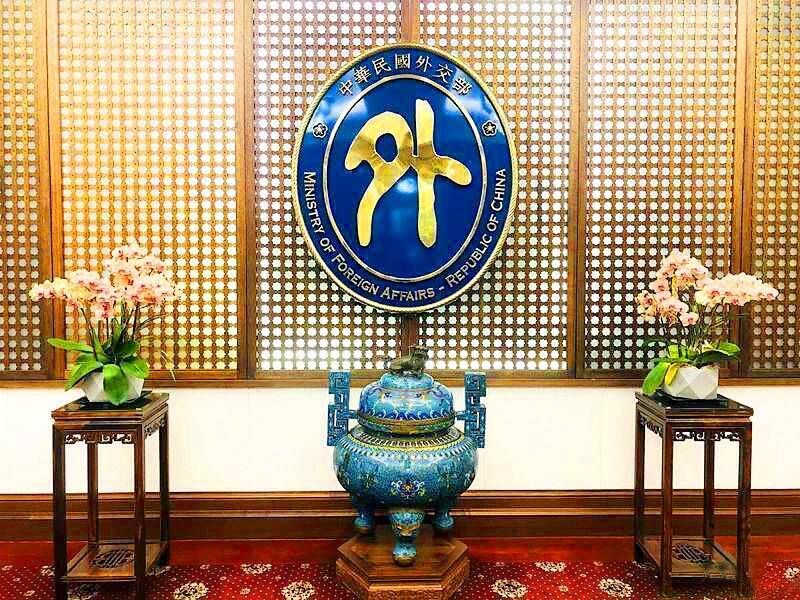
Photo: Taipei Times
In recent years, democratic countries around the world have reiterated the importance of cross-strait peace and stability and opposition to unilateral change to the “status quo” across the Taiwan Strait, he said.
The concerns and support from the international community can help deter China’s aggression, he said.
To strive for peace and back it up, the nation would strengthen its self-defense capabilities to prepare for any possible situation, he said.
Meanwhile, the US and the Philippines earlier this week reiterated the importance of peace across the Taiwan Strait while urging China to cease its dangerous actions in the South China Sea.
Washington and Manila “reaffirmed the importance of peace and stability across the Taiwan Strait” in a joint statement issued after the 11th US-Philippines Bilateral Strategic Dialogue in Washington on Monday and Tuesday.
The two sides pledged to “advance a free, safe and open Indo-Pacific, which is inclusive, prosperous, secure and based on international law, and that protects shared principles including territorial integrity; sovereignty; sovereign rights and jurisdiction; and the peaceful resolution of disputes,” the statement said.
They voiced opposition to “any threat or use of force against the territorial integrity or political independence of any state.”
They urged China to abide by the 1982 UN Convention on the Law of the Sea and refrain from aggressive and dangerous actions in the South China Sea, it said.
In other developments, Belgian Minister of Foreign Affairs Hadja Lahbib voiced the country’s support for Taiwan’s participation in the World Health Assembly (WHA) as an observer.
Lahbib on Tuesday told the Belgian parliament that Belgium supports Taiwan’s participation in the WHO and considers it appropriate to invite Taiwan to participate as an observer at the WHA next month, the Taipei Representative Office in the EU and Belgium said.
According to the office, Lahbib said that Belgium’s Permanent Mission in Geneva has advocated for Taiwan’s involvement on various occasions.
Lahbib said that her ministry would continue to communicate with authorities and like-minded countries about the issue, the office said.
This year’s assembly is scheduled to take place in Geneva, Switzerland, from May 27 to June 1.
Belgian parliamentarian Els van Hoof, chair of the Belgian Chamber of Representatives’ Foreign Affairs Committee, and other lawmakers recognized the nation’s public health expertise and experience and supported Taiwan’s joining the WHO to contribute to global public health, the office said.
The office thanked Lahbib for expressing the Belgian government’s public endorsement of Taiwan’s attendance at the WHA as an observer for four consecutive years.

The National Chungshan Institute of Science and Technology yesterday showcased its locally developed variants of the Vision 60 robotic patrol dog, which it plans to deploy on the nation’s outlying territories in the South China Sea. The variants were produced under the Joint Lab project — created by the institute and domestic companies — and assembled with domestically produced motors, lenses and artificial intelligence (AI) systems alongside licensed tech from the US, Missile and Rocket Systems Research Division deputy director Jen Kuo-kang (任國光) told the media event at a military base in Taipei’s Dazhi (大直) area. Taiwan has built up its strengths

RIGHT DIRECTION: Taiwan’s efforts to prevent forced labor include a proposal to ‘fully prohibit’ employers from withholding workers’ documents, an official said Taiwan is to establish a mechanism to restrict imports of goods linked to forced labor, the Executive Yuan said yesterday, after the US proposed imposing additional tariffs on Taiwanese goods over labor concerns. “The Ministry of Labor and the Ministry of Economic Affairs are to establish an interministerial review procedure,” Executive Yuan spokesperson Michelle Lee (李慧芝) said at a news briefing in Taipei. “The government is to use the Foreign Trade Act [貿易法] as the legal basis to restrict imports of goods produced with forced labor” and bring its supply chain governance more in line with international standards on human rights, resilience

NOT IMMEDIATE: Taiwan has a chance to appeal the proposed 10 percent tariff before it starts, while other countries face a 12.5 percent tariff from the trade office Taiwan is among 60 economies determined by the US to have failed to impose or enforce a ban on the importation of goods produced with forced labor, according to a notice released on Tuesday by the Office of the US Trade Representative (USTR), which proposed imposing an additional 10 percent or more tariff on them. The USTR in a statement said that following an investigation, it had determined under Section 301 of the Trade Act of 1974 that the failure of the 60 economies to impose and effectively enforce a prohibition on the importation of goods produced with forced labor is

TIT-FOR-TAT: The US allegedly revoked the visa of a Chinese national working at Xinhua News Agency in the US in response to Beijing’s expulsion of Vivian Wang The Presidential Office yesterday condemned China for expelling a New York Times correspondent from Beijing following the newspaper’s interview with President William Lai (賴清德), saying the move highlighted Beijing’s suppression of press freedom and its threat to international news media. Taiwan has noted a series of recent incidents in which Beijing used similar tactics to “threaten and pressure international media outlets and journalists,” Presidential Office spokeswoman Karen Kuo (郭雅慧) said in a statement. “This concerns not only press freedom and freedom of expression, but also the safety of journalists, and Taiwan and relevant partners are paying close attention to the situation,” she


 RSS
RSS