


President Tsai Ing-wen (蔡英文) yesterday emphasized the importance of the Taiwan-US partnership in maintaining peace and stability in the Indo-Pacific region, as she received Project 2049 Institute chairman Randall Schriver and members of his delegation at the Presidential Office in Taipei.
Her meeting with the representatives of the US think thank marked the 45th anniversary of the day the Taiwan Relations Act took effect, a cornerstone legislation for Washington’s relationship with the nation, including arms sales to maintain Taiwan’s self-defense capability.
Tsai thanked the US government, Congress and the American people for their continued friendship with Taiwan, adding that Taipei is committed to deepening the partnership and cooperation between the two nations.
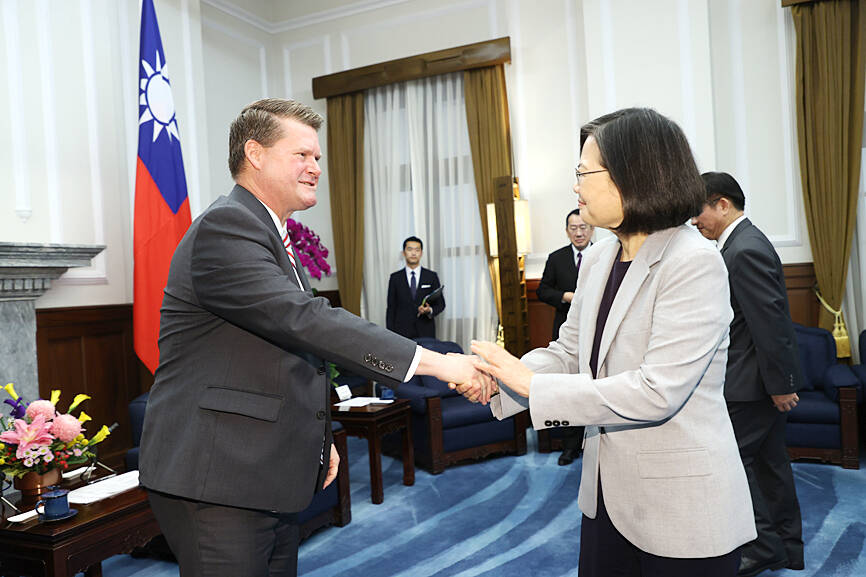
Photo: CNA
The Project 2049 Institute is a longtime contributor to the security of the Indo-Pacific region and has voiced support for Taiwan many times at public events and on social media, for which the nation is grateful, she said
Taipei and Washington have unceasingly strengthened the bilateral security partnership, with the US continuing to supply Taiwan with arms as stipulated in the Taiwan Relations Act and the “six assurances,” Tsai said.
The six assurances, agreed to by then-US president Ronald Reagan in July 1982, are guarantees that the US would not set a date for ending arms sales to Taiwan, hold prior consultations with China on weapons sales to Taiwan, play any mediation role between Taipei and Beijing, revise the Taiwan Relations Act, change its position regarding sovereignty over Taiwan, or exert pressure on Taiwan to negotiate with China.
Concurrent with US arms sales, Taiwan completed its first indigenous defense submarine, the Hai Kun, and six Tuo Chiang-class corvettes, demonstrating that the nation has the will and capability to defend itself, Tsai said.
Taiwan continues to safeguard regional peace and stability as a partner of the US, Tsai said, adding that she looks forward to exchanging views with the institute’s members.
Schriver said that the Taiwan Relations Act was not merely a contingent product of geostrategic events at the time of its writing, but also serves as an important platform for cooperation in trade, security and military affairs between Taipei and Washington.
Although some have said the Taiwan Relations Act should be amended, the legislation has undoubtedly enabled the two nations to finish the difficult and important work toward achieving the friendship they enjoy today, said Schriver, a former US assistant secretary of defense for Indo-Pacific security affairs.
The institute’s delegates pray for those affected by the earthquake, Schriver said, adding that Taiwan’s resilience and will in the face of adversity was heartening to see.
The institute thanked Tsai for her contributions to Taiwan-US relations and her inspired leadership during the COVID-19 pandemic from which the world can still benefit, he said.
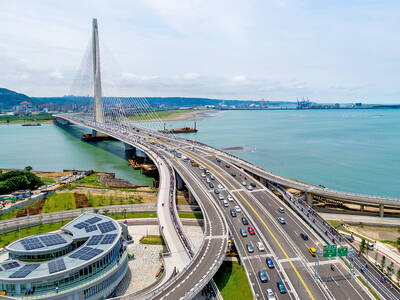
The Ministry of Transportation and Communications yesterday inaugurated the Danjiang Bridge across the Tamsui River in New Taipei City, saying that the structure would be an architectural icon and traffic artery for Taiwan. Feted as a major engineering achievement, the Danjiang Bridge is 920m long, 211m tall at the top of its pylon, and is the longest single-pylon asymmetric cable-stayed bridge in the world, the government’s Web site for the structure said. It was designed by late Iraqi-British architect Zaha Hadid. The structure, with a maximum deck of 70m, accommodates road and light rail traffic, and affords a 200m navigation channel for boats,
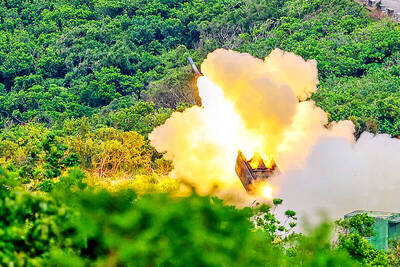
PRECISION STRIKES: The most significant reason to deploy HIMARS to outlying islands is to establish a ‘dead zone’ that the PLA would not dare enter, a source said A High Mobility Artillery Rocket System (HIMARS) would be deployed to Penghu County and Dongyin Island (東引) in Lienchiang County (Matsu) to force the Chinese military to retreat at least 100km from the coastline, a military source said yesterday. Taiwan has been procuring HIMARS and Army Tactical Missile Systems (ATACMS) from the US in batches. Once all batches have been delivered, Taiwan would possess 111 HIMARS units and 504 ATACMS, which have a range of 300km. Considering that “offense is the best defense,” the military plans to forward-deploy the systems to outlying islands such as Penghu and Dongyin so that

Taiwan Semiconductor Manufacturing Co (TSMC, 台積電), the world’s largest foundry service provider, yesterday said that global semiconductor revenue is projected to hit US$1.5 trillion in 2030, after the figure exceeds US$1 trillion this year, as artificial intelligence (AI) demand boosts consumption of token and compute power. “We are still at the beginning of the AI revolution, but we already see a significant impact across the whole semiconductor ecosystem,” TSMC deputy cochief operating officer Kevin Zhang (張曉強) said at the company’s annual technology symposium in Hsinchu City. “It is fair to say that in the past decade, smartphones and other mobile devices were
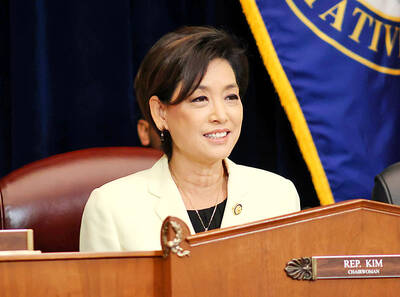
‘CLEAR MESSAGE’: The bill would set up an interagency ‘tiger team’ to review sanctions tools and other economic options to help deter any Chinese aggression toward Taiwan US Representative Young Kim has introduced a bill to deter Chinese aggression against Taiwan, calling for an interagency “tiger team” to preplan coordinated sanctions and economic measures in response to possible Chinese military or political action against Taiwan. “[Chinese President] Xi Jinping [習近平] has directed the People’s Liberation Army to be ready to invade Taiwan by 2027. China has a plan. America should have one too,” Kim said in a news release on Thursday last week. She introduced the “Deter PRC [People’s Republic of China] aggression against Taiwan act” to “ensure the US has a coordinated sanctions strategy ready should


 RSS
RSS