

President Tsai Ing-wen (蔡英文) and Cabinet members yesterday activated the Central Emergency Operation Center (中央災害應變中心) to coordinate and supervise rescue and relief efforts following a magnitude 7.2 earthquake that hit Hualien County in the morning.
At the center, which is headquartered in New Taipei City’s Sindian District (新店), Tsai and Premier Chen Chien-jen (陳建仁) received first-hand reports from government agencies on the situation in areas hardest hit by the earthquake and rescue operations.
Vice Premier Cheng Wen-tsan (鄭文燦) and Minister of the Interior Lin Yu-chang (林右昌) were also in attendance.
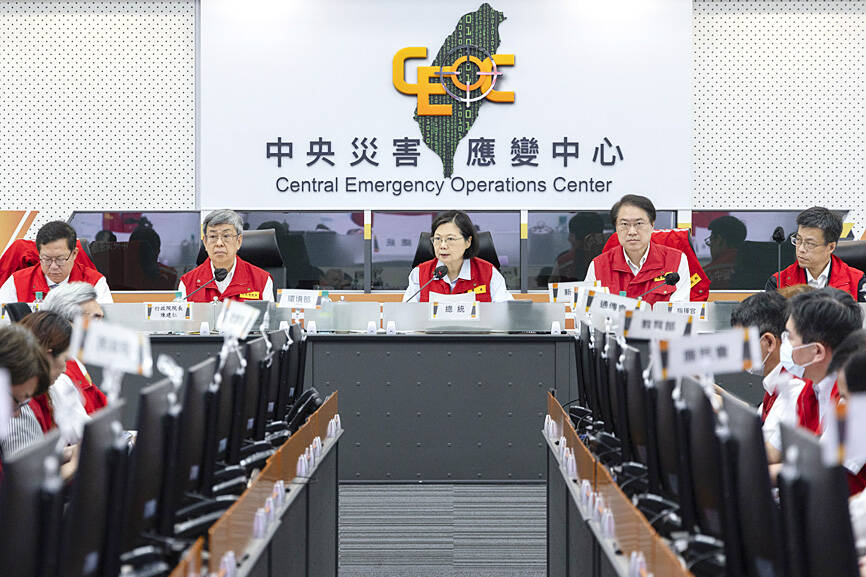
Photo courtesy of the Presidential Office
The officials received reports from agencies including the National Science and Technology Center for Disaster Reduction, the Central Weather Administration, the Ministry of National Defense, the Ministry of Transportation and Communications, the National Fire Agency and the Ministry of Economic Affairs.
“Cabinet ministries are required to remain in constant communication with local government authorities for the latest updates and to organize emergency response measures, while military units are ready to provide assistance and resources to central and local government agencies,” Tsai said.
Taiwan is likely to have aftershocks in the next few days, “so everyone must stay alert and keep safe,” Lin said.
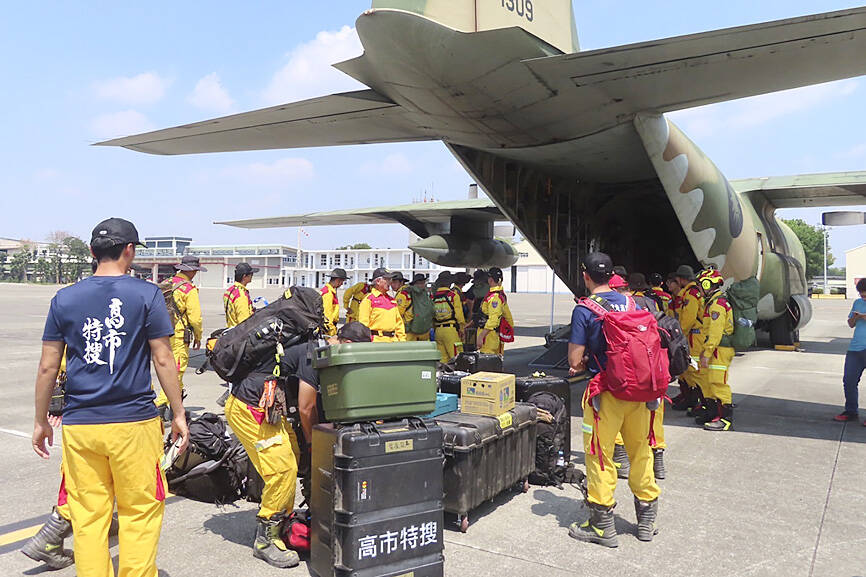
Photo courtesy of the Taiwan Air Force Command Headquarters
There are three important things to remember in an earthquake: “Get down, take cover and hold on to something sturdy,” he said.
Shortly after the earthquake struck, the interior ministry activated its emergency response procedures and coordinated agencies to compile updates and begin the relief effort, including the delivery of medical supplies and essential materials, he said.
Separately, president-elect William Lai (賴清德) traveled to Hualien City yesterday afternoon, visiting sites where the damage was most severe, including the collapsed Tien Wang Hsing Building (天王星大樓), in which scores were injured and at least one person died.
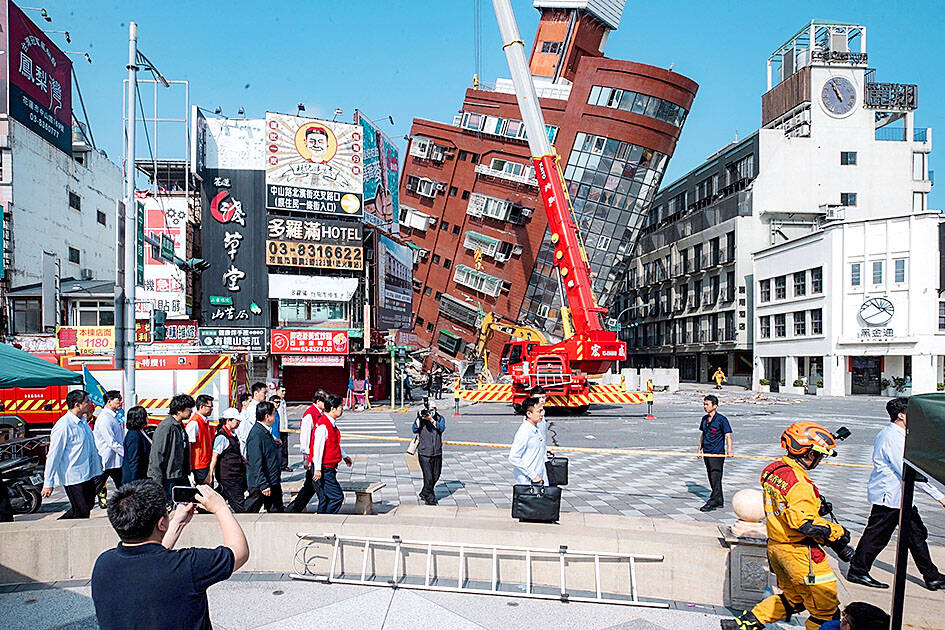
Photo courtesy of the Presidential Office
“The most important issue is to rescue people and to determine how many people are still inside,” Lai said.
“Those with injuries must receive medical treatment, while electricity and water services must be restored, and roads must be cleared for traffic,” he said.
The central government would provide funding and resources for the Hualien City and Hualien County governments to help with rescue and rebuilding work, he said.
That would include a rental subsidy for people affected by the earthquake, and subsidies for repairs and reinforcement work, he added.
The Ministry of Labor said in a statement that employers cannot mark employees as late if their commute was disrupted, as the earthquake caused suspension of operations at several public transport systems nationwide.
“If there are disputes, employees can report their situation to a local labor bureau,” it said.
Ministry of Health and Welfare officials said that people who were injured in the quake, but had lost their National Health Insurance card can receive medical care at ministry-authorized hospitals and clinics using “medical visit under special circumstances” rules.
“People can register their personal information and the date of the visit and get medical care,” they said, adding that the National Health Insurance Administration would verify the person’s identity and issue a new card.
Officers at military bases across Taiwan have been ordered to have barracks, field offices and training fields inspected for earthquake damage, the defense ministry said.
“After receiving reports of partial collapses of civilian buildings and other damage in Hualien, troops at the Second Combat Zone have been mobilized to help with rescue and relief work,” it said.
Separately, the Air Force Command Headquarters said in a release that it authorized sorties by C-130H transport planes to Hualien, with one carrying a rescue team of 15 from Tainan, another a team of 30 from Kaohsiung and another 15-member team from Pingtung County.
Additional reporting by CNA
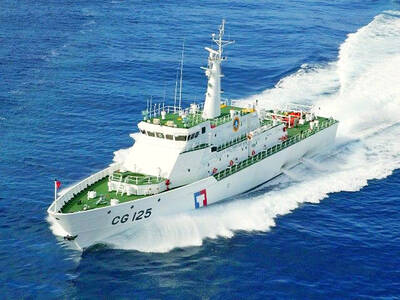
GEOPOLITICAL SIGNIFICANCE: The CGA’s nonmilitary role makes it a tool to avert diplomatic issues, an official said, while confirming the donation of a ship to Manila Coast Guard Administration (CGA) ships are scheduled to sail to the Philippines bearing the words “Taiwan Coast Guard” in a high-profile visit in October next year, the first such visit by a Taiwanese maritime law enforcement vessel to the Southeast Asian nation, the agency said yesterday. The CGA also confirmed that it had donated one of its decommissioned patrol vessels to the Philippines in a rare transfer of a retired ship to a nondiplomatic ally. The Republic of China (ROC) Navy last made such a visit in 1974, shortly before the Philippines switched diplomatic recognition to the People’s Republic of China in
CALL FOR CHANGE: They urged the UN to facilitate Taiwan’s involvement in the body, recognize its peace efforts and to work with members in preventing military conflict Representatives to the UN from five of Taiwan’s diplomatic allies sent a joint letter to UN Secretary-General Antonio Guterres on Friday, calling for the country’s inclusion in the body. Allies in the letter sent ahead of the 81st session of the UN General Assembly General Debate made three demands in support of Taiwan: inclusion, recognition and camaraderie. They implored the UN to seek an appropriate way to facilitate Taiwan’s meaningful involvement in the world governing body, saying that UN Resolution 2758, which accepted the People’s Republic of China (PRC) as a member of the UN, does not exclude Taiwan. Beijing claims that the

‘GLOBAL WARNING’: The infiltration is not just a local problem, as Beijing has been deploying the same tactics worldwide against Western democracies, a report said Between 50,000 and 100,000 Chinese spies are operating in Taiwan, far more than the National Security Bureau’s previous estimate of 5,000, German journalist and author Jurgen Kremb said on Monday. Kremb presented his research, titled “The War of Spies: How China’s Intelligence Services Are Infiltrating Taiwan — and What Europe Must Learn from It,” at a joint event held by the Taiwan offices of the Friedrich Naumann Foundation and the European Values Center for Security Policy. The report was published in June in the Ministry of Justice Investigation Bureau’s Prospect & Exploration Monthly (展望與探索月刊). By spies, he said he was referring to informants,

SOFT TENNIS: Yu Kai-wen and Huang Shih-yuan narrowly defeated their Japanese rivals to capture Taiwan’s first gold at the Asian Games in Nagoya Yu Kai-wen (余凱文) and Huang Shih-yuan (黃詩媛) won Taiwan’s first gold of this year’s Asian Games, defeating a Japanese duo in a nail-biter in the soft tennis mixed doubles final in Nagoya, Japan, while Johnny Sun (孫家閎) won silver in wushu and Shih Cheng-chung (石政中) won bronze in men’s kumite. Yu and Huang narrowly defeated Japan’s Toshiki Uematsu and Rena Temma 5-4 (2-4, 5-3, 4-2, 1-4, 1-4, 4-0, 1-4, 4-1, 7-5) to give Taiwan its first gold in soft tennis mixed doubles at an Asian Games since 2018. Sun secured Taiwan’s first wushu medal at this year’s game, with a combined score


 RSS
RSS