


Vice president-elect Hsiao Bi-khim (蕭美琴) on Thursday met with two Lithuanian presidential candidates during a low-key visit to Vilnius, a Lithuanian national security expert said on Friday.
Hsiao met with Dainius Zalimas of the Freedom Party, part of the ruling block, and Giedrimas Jeglinskas of the opposition Union of Democrats “For Lithuania,” Marius Laurinaviciusin wrote on Facebook.
The meeting not only showcased Zalimas’ consistent pro-Taiwan stance, but also hinted at a potential shift in attitude toward Taipei within the opposition bloc, wrote Laurinaviciusin, a Lithuanian journalist and political commentator who also attended the meeting.
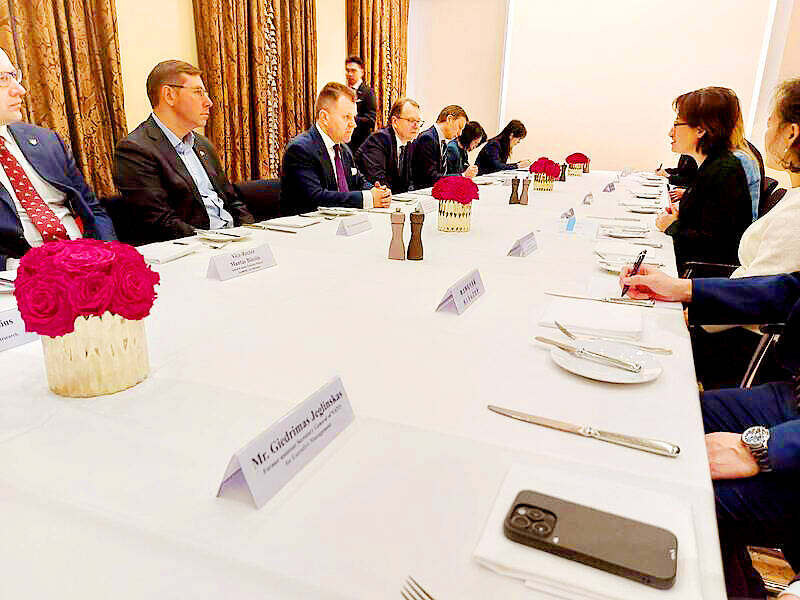
Photo: Screen grab from Marius Laurinaviciusin’s Facebook page
In addition to the talks, Hsiao visited Taiwan-friendly politicians and gave a speech about the nation’s democratic development at the Institute of International Relations and Political Sciences in Vilnius, he said.
It is regrettable that the news was neither disclosed by any local politicians nor covered by the media, he added.
“In any case, this visit was really the most important event of today in Lithuania in the field of international relations,” he said.
Laurinaviciusin also praised Czech Senate President Milos Vystrcil, who on Tuesday posted a photograph on X of him meeting with Hsiao.
The incoming vice president’s low-key Czech trip came after she reportedly visited the US in a personal capacity earlier this month. Both triggered anger from China.
Yesterday, Zygimantas Pavilionis, chairman of the Lithuanian Semias’ Foreign Affairs Committee, posted on X group photos of Hsiao and himself with his Estonian and Latvian counterparts — Marko Mihkelson and Rihards Kols.
Jason Worlledge, International Republican Institute resident program director of Eurasia and transatlantic strategies in Poland, posted a selfie of himself with Hsiao on X, saying it was great to have met her in Warsaw.
Hsiao first visited the Polish capital for a forum held by the Casimir Pulaski Foundation before traveling to Lithuania, a Polish academic said.
Hsiao, 52, served as Taiwan’s top representative to Washington from July 2020, before resigning from the post in November last year to be Vice President William Lai’s (賴清德) running mate in the Jan. 13 presidential race.


RESILIENCE: Taiwan plays a key role in semiconductors, energy, information infrastructure and advanced manufacturing, AIT Director Raymond Greene said Taiwan’s continued investment in deterrence and resilience remains vital, especially in uncrewed systems and other emerging technologies, American Institute in Taiwan (AIT) Director Raymond Greene said yesterday. Greene made the remarks at the annual National Strategic Summit on Supply Chain Resilience held by the Research Institute for Democracy, Society and Emerging Technology (DSET), a government-backed think tank. As Taiwan last year became the US’ fourth-largest trading partner and supply chain security is becoming more important, cooperation in emerging technologies continues to deepen between the two countries, he said. The US is committed to accelerating innovation, building key infrastructure, strengthening cooperation

The National Chungshan Institute of Science and Technology yesterday showcased its locally developed variants of the Vision 60 robotic patrol dog, which it plans to deploy on the nation’s outlying territories in the South China Sea. The variants were produced under the Joint Lab project — created by the institute and domestic companies — and assembled with domestically produced motors, lenses and artificial intelligence (AI) systems alongside licensed tech from the US, Missile and Rocket Systems Research Division deputy director Jen Kuo-kang (任國光) told the media event at a military base in Taipei’s Dazhi (大直) area. Taiwan has built up its strengths

RIGHT DIRECTION: Taiwan’s efforts to prevent forced labor include a proposal to ‘fully prohibit’ employers from withholding workers’ documents, an official said Taiwan is to establish a mechanism to restrict imports of goods linked to forced labor, the Executive Yuan said yesterday, after the US proposed imposing additional tariffs on Taiwanese goods over labor concerns. “The Ministry of Labor and the Ministry of Economic Affairs are to establish an interministerial review procedure,” Executive Yuan spokesperson Michelle Lee (李慧芝) said at a news briefing in Taipei. “The government is to use the Foreign Trade Act [貿易法] as the legal basis to restrict imports of goods produced with forced labor” and bring its supply chain governance more in line with international standards on human rights, resilience
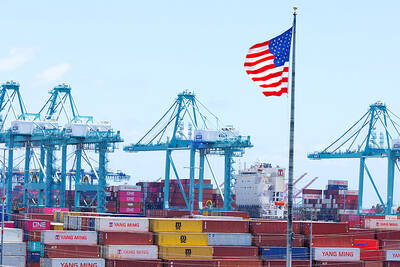
NOT IMMEDIATE: Taiwan has a chance to appeal the proposed 10 percent tariff before it starts, while other countries face a 12.5 percent tariff from the trade office Taiwan is among 60 economies determined by the US to have failed to impose or enforce a ban on the importation of goods produced with forced labor, according to a notice released on Tuesday by the Office of the US Trade Representative (USTR), which proposed imposing an additional 10 percent or more tariff on them. The USTR in a statement said that following an investigation, it had determined under Section 301 of the Trade Act of 1974 that the failure of the 60 economies to impose and effectively enforce a prohibition on the importation of goods produced with forced labor is


 RSS
RSS