


Taiwan Semiconductor Manufacturing Co (TSMC, 台積電) yesterday said that Japan Advanced Semiconductor Manufacturing Inc (JASM), its majority-owned subsidiary in Kumamoto Prefecture, plans to build a second wafer fab to meet growing customer demand, broadening its offerings to include advanced 6-nanometer and 7-nanometer chips.
Moreover, JASM is to add a new shareholder, Toyota Motor Corp, which is to take a minority stake of 2 percent, joining Sony Semiconductor Solutions Corp (SSS) and DENSO Corp, a joint statement said.
“In response to rising customer demand, JASM plans to commence construction of its second fab by the end of 2024. The increased production scale is also expected to improve overall cost structure and supply chain efficiency for JASM,” the statement said.
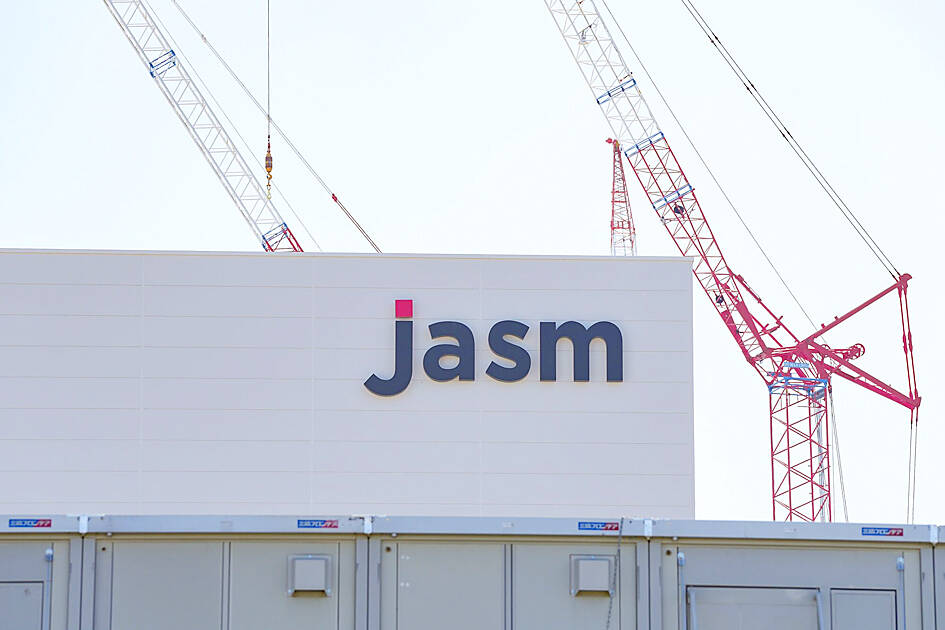
Photo: Bloomberg
JASM’s new factory is scheduled to start operations by the end of the 2027, three years after the opening of its first fab, the statement said.
Together with JASM’s first fab, overall investment in JASM would exceed US$20 billion, with strong support from the Japanese government, it said.
TSMC, the world’s biggest contract chipmaker, last month said that JASM’s first fab is on track to start volume production in the fourth quarter of this year, focusing on less-advanced chips from 12-nanometer, 16-nanometer, 22-nanometer to 28-nanometer chips.
With both fabs, JASM’s Kumamoto site is expected to offer a total production capacity of more than 100,000 12-inch equivalent wafers per month — from 40-nanometer to 6-nanometer and 7 nanometer process technologies — for automotive, industrial, consumer and high-performance-computing-related applications, the statement said.
The capacity plan might be further adjusted depending on customer demand, it said.
With both fabs, the Kumamoto site is expected to directly create more than 3,400 high-tech jobs.
TSMC holds a 86.5 percent stake in JASM, while SSS and DENSO own minority stakes of 6 percent and 5.5 percent respectively.
In a separate statement, TSMC’s board of directors yesterday approved the capital injection of not more than US$5.26 billion into JASM and not more than US$5 billion into TSMC Arizona, a wholly owned subsidiary.
In addition, the board approved the capital injection of not more than US$3 billion into TSMC Global Ltd to reduce its foreign exchange hedging costs.
The board gave the go-ahead to the capital appropriations of approximately US$9.42 billion primarily for the installation of advanced technology capacity, advanced packaging, mature or specialty technology capacity, as well as fab construction and installation of fab facility systems.
It also approved the distribution of a cash dividend of NT$3.50 per share for the fourth quarter of last year, as well as the distribution of employee performance bonuses and profit sharing totaling approximately NT$100.18 billion (US$3.19 billion) for last year.

A signaling system malfunction disrupted high-speed rail (HSR) services beginning at 8am today, with trains temporarily reduced to three northbound and three southbound trains per hour as authorities conduct inspections. The malfunction occurred on a section of track in Miaoli County during pre-operation checks early this morning, forcing northbound and southbound trains to use a single track, the HSR operator said. The regular schedule has been replaced with three hourly trains offering only nonreserved seating in each direction, stopping at every station, it said, adding that business class cars would still have reserved seating. Departures from terminal stations are scheduled at the top
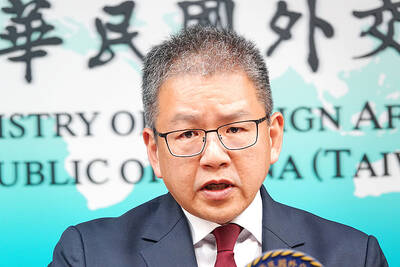
Taiwan is still in the process of assessing the possibility of recruiting workers from Eswatini, the Ministry of Foreign Affairs said yesterday, adding that its goal is to help Eswatini upgrade its vocational training centers. If there are plans to recruit workers from Eswatini, safeguarding national security, protecting public health and ensuring the employment rights of Taiwanese would be prerequisites, Department of West Asian and African Affairs Director-General Yen Chia-liang (顏嘉良) told a news conference. Key considerations would also include filling labor shortages in specific industries, and fostering bilateral professional and technical exchanges, he said. Yen was asked about the progress of labor

VERBOSE VESSELS: A CGA cutter and a China Coast Guard exchanged verbal barbs for more than a day in Taiwanese-controlled waters before the Chinese vessel left The Taiwanese and Chinese coast guards had a standoff near the strategically located Pratas Islands (Dongsha Islands, 東沙群島) in the north of the South China Sea, the Coast Guard Administration (CGA) said yesterday. The two sides engaged in intense radio exchanges over sovereignty claims during the 33-hour standoff. China Coast Guard vessel 3501 eventually left the restricted waters, 26.6 nautical miles (49.2km) west of the Pratas Islands, at 5pm yesterday, the CGA said. Lying approximately between southern Taiwan and Hong Kong, the Taiwan-controlled Pratas are seen by some security experts as vulnerable to Chinese attack due to their distance — more than

A US uncrewed surface vessel (USV) encountered multiple Chinese warships during an autonomous transit of the Taiwan Strait, US defense company Seasats said in a statement on Wednesday. Seasats announced that a Lightfish USV had completed the first autonomous transit of the Taiwan Strait. Over five days, the USV traversed the entire length of the Strait while constantly monitoring surface vessel traffic, the company said. The Lightfish encountered multiple Chinese warships, one of which was a Chinese People’s Liberation Army Navy (PLAN) Type 056 corvette, it said. The Chinese vessels were operating “well within Taiwan’s exclusive economic zone without transmitting their identity via the


 RSS
RSS