


Japanese marines in amphibious assault vehicles yesterday stormed an island beach at the edge of the East China Sea in a simulated attack to dislodge invaders from territory that Tokyo worries is vulnerable to attack from China.
As tensions run high with neighbors China, Russia and North Korea, the drill on the southwest island of Tokunoshima capped an 11-day series of exercises nationwide dubbed 05JX, meant to show the readiness of ground, sea and air forces to defend Japan’s territory and infrastructure, including nuclear power plants.
“The goal of JX is to show that if there is an emergency situation resulting from an attack, that we are able respond in a joint way,” Japan Self-Defense Forces Chief of Staff, Joint Staff General Yoshihide Yoshida said after observing the drill on Tokunoshima.
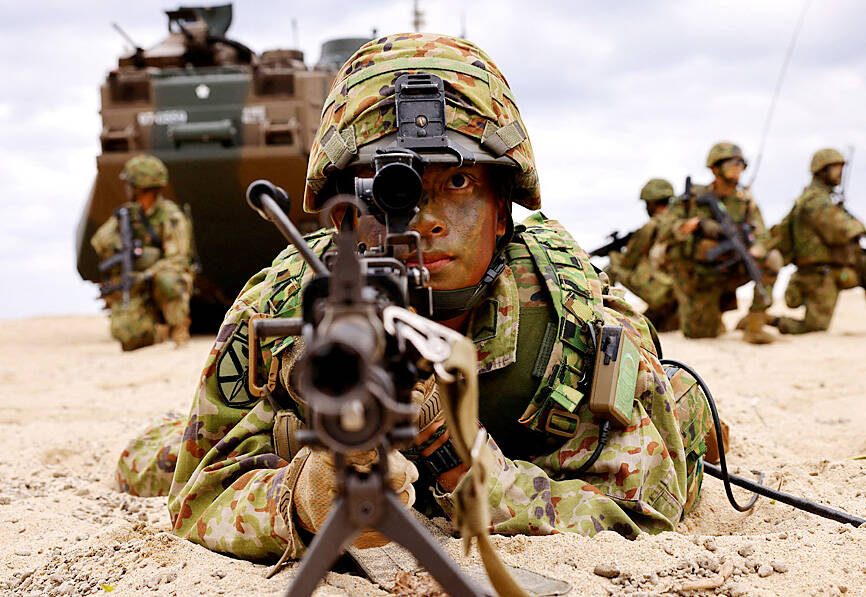
Photo: Reuters
The Chinese Ministry of National Defense could not be reached for comment on the drills.
Japan Ground Self-Defense Force amphibious assault vehicles launched from two Japan Maritime Self-Defense Force landing ships anchored offshore. Other troops arrived in semi-inflatable rubber boats, with heavy equipment carried to shore on military hovercraft.
Unlike many of the beaches along Japan’s southwest island chain stretching toward Taiwan, the one on Tokunoshima does not have a coral reef that would make military operations more difficult.
The scope and pace of military exercises in Japan are likely to increase over the next few years, including with US forces, after Japanese Prime Minister Fumio Kishida in December last year unveiled the country’s biggest military buildup since World War II, with a pledge to double defense spending over five years.
Kishida has warned that East Asia could be the next Ukraine, if China, emboldened by Russia’s assault on its neighbor, attacks Taiwan.
The ¥43.5 trillion (US$290.9 billion) in planned spending would go to new weapons such as longer-range missiles as well as to increase stocks of spare parts and munitions to fight a sustained conflict.
However, the yen’s sharp decline this year has forced Japan to cut back on some planned purchases, including new models of the US-made Chinook helicopters that Japan’s military used in the Tokunoshima drill.
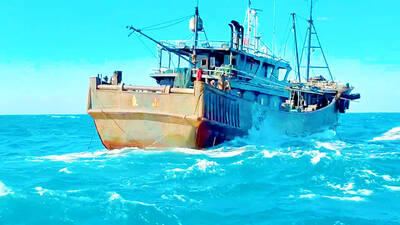
MAKING WAVES: China’s maritime militia could become a nontraditional threat in war, clogging up shipping lanes to prevent US or Japanese intervention, a report said About 1,900 Chinese ships flying flags of convenience and fishing vessels that participated in China’s military exercises around Taiwan last month and in January last year have been listed for monitoring, Coast Guard Administration (CGA) Deputy Director-General Hsieh Ching-chin (謝慶欽) said yesterday. Following amendments to the Commercial Port Act (商港法) and the Law of Ships (船舶法) last month, the CGA can designate possible berthing areas or deny ports of call for vessels suspected of loitering around areas where undersea cables can be accessed, Oceans Affairs Council Minister Kuan Bi-ling (管碧玲) said. The list of suspected ships, originally 300, had risen to about
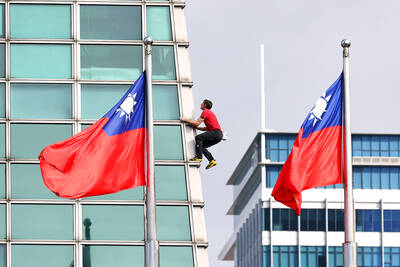
DAREDEVIL: Honnold said it had always been a dream of his to climb Taipei 101, while a Netflix producer said the skyscraper was ‘a real icon of this country’ US climber Alex Honnold yesterday took on Taiwan’s tallest building, becoming the first person to scale Taipei 101 without a rope, harness or safety net. Hundreds of spectators gathered at the base of the 101-story skyscraper to watch Honnold, 40, embark on his daredevil feat, which was also broadcast live on Netflix. Dressed in a red T-shirt and yellow custom-made climbing shoes, Honnold swiftly moved up the southeast face of the glass and steel building. At one point, he stepped onto a platform midway up to wave down at fans and onlookers who were taking photos. People watching from inside
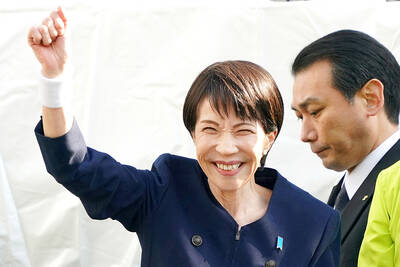
Japan’s strategic alliance with the US would collapse if Tokyo were to turn away from a conflict in Taiwan, Japanese Prime Minister Sanae Takaichi said yesterday, but distanced herself from previous comments that suggested a possible military response in such an event. Takaichi expressed her latest views on a nationally broadcast TV program late on Monday, where an opposition party leader criticized her for igniting tensions with China with the earlier remarks. Ties between Japan and China have sunk to the worst level in years after Takaichi said in November that a hypothetical Chinese attack on Taiwan could bring about a Japanese
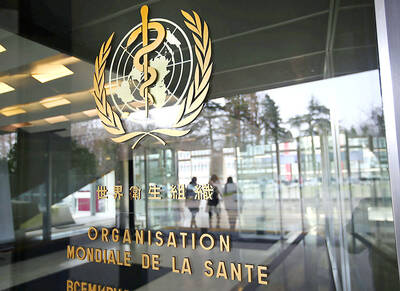
The WHO ignored early COVID-19 warnings from Taiwan, US Deputy Secretary of Health and Human Services Jim O’Neill said on Friday, as part of justification for Washington withdrawing from the global health body. US Secretary of State Marco Rubio on Thursday said that the US was pulling out of the UN agency, as it failed to fulfill its responsibilities during the COVID-19 pandemic. The WHO “ignored early COVID warnings from Taiwan in 2019 by pretending Taiwan did not exist, O’Neill wrote on X on Friday, Taiwan time. “It ignored rigorous science and promoted lockdowns.” The US will “continue international coordination on infectious


 RSS
RSS