


Taiwan yesterday inked an Enhanced Trade Partnership (ETP) deal with the UK, marking the nation’s first trade framework agreement with a European country, the Executive Yuan’s Office of Trade Negotiations said.
The agreement was signed in a teleconference by Minister Without Portfolio John Deng (鄧振中), who heads the office, Representative to the UK Kelly Hsieh (謝武樵) and British officials, Deng and Hsieh said in a joint statement.
The ETP showed the growth of Taiwan-UK economic ties and provided a guideline for Taipei and London to conduct trade talks, they said.
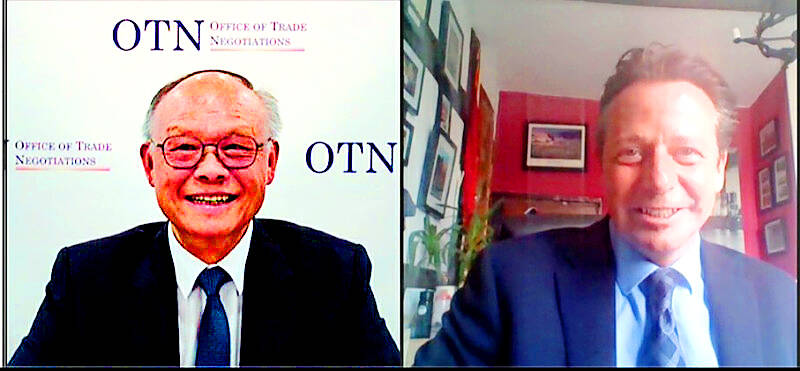
Photo courtesy of the Office of Trade Negotiations
Taiwan plans to continue its discussions with the UK over collaborations in digital trade, investment and net zero emissions, they said.
Taipei hopes to expand the scope of bilateral cooperation with London after meeting these objectives, they said.
Establishing economic ties with the UK — which is poised to join the Comprehensive and Progressive Agreement for Trans-Pacific Partnership (CPTPP) — would boost Taiwan’s chances in its bid to become a member of that trade pact, Deng said.
The UK is a trade powerhouse and the world’s sixth-biggest economy, and is searching for economic partners following its exit from the EU, he said, adding that the UK continues to be a force in global commerce and politics.
Taiwan’s economic needs are compatible with the requirements of the UK, which is a world leader in biotechnology, energy, vehicle manufacturing, artificial intelligence and banking, he said.
London’s trade outreach to the Indo-Pacific region has created favorable conditions for Taiwan to expand its international commerce, Deng said.
The Executive Yuan is to remain in touch with industries that can benefit from any Taiwan-UK economic agreements, as it negotiates them with London, the office said.
The government would promote sustainability, gender equality, corporate social responsibility and consumer protection standards as it seeks closer economic ties with the UK, it said.
Taipei and London began talks on the ETP in July, with Deng taking the lead in negotiations. His counterpart was British Minister of State for International Trade Nigel Huddleston.
The office previously said that the ETP might be expanded — with a free trade agreement (FTA) being its ultimate goal.
However, the path from ETP to FTA is not straightforward, it said, adding that India and the UK signed an ETP agreement in 2021, but an FTA has yet to materialize.
President Tsai Ing-wen (蔡英文) earlier this year urged World Taiwanese Chambers of Commerce members to exert their influence to help the nation’s bid to become a CPTPP member, citing the need to make the economy more resilient.

‘NO SECURITY RISK’: The Railway Bureau reassured the public that the technicians’ activities were limited to technical guidance and did not involve sensitive systems The Railway Bureau yesterday said it had invited eight Chinese technicians to assist with an airport MRT construction project. The bureau issued the confirmation after an Internet user said Chinese nationals had entered the construction zone of Taiwan Taoyuan International Airport’s Terminal 3 project. They asked why “individuals from an enemy state” were allowed access to such a major national infrastructure project, which raised serious concerns over Taiwan’s industrial safety, sensitive systems and information security. The bureau’s Northern Region Engineering Branch Office said subcontractor Taiwan Handle Industrial Co (台灣手把工業) of the Taoyuan airport MRT’s “Contract No. CU05 Project A14 Station Civil, MEP &

A US uncrewed surface vessel (USV) encountered multiple Chinese warships during an autonomous transit of the Taiwan Strait, US defense company Seasats said in a statement on Wednesday. Seasats announced that a Lightfish USV had completed the first autonomous transit of the Taiwan Strait. Over five days, the USV traversed the entire length of the Strait while constantly monitoring surface vessel traffic, the company said. The Lightfish encountered multiple Chinese warships, one of which was a Chinese People’s Liberation Army Navy (PLAN) Type 056 corvette, it said. The Chinese vessels were operating “well within Taiwan’s exclusive economic zone without transmitting their identity via the
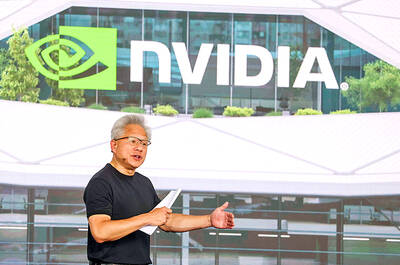
‘BOOMING’: ’ The number of partners we have here is incredible. You can see from their stock prices. They’re doing so well, they’re so happy,’ Jensen Huang said Nvidia Corp’s spending in Taiwan has ballooned to about US$150 billion a year, 10 times the US$10 billion to US$15 billion the company spent five years ago, Nvidia chief executive officer Jensen Huang (黃仁勳) said yesterday, suggesting Taiwan’s strategic importance in the global artificial intelligence (AI) supply chain. “Taiwan is the epicenter of the AI revolution. This is where the chips come, packaging comes. This is where the systems are made. This is where AI supercomputers were created,” Huang said at a meeting for the company’s employees in Beitou-Shilin Technology Park (北投士林科技園區) in Taipei, the planned site of Nvidia’s Taipei headquarters. “Taiwan
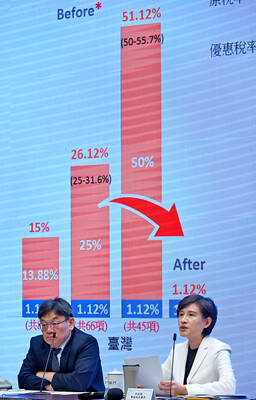
GREATER REACH? Auto parts and wood products would face tariffs of up to 15%, matching those targeting the EU, Japan and South Korea, Vice Premier said The US has announced that preferential tariff treatment for Taiwan’s non-semiconductor Section 232 goods would take effect retroactively from May 1, the Executive Yuan said yesterday. The US government yesterday posted a notice on the Federal Register’s public inspection Web site previewing tariff concessions for Taiwan under a memorandum of understanding (MOU) on Taiwan-US investment after two months of negotiations. The MOU signed on Jan. 15 stipulated three major preferential tariff arrangements: a 15 percent “reciprocal” tariff rate for Taiwan without stacking most-favored nation (MFN) rates; preferential Section 232 treatment for semiconductors and related products; and preferential Section 232 treatment for non-semiconductor


 RSS
RSS