


A US destroyer and a Canadian frigate conducted a “routine” transit of the Taiwan Strait on Wednesday — their second joint passage in two months — to demonstrate a commitment “to a free and open Indo-Pacific,” the 7th Fleet of the US Pacific Command said yesterday.
In a statement, the US 7th Fleet said that the “unremarkable [and] unprovocative” transit by the USS Rafael Peralta, an Arleigh Burke-class guided-missile destroyer, and the Royal Canadian Navy’s Halifax-class frigate the HMCS Ottawa was made “through waters where high seas freedoms of navigation and overflight apply in accordance with international law.”
The transit was made through “a corridor in the Strait that is beyond the territorial sea of any coastal state” to “demonstrate the commitment of the United States and our allies and partners to a free and open Indo-Pacific,” the US 7th Fleet said.
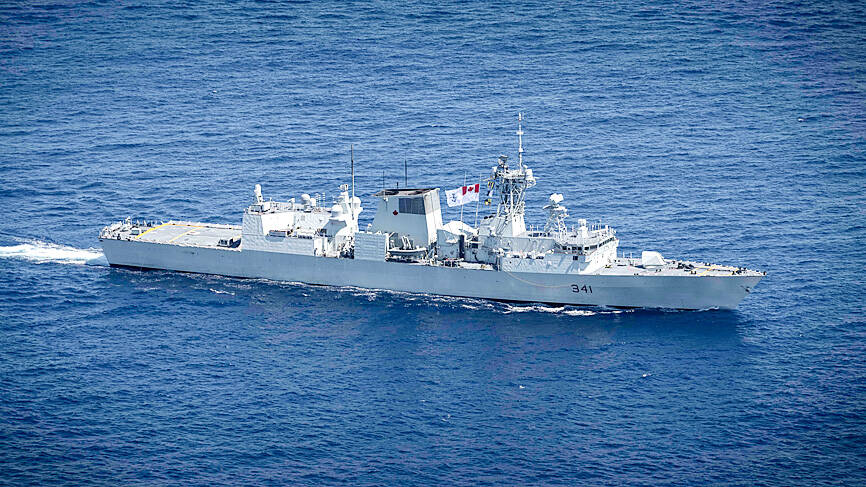
Photo from the HMCS Ottawa’s Facebook page
“Cooperation like this represents the centerpiece of our approach to a secure and prosperous region where aircraft and ships of all nations may fly, sail and operate anywhere international law allows,” it said.
The Ministry of National Defense later confirmed the transit, saying in a statement that the military was on top of the situation as one US destroyer and one Canadian frigate sailed northward in the Taiwan Strait, and it did not see any irregularities.
China yesterday said its troops were “on constant high alert” after the transit.
“Troops in the theater remain on constant high alert, and will resolutely protect national sovereignty and security as well as regional peace and stability,” Senior Colonel Shi Yi (施毅), a spokesman for China’s Eastern Theater Command, said in a statement.
Shi slammed the latest transit as “public hype” and said its naval and air forces had “trailed their entire course.”
US warships have been making routine, almost monthly passages through the Taiwan Strait for more than two years, occasionally accompanied by vessels from allied nations such as Canada.
The last voyage made by US and Canadian warships was on Sept. 9 by the Arleigh Burke-class guided-missile destroyer USS Ralph Johnson and the Royal Canadian Navy Halifax-class frigate HMCS Ottawa.
Taipei has welcomed such transits, describing them as beneficial to promoting regional peace and stability.
Additional reporting by AFP
South Korea has adjusted its electronic arrival card system to no longer list Taiwan as a part of China, a move that the Ministry of Foreign Affairs said would help facilitate exchanges between the two sides. South Korea previously listed “Taiwan” as “Taiwan (China)” in the drop-down menus of its online arrival card system, where people had to fill out where they came from and their next destination. The ministry had requested South Korea make a revision and said it would change South Korea’s name on Taiwan’s online immigration system from “Republic of Korea” to “Korea (South),” should the issue not be

Tainan, Taipei and New Taipei City recorded the highest fines nationwide for illegal accommodations in the first quarter of this year, with fines issued in the three cities each exceeding NT$7 million (US$220,639), Tourism Administration data showed. Among them, Taipei had the highest number of illegal short-term rental units, with 410. There were 3,280 legally registered hotels nationwide in the first quarter, down by 14 properties, or 0.43 percent, from a year earlier, likely indicating operators exiting the market, the agency said. However, the number of unregistered properties rose to 1,174, including 314 illegal hotels and 860 illegal short-term rental
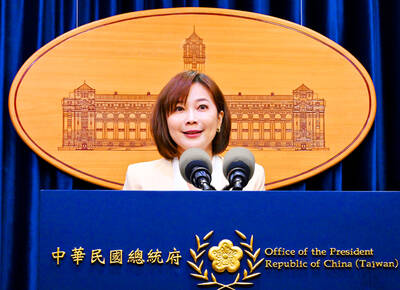
ECONOMIC COERCION: Such actions are often inconsistently applied, sometimes resumed, and sometimes just halted, the Presidential Office spokeswoman said The government backs healthy and orderly cross-strait exchanges, but such arrangements should not be made with political conditions attached and never be used as leverage for political maneuvering or partisan agendas, Presidential Office spokeswoman Karen Kuo (郭雅慧) said yesterday. Kuo made the remarks after China earlier in the day announced 10 new “incentive measures” for Taiwan, following a landmark meeting between Chinese President Xi Jinping (習近平) and Chinese Nationalist Party (KMT) Chairwoman Cheng Li-wun (鄭麗文) in Beijing on Friday. The measures, unveiled by China’s Xinhua news agency, include plans to resume individual travel by residents of Shanghai and China’s Fujian

Chinese President Xi Jinping (習近平) and Chinese Nationalist Party (KMT) Chairwoman Cheng Li-wun (鄭麗文) met in Beijing yesterday, where they vowed to bring people on both sides of the Taiwan Strait closer to facilitate the “great rejuvenation of the Chinese nation.” The meeting was held in the East Hall of the Great Hall of the People, a venue typically reserved for meetings between Xi and foreign heads of state. In public remarks prior to a closed-door meeting, Xi, in his role as head of the Chinese Communist Party (CCP), said that Taiwan is historically part of China, and remains an “inalienable” and


 RSS
RSS