


Emergency workers yesterday combed through wreckage after a blaze ripped through a packed Spanish nightclub complex, killing 13 people, to try to understand the cause of the fire.
The blaze, which broke out early on Sunday in a building housing the Teatre and Fonda Milagros discos on the outskirts of the southeastern city of Murcia, was Spain’s deadliest nightclub fire in more than three decades.
Murcia City Hall had in January last year ordered the nightclubs shut as the company that operated them only had a licence for one of them — the Teatre — and not for Fonda which was created later, Murcia Deputy Mayor Antonio Navarro told a news conference.

Photo: AFP / Murica Region 112 Emergency Services
“We are going to determine all responsibilities,” he said without explaining why the discos were still operating.
All of the people who were reported missing after the fire have been accounted for, including three people who were at a beach and had their mobile phones turned off, local officials said.
“It seems that there are no more people missing,” the head of the Murcia regional government, Fernando Lopez Miras, told Spanish public television.

Photo: Reuters
Police suspect the fire broke out in the Fonda nightclub and then spread to neighboring venues as patrons raced to escape.
“The fatalities were all concentrated in a very small area in the Fonda establishment,” police spokesman Diego Seral said, adding that a birthday party was being held there at the time.
Video footage released by the Murcia fire brigade showed firefighters holding a long hose approaching fierce flames inside the venue, passing bar tables that still had drinks on them.
A man named Jairo, who said he was the father of one of the victims, told reporters his 28-year-old daughter had been inside one of the clubs.
He had received no news of her since she left a desperate voice mail message at 6:06am, he said.
“Mum, I love you. We’re going to die. I love you mum,” a young woman’s voice could be heard crying on the recording, while in the background people shouted for someone to turn on the lights.
The fire appears to have spread through the air-conditioning vents “which is why it spread so quickly,” said the central government’s representative in Murcia, Francisco Jimenez.
Police said three of the victims had been identified by their fingerprints. The rest of the bodies would have to be identified using DNA samples from close relatives.
“We must be patient with the identification of the bodies... The bodies are very badly burned and it is going to be very difficult for experts to work on them,” Jimenez said.
Four people — two women aged 22 and 25, and two men in their 40s — were treated for smoke inhalation, officials said.
Murcia City Hall announced three days of mourning, and a minute of silence was observed at noon yesterday for the victims.
“We are devastated, shocked,” Lopez Miras said after meeting family members of the victims.
“There is nothing we can say to console relatives and friends of the victims. You are left without words,” he said.
Firefighters dispatched to the scene at 7am were able to extinguish the fire by 8am, Murcia Mayor Jose Ballesta said.
It was the worst nightclub fire in Spain since 43 people died in 1990 at a blaze at a disco in Zaragoza.


A global survey showed that 60 percent of Taiwanese had attained higher education, second only to Canada, the Ministry of the Interior said. Taiwan easily surpassed the global average of 43 percent and ranked ahead of major economies, including Japan, South Korea and the US, data from the Organisation for Economic Co-operation and Development (OECD) for 2024 showed. Taiwan has a high literacy rate, data released by the ministry showed. As of the end of last year, Taiwan had 20.617 million people aged 15 or older, accounting for 88.5 percent of the total population, with a literacy rate of 99.4 percent, the data

NEW LOW: The council in 2024 based predictions on a pessimistic estimate for the nation’s total fertility rate of 0.84, but last year that rate was 0.69, 17 percent lower An expected National Development Council (NDC) report expects the nation’s population to drop below 12 million by 2065, with the old-age dependency ratio to top 100 percent sooner than 2070, sources said yesterday. The council is slated to release its latest population projections in August, using an ultra-low fertility model, the sources said. The previous report projected that Taiwan’s population would fall to 14.37 million by 2070, but based on a new estimate of the total fertility rate (TFR) — the average number of children born to a woman over her lifetime — the population is expected to reach 12 million by
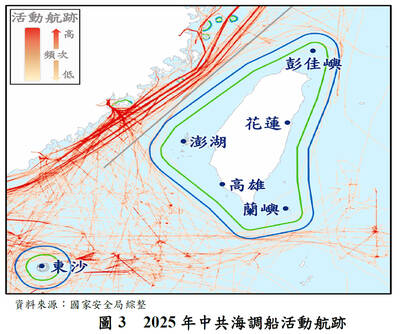
INTENSIFYING THREATS: Beijing’s tactics include massive attacks on the government service network, aircraft and naval vessel incursions and damaging undersea cables China is prepared to interfere in November’s nine-in-one local elections by launching massive attacks on the Taiwanese government’s service network (GSN), a report published by the National Security Bureau showed. The report was submitted to the Legislative Yuan ahead of the bureau’s scheduled briefing at the Foreign Affairs and National Defense Committee tomorrow. The national security team has identified about 13,000 suspicious Internet accounts and 860,000 disputed messages, the bureau said of China’s cognitive warfare against Taiwan. The disputed messages focus on major foreign affairs, national defense and economic issues, which were produced using generative artificial intelligence (AI) and distributed through Chinese

COUNTERING HOSTILITY: The draft bill would require the US to increase diplomatic pressure on China and would impose sanctions on those who sabotage undersea cable networks US lawmakers on Thursday introduced a bipartisan bill to bolster the resilience of Taiwan’s submarine cables to counter China’s hostile activities. The proposal, titled the critical undersea infrastructure resilience initiative act, was cosponsored by Republican representatives Mike Lawler and Greg Stanton, and Democratic Representative Dave Min. US Senators John Curtis and Jacky Rosen also introduced a companion bill in the US Senate, which has passed markup at the chamber’s Committee on Foreign Relations. The House’s version of the bill would prioritize the deployment of sensors to detect disruptions or potential sabotage in real-time and enhance early warning capabilities through global intelligence sharing frameworks,


 RSS
RSS