


The US on Friday urged Belgrade to pull its forces back from the border with Kosovo after detecting what it called an “unprecedented” Serbian military buildup.
Serbia deployed sophisticated tanks and artillery on the frontier after deadly clashes erupted at a monastery in northern Kosovo last week, the White House said.
The violence — in which a Kosovar police officer and three Serbian gunmen were killed — marked one of the gravest escalations for years in Kosovo, a former Serbian breakaway province.
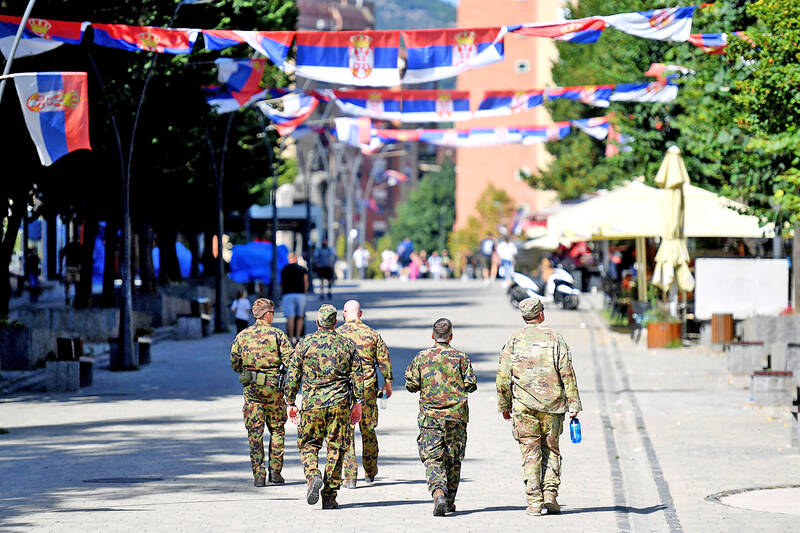
Photo: AFP
“We are monitoring a large Serbian military deployment along the border with Kosovo,” White House National Security Council spokesman John Kirby told reporters.
“That includes an unprecedented staging of advanced Serbian artillery, tanks, mechanized infantry units. We believe that this is a very destabilizing development,” he said. “We are calling on Serbia to withdraw those forces from the border.”
The build-up took place within the past week, but its purpose was not yet clear, Kirby said.
US Secretary of State Antony Blinken had telephoned Serbian President Aleksandar Vucic to urge “immediate de-escalation and a return to dialogue,” he said.
US National Security Adviser Jake Sullivan also spoke with Kosovar Prime Minister Albin Kurti and “expressed concern about Serbian military mobilizations,” a readout of the call said.
The pair also “discussed the EU-facilitated Dialogue between Kosovo and Serbia, which Mr. Sullivan underscored was the only long-term solution to ensuring stability throughout Kosovo,” the readout said.
Vucic did not directly deny that there had been a recent buildup, but rejected claims that his country’s forces were on alert.
“I have denied untruths where they talk about the highest level of combat readiness of our forces, because I simply did not sign that and it is not accurate,” Vucic told reporters. “We don’t even have half the troops we had two or three months ago.”
Serbia on Wednesday said that its defense minister and head of the armed forces had gone to visit a “deployment zone,” but gave no further details.
The clashes on Sunday last week began when heavily armed ethnic Serb gunmen ambushed a patrol a few kilometers from the Serbian border, killing a Kosovar police officer. Several dozen assailants then barricaded themselves at an Orthodox monastery, sparking an hour-long firefight in which three gunmen were killed and three were arrested.
Kosovo’s government has accused Belgrade of backing the operation, while a member of a major Kosovo Serb political party admitted to leading the gunmen, his lawyer said on Friday.
Kirby said the attack had a “very high level of sophistication,” involving about 20 vehicles, “military-grade” weapons, equipment and training.
“It’s worrisome. It doesn’t look like just a bunch of guys who got together to do this,” he said.
The NATO peacekeeping force known as Kosovo Force (KFOR) would be “increasing its presence” following the attack, Kirby added.
In Brussels, NATO Secretary-General Jens Stoltenberg said that the US-led alliance was ready to boost the force to deal with the situation.
In the north of Kosovo, where the Serb minority is concentrated, KFOR has decided to “increase its presence and activity,” a NATO official said, speaking on condition of anonymity.
He added that KFOR was prepared to make “further adjustments” if necessary to enable it to fulfill its peacekeeping mandate.
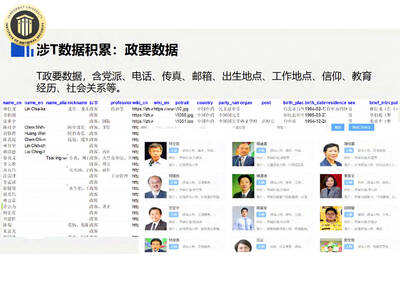
NETWORK-MAPPING PROJECT: The database contains 170 detailed files of Taiwanese politicians and about 23 million records of household registration data in Taiwan China has developed a network-mapping project targeting political figures and parties in Taiwan to monitor public opinion during elections and to craft tailored influence campaigns aimed at dividing Taiwanese society, according to documents leaked by Chinese technology firm GoLaxy (中科天璣). The documents, collected by Taipei-based Doublethink Lab, showed a database was specifically created to gather detailed information on Taiwanese political figures, including their political affiliations, job histories, birthplaces, residences, education, religion and a brief biography about them. Several notable Taiwanese politicians are in the database, including President William Lai (賴清德), former president Tsai Ing-wen (蔡英文), Minister of Foreign Affairs Lin Chia-lung (林佳龍),
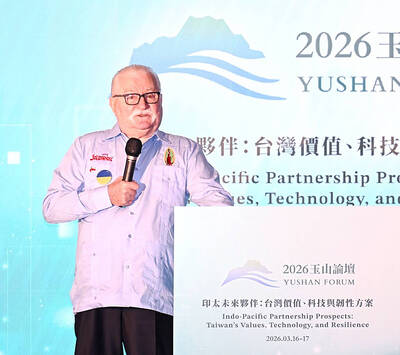
RECOGNITION: Former Fijian prime minister Mahendra Chaudhry said that Taiwan’s New Southbound Policy serves as a stabilizing force in the Indo-Pacific region Taiwan can lead the unification of the Chinese people, Nobel Peace Prize laureate and former Polish president Lech Walesa said in Taipei yesterday, adding that as the world order is changing, peaceful discussion would find good solutions, and that the use of force and coercion would always fail. Walesa made the remarks during his keynote address at a luncheon of the Yushan Forum in Taipei, titled “Indo-Pacific Partnership Prospects: Taiwan’s Values, Technology and Resilience,” organized by the Taiwan-Asia Exchange Foundation with the Ministry of Foreign Affairs. Walesa said that he had been at the forefront of a big peaceful revolution and “if
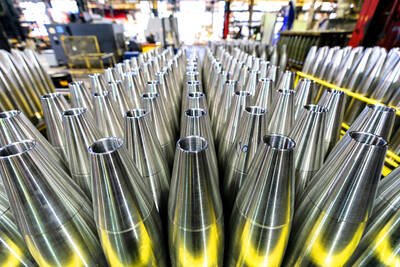
UPGRADED MISSILE: The Chungshan Institute of Science and Technology is reportedly to conduct a live-fire test of the Hsiung Feng III anti-ship missile on Thursday next week The US Army is planning to build new facilities to boost explosives production and strengthen its supply chain, a move aimed at addressing munitions shortages and supporting obligations to partners including Taiwan, Ukraine and Israel, Defense News reported. The army has issued a sources sought notice for a proposed Center of Excellence at the Blue Grass Army Depot in Kentucky, the report said. The facility would serve as a hub within the US industrial base for the production of key military explosives, including research department explosives (RDX) and high melting explosives (HMX), while also supporting research and development of next-generation materials. The proposed
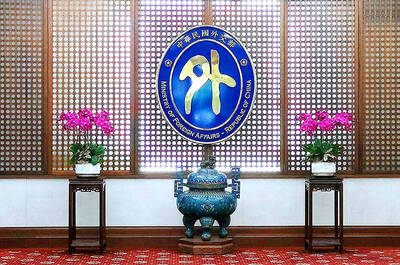
SOUTH KOREA DISPUTE: If Seoul continues to ignore its request, Taiwan would change South Korea’s designation on its arrival cards, the foreign ministry said If South Korea does not reply appropriately to a request to correct Taiwan’s name on its e-Arrival card system before March 31, the government would take corresponding measures to change how South Korea is labeled on the online Taiwan Arrival Card system, the Ministry of Foreign Affairs said yesterday. South Korea’s e-Arrival card system lists Taiwan as “China (Taiwan)” in the “point of departure” and “next destination” fields. Taipei has asked Seoul to change the wording. Since March 1, South Koreans who hold government-issued Alien Resident Certificates (ARC) have been identified as from “South Korea” rather than the “Republic of Korea,” the


 RSS
RSS