


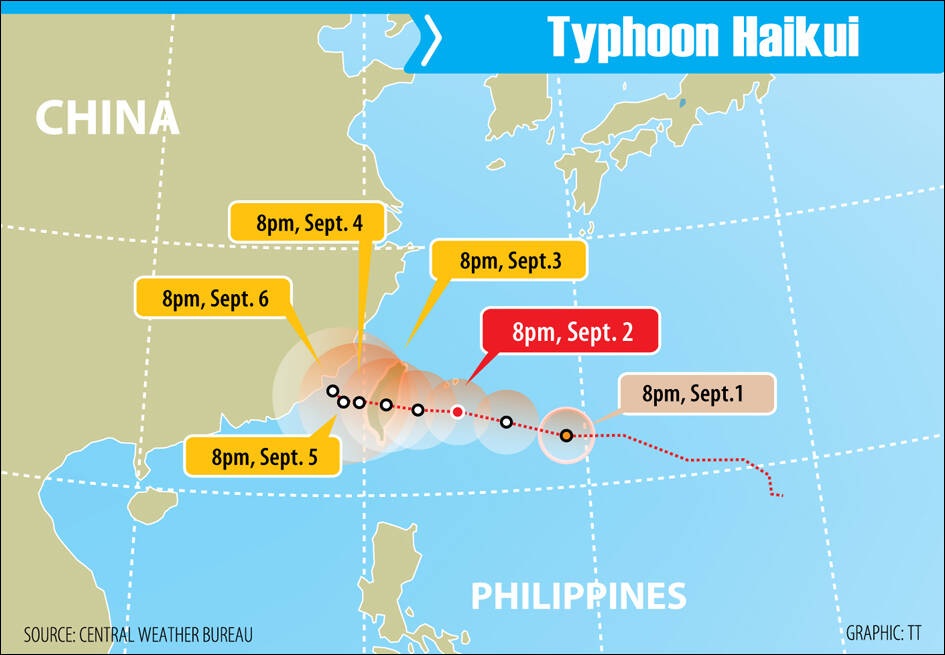
The Central Weather Bureau (CWB) issued a sea warning for Typhoon Haikui at about 8:30pm yesterday, as its storm circle approached waters to the east of Taiwan and the Bashi Channel.
As of 8pm yesterday, the eye of Haikui was 730km east of Taiwan’s southernmost tip, Oluanpi (鵝鑾鼻), and was moving west-northwest at 15kph to 19kph, with sustained winds of 119kph and gusts of up to 155kph, CWB data showed.
Due to the approaching Haikui and the effect of its periphery, Taiwan could experience heavy rain from today to Wednesday next week, the bureau said.
From Thursday to Friday next week, Taiwan would still see rain due to the effect of a low-pressure zone, it said.
Haikui is forecast to make landfall in eastern Taiwan before affecting the entire country, Weather Forecast Center Director Lu Kuo-chen (呂國臣) said.
A land warning is expected to be issued this morning, he added.
Haikui is likely to slow down as it moves across the Taiwan Strait, which would result in Taiwan being affected by the typhoon for a longer period, Lu said.
Ferry services across Taiwan are subject to change or might be canceled for three days from yesterday to tomorrow, as Haikui approaches, the Maritime and Port Bureau said yesterday.
Many activities at the secondary pavilions of the 2023 Hakka Expo in Taoyuan have been suspended, including a market at the International Indigenous Cultural and Creative Industrial Park today and tomorrow as the canopy frame was destroyed by strong winds.
The market has stopped operating since Wednesday because of Typhoon Saola, information on the event’s Web site says.
The Hsinchu City International Kite Festival, which was to be held today and tomorrow, has been postponed for one week and is to take place on Saturday and Sunday next week, the organizer said on Facebook.
Dozens of domestic flights in Taiwan, as well as flights to Hong Kong and Macau, between yesterday and tomorrow have also been canceled due to the typhoon.
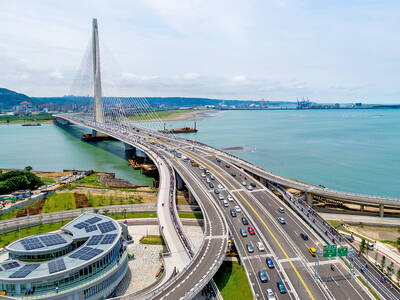
The Ministry of Transportation and Communications yesterday inaugurated the Danjiang Bridge across the Tamsui River in New Taipei City, saying that the structure would be an architectural icon and traffic artery for Taiwan. Feted as a major engineering achievement, the Danjiang Bridge is 920m long, 211m tall at the top of its pylon, and is the longest single-pylon asymmetric cable-stayed bridge in the world, the government’s Web site for the structure said. It was designed by late Iraqi-British architect Zaha Hadid. The structure, with a maximum deck of 70m, accommodates road and light rail traffic, and affords a 200m navigation channel for boats,
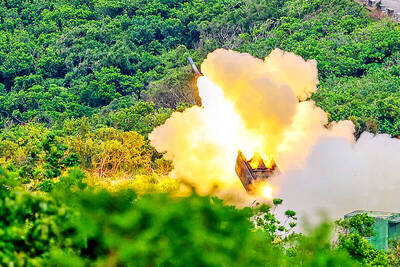
PRECISION STRIKES: The most significant reason to deploy HIMARS to outlying islands is to establish a ‘dead zone’ that the PLA would not dare enter, a source said A High Mobility Artillery Rocket System (HIMARS) would be deployed to Penghu County and Dongyin Island (東引) in Lienchiang County (Matsu) to force the Chinese military to retreat at least 100km from the coastline, a military source said yesterday. Taiwan has been procuring HIMARS and Army Tactical Missile Systems (ATACMS) from the US in batches. Once all batches have been delivered, Taiwan would possess 111 HIMARS units and 504 ATACMS, which have a range of 300km. Considering that “offense is the best defense,” the military plans to forward-deploy the systems to outlying islands such as Penghu and Dongyin so that

Taiwan Semiconductor Manufacturing Co (TSMC, 台積電), the world’s largest foundry service provider, yesterday said that global semiconductor revenue is projected to hit US$1.5 trillion in 2030, after the figure exceeds US$1 trillion this year, as artificial intelligence (AI) demand boosts consumption of token and compute power. “We are still at the beginning of the AI revolution, but we already see a significant impact across the whole semiconductor ecosystem,” TSMC deputy cochief operating officer Kevin Zhang (張曉強) said at the company’s annual technology symposium in Hsinchu City. “It is fair to say that in the past decade, smartphones and other mobile devices were

‘CLEAR MESSAGE’: The bill would set up an interagency ‘tiger team’ to review sanctions tools and other economic options to help deter any Chinese aggression toward Taiwan US Representative Young Kim has introduced a bill to deter Chinese aggression against Taiwan, calling for an interagency “tiger team” to preplan coordinated sanctions and economic measures in response to possible Chinese military or political action against Taiwan. “[Chinese President] Xi Jinping [習近平] has directed the People’s Liberation Army to be ready to invade Taiwan by 2027. China has a plan. America should have one too,” Kim said in a news release on Thursday last week. She introduced the “Deter PRC [People’s Republic of China] aggression against Taiwan act” to “ensure the US has a coordinated sanctions strategy ready should


 RSS
RSS