


A China-based hacker group called Flax Typhoon has targeted dozens of Taiwanese government agencies with the likely aim of spying on them, Microsoft said on Thursday.
Flax Typhoon, “a nation-state actor based out of China,” has since the middle of 2021 mainly “targeted government agencies and education, critical manufacturing, and information technology organizations in Taiwan,” Microsoft said in a blog post.
The activities observed suggest that “the threat actor intends to perform espionage and maintain access to organizations across a broad range of industries for as long as possible,” the US tech giant said.
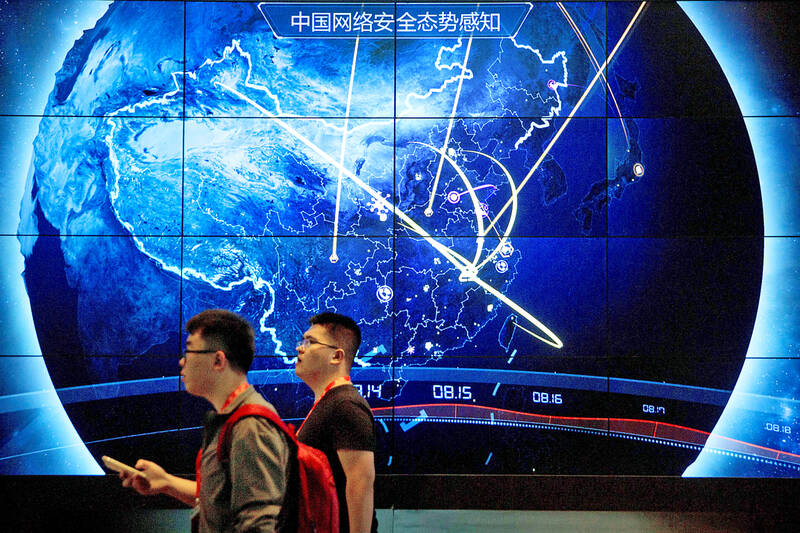
Photo: AP
“However, Microsoft has not observed Flax Typhoon act on final objectives in this campaign,” it said.
In addition to government agencies, Microsoft said that Flax Typhoon has also targeted “critical manufacturing and information technology organizations in Taiwan.”
The firm said that outside of Taiwan, there were some Flax Typhoon “victims” in Southeast Asia, North America and Africa.
Last month, Microsoft said that China-based hackers seeking intelligence had breached the e-mail accounts of some US government agencies.
That hacking group — which Microsoft called Storm-0558 — primarily focuses on “espionage, data theft and credential access,” it said.
The company also warned this year that state-sponsored Chinese hackers had infiltrated critical US infrastructure networks, saying this was likely aimed at hampering the US during a conflict.
Microsoft made particular mention of Guam, a US Pacific territory with a vital military base, as a target.
In Taipei, Deputy Minister of Digital Affairs Lee Huai-jen (李懷仁) yesterday said that Microsoft is a tech-affiliated member of Taiwan’s National Infrastructure Simulation and Analysis Center, and the two often share information on cyberdefense.
Taiwan is using the Vulnerability Analysis and Notice System to offer a systemic comparison of vulnerabilities logged with the US’ National Vulnerability Database, Lee said.
This allows the government to isolate and patch breaches immediately, he said.
Technological advances inevitably expose all nations to some form of information security risk, and Taiwan’s unique political and economic situation has made it a constant target, Lee said, adding that Taiwan would continue to work with other countries and exchange information so that every nation can bolster its own cyberdefenses.
Additional reporting by CNA
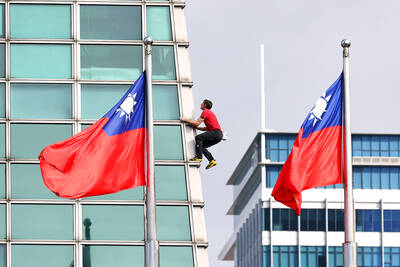
DAREDEVIL: Honnold said it had always been a dream of his to climb Taipei 101, while a Netflix producer said the skyscraper was ‘a real icon of this country’ US climber Alex Honnold yesterday took on Taiwan’s tallest building, becoming the first person to scale Taipei 101 without a rope, harness or safety net. Hundreds of spectators gathered at the base of the 101-story skyscraper to watch Honnold, 40, embark on his daredevil feat, which was also broadcast live on Netflix. Dressed in a red T-shirt and yellow custom-made climbing shoes, Honnold swiftly moved up the southeast face of the glass and steel building. At one point, he stepped onto a platform midway up to wave down at fans and onlookers who were taking photos. People watching from inside

A Vietnamese migrant worker yesterday won NT$12 million (US$379,627) on a Lunar New Year scratch card in Kaohsiung as part of Taiwan Lottery Co’s (台灣彩券) “NT$12 Million Grand Fortune” (1200萬大吉利) game. The man was the first top-prize winner of the new game launched on Jan. 6 to mark the Lunar New Year. Three Vietnamese migrant workers visited a Taiwan Lottery shop on Xinyue Street in Kaohsiung’s Gangshan District (崗山), a store representative said. The player bought multiple tickets and, after winning nothing, held the final lottery ticket in one hand and rubbed the store’s statue of the Maitreya Buddha’s belly with the other,
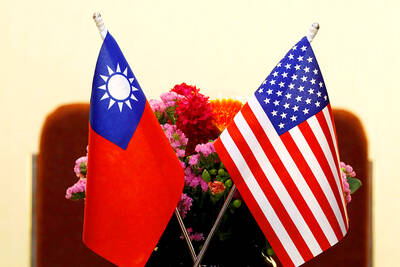
‘NATO-PLUS’: ‘Our strategic partners in the Indo-Pacific are facing increasing aggression by the Chinese Communist Party,’ US Representative Rob Wittman said The US House of Representatives on Monday released its version of the Consolidated Appropriations Act, which includes US$1.15 billion to support security cooperation with Taiwan. The omnibus act, covering US$1.2 trillion of spending, allocates US$1 billion for the Taiwan Security Cooperation Initiative, as well as US$150 million for the replacement of defense articles and reimbursement of defense services provided to Taiwan. The fund allocations were based on the US National Defense Authorization Act for fiscal 2026 that was passed by the US Congress last month and authorized up to US$1 billion to the US Defense Security Cooperation Agency in support of the

HIGH-TECH DEAL: Chipmakers that expand in the US would be able to import up to 2.5 times their new capacity with no extra tariffs during an approved construction period Taiwan aims to build a “democratic” high-tech supply chain with the US and form a strategic artificial intelligence (AI) partnership under the new tariffs deal it sealed with Washington last week, Taipei’s top negotiator in the talks said yesterday. US President Donald Trump has pushed Taiwan, a major producer of semiconductors which runs a large trade surplus with the US, to invest more in the US, specifically in chips that power AI. Under the terms of the long-negotiated deal, chipmakers such as Taiwan Semiconductor Manufacturing Co (TSMC, 台積電) that expand US production would incur a lower tariff on semiconductors or related manufacturing


 RSS
RSS