


The Ill-gotten Party Assets Settlement Committee has reclaimed more than NT$100 billion (US$3.13 billion) of assets that the Chinese Nationalist Party (KMT) obtained during the Martial Law era, committee Chairman Lin Feng-jeng (林?正) said yesterday.
The committee has nationalized about NT$53 billion and 136,000m2 of land from the KMT and its affiliates, Lin said in an interview published yesterday by the Liberty Times (the Taipei Times’ sister paper) ahead of the seventh anniversary this month of the committee’s founding.
The restored properties generate NT$50 million in combined rent each year, he said.
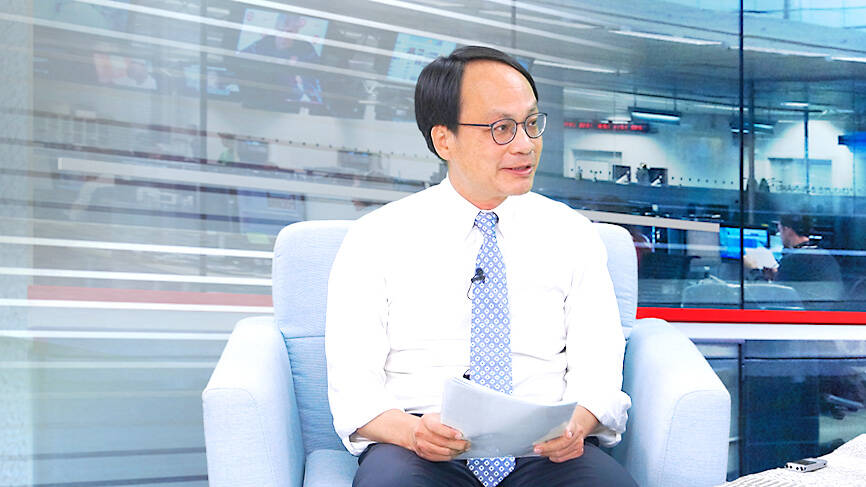
Photo: Chen Yu-fu, Taipei Times
The KMT was ordered to transfer to the government its 100 percent stake in Central Investment Holdings (中央投資), which has an estimated value of NT$20 billion to NT$30 billion, he said.
The committee believes that Central Investment Holdings was founded using public funds, which justified the move to nullify the party’s ownership, Lin said.
Taiwan could learn from how Spain has dealt with local governments that refuse to dispose of icons of authoritarian figures, Lin said.
Spain ordered local governments to dispose of monuments to general Franciso Franco — who led the overthrow of the Second Spanish Republic and governed the nation from 1939 to 1975 — or face fines of up to 10,000 euros (US$10,867), Lin said.
Transitional justice in Spain has achieved measurable success in doing away with symbols of Franco, which had once been as prevalent there as busts and statues of Chiang Kai-shek (蔣介石) in government offices, schools and parks in Taiwan, he said.
“Where we are still struggling, they have more or less completed the work,” he said.
However, Taiwan has moved faster than Spain to return unlawfully expropriated property and wealth to their rightful owners, he added.
Spanish society in general showed more willingness to support the government in dealing with its authoritarian past, while swathes of the Taiwanese public and some groups continue to resist democratization, he said.
Last week, the Taipei High Administrative Court ruled that the Chinese Association for Relief and Ensuing Services illegally gained assets as a KMT affiliate during the authoritarian period, he said.
The association used the support of the state’s propaganda apparatuses to launch donation drives and levy pseudo-taxes on movie tickets during the Martial Law era, Lin said.
It was created as an intermediary entity for diplomatic activities that the government and the KMT did not want to officially acknowledge, but the party-state tightly controlled every aspect of the group, he said.
The group was ordered to withdraw its decision to name democracy advocate Lei Chen (雷震) as a member of its board of supervisors, apparently because Chiang had a falling out with Lei, Lin said.
The committee has proof that the association’s activities were dictated by the KMT’s central standing committee of the time, he said.
The assets committee had no issue with the association using public funds to carry out official tasks, but it hoarded the resources long after the KMT party-state ended, Lin said.
Its assets were later used by a non-public actor for activities that had nothing to do with the public interest, he added.
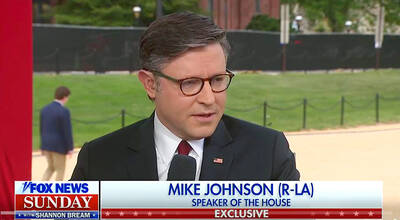
RESOLUTE BACKING: Two Republican senators are planning to introduce legislation that would impose immediate sanctions on China if it attempts to invade Taiwan US House of Representatives Speaker Mike Johnson on Sunday reaffirmed US congressional support for Taiwan, saying the US and “all freedom-loving people” have a stake in preventing China from seizing Taiwan by force. Johnson made the remarks in an interview with Fox News Sunday on US President Donald Trump’s summit with Chinese President Xi Jinping (習近平) last week. In an interview that aired on Friday on Fox News, just as Trump wrapped up a high-stakes visit to China, he said he has yet to green-light a new US$14 billion arms package to Taiwan and that it “depends on China.” “It’s a very good

DRONE CENTRAL: Taiwan aims to become Asia’s democratic hub for drones, with most exports focused on high-quality military-grade models, an official said Taiwan’s drone industry is expected to expand significantly by 2030, producing 100,000 units per month and exporting half of them, the Ministry of Economic Affairs said yesterday. Current drone production capacity is about 15,000 units per month, but the industry can quickly scale up as demand increases, Industrial Development Administration Director-General Chiou Chyou-huey (邱求慧) told a news conference in Taipei. Taiwan’s drone output grew 2.5-fold last year to NT$12.9 billion (US$408.3 million) under a government program to develop the uncrewed vehicle sector, he said. The Executive Yuan in October last year approved plans to invest NT$44.2 billion into domestic production of uncrewed aerial

WARNING: China should stop engaging in actions that undermine regional peace and stability, as it would only build resentment among people across the Strait, the CGA said China has deployed more than 100 navy, coast guard and other vessels in waters from the Yellow Sea to the South China Sea and the western Pacific since US President Donald Trump and Chinese President Xi Jinping (習近平) met in Beijing, National Security Council Secretary-General Joseph Wu (吳釗燮) said yesterday. “In this part of the world, #China is the one & only PROBLEM wrecking the #StatusQuo & threatening regional peace & stability,” Wu wrote on X. In a separate post, he said Beijing was coercing Taiwan’s maritime domain, calling it illegal and provocative, after the Coast Guard Administration (CGA) expelled a
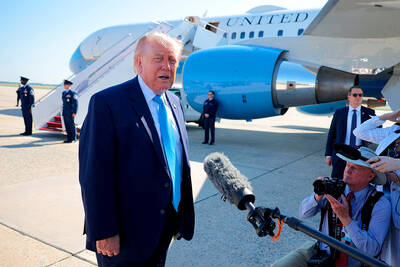
US President Donald Trump yesterday said he would speak to President William Lai (賴清德) as his administration considers whether to move ahead with a US$14 billion weapons sale to Taiwan — a potential arms deal that has drawn criticism from China. “Well, I’ll speak to him. I speak to everybody,” Trump told reporters yesterday when asked if he had any plans to call his counterpart, although he did not offer a time frame for when such a conversation could take place. Trump previously said he would speak to the person “that’s running Taiwan,” without specifying who he meant. “We have that situation very


 RSS
RSS