


Four people died and two were injured in a vehicle accident in Taoyuan’s Fusing District (復興) yesterday, as Typhoon Khanun brought heavy rain and strong winds to northern Taiwan.
The Taoyuan Fire Department said the accident occurred at about noon when a Taiwan Power Co (Taipower, 台電) construction vehicle fell down a 50m slope while rounding a curve near Sbunaw Bridge (雪霧鬧橋).
Four passengers showed no vital signs when rescuers arrived at the site, while one man and one woman sustained injuries.

Photo: Lu Hsiu-hsien, Taipei Times
Further investigation is necessary to determine possible causes of the accident, the police said.
The state-run power firm said that the vehicle was carrying contract workers who were recruited to work on electricity towers along Provincial Highway No. 7.
Taipower had told the contractor that there would be no work because of the typhoon, Taipower spokesman Tsai Chih-meng (蔡志孟) said, adding that the contractor had confirmed that no one was at work.
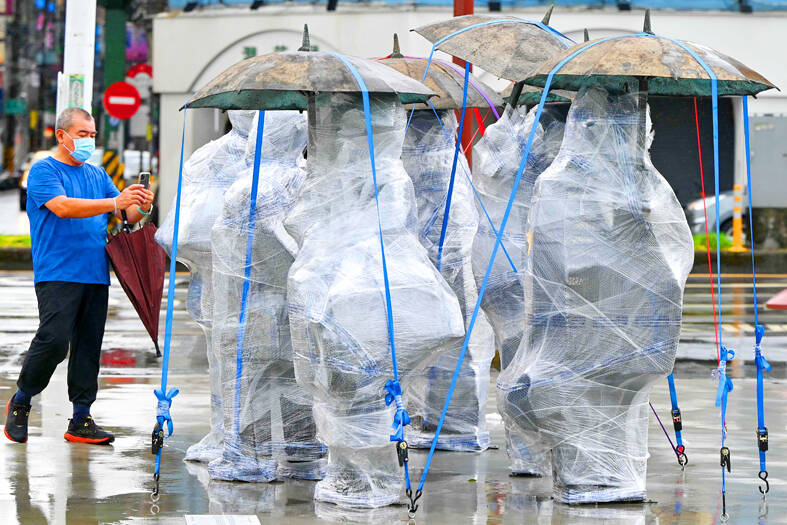
Photo: Sam Yeh, AFP
“We have dispatched personnel to Taoyuan to get a better understanding of the situation,” Tsai added.
While Taipei, New Taipei City and Keelung declared yesterday a typhoon day, the Taoyuan City Government said that work and school would continue as usual.
It had been raining continually in Fusing since Wednesday night as the typhoon approached, possibly rendering the roads slippery.

Photo: CNA
As of 2:30pm yesterday, the Central Emergency Operation Center had recorded 250 cases of damage caused by the storm, 110 of which were fallen trees on roadsides and 46 involved infrastructure damage.
As of 3pm yesterday, 1,741 households had no power, including 1,730 in seven districts in New Taipei City and 11 in Yilan County’s Sansing Township (三星).
The typhoon also disrupted air travel, shipping and railway services across the nation. Eighty domestic and 46 international flights, as well as 44 ferry services, were canceled, the Ministry of Transportation and Communications said.
As of 6pm, Khanun was centered 330km northeast of Taipei and was moving northeast at 8kph, Central Weather Bureau forecaster Hsu Chung-yi (徐仲毅) said.
The typhoon had weakened slightly and appeared to be spinning in place, with its radius briefly reaching the nation’s northeast coast, Hsu said.
Today, residents of mountainous areas in Kaohsiung and Taichung, as well as Miaoli, Nantou, Chiayi and Pingtung counties, should beware of damage caused by extremely heavy rainfall brought by a southwest wind.
The bureau forecast that the typhoon would be closest to Taiwan from last night to early this morning before moving north today, Hsu said, adding that it might lift the land alert this afternoon.
Winds on Orchid Island (Lanyu, 蘭嶼) and Green Island (綠島) could reach Level 11 or 12 on the Beaufort scale, while those on north and northeast coasts could reach Level 10 or 11, he said.
As of press time last night, the Kaohsiung City Government announced that school and work would be canceled today in Taoyuan (桃源), Maolin (茂林), Namasia (那瑪夏), Jiasian (甲仙) and Liouguei (六龜) districts, while the Taitung County Government canceled work and school on Orchid Island and Green Island.
Work and school are to resume today in Taipei, New Taipei City, Keelung and Yilan County.

‘UNFRIENDLY’: Changing the nationality listing of Taiwanese residents to ‘China’ goes against EU foreign policy as well as democratic and human rights principles, MOFA said Taiwan yesterday called on Denmark to correct its designation of the nationality of Taiwanese residents as “China” or face retaliatory measures. The Danish government in 2024 changed the nationality of Taiwanese citizens on their residence permits from “Taiwan” to “China.” The decision goes against EU foreign policy and contravenes democratic and human rights principles, Ministry of Foreign Affairs (MOFA) spokesman Hsiao Kuang-wei (蕭光偉) said. Denmark should present a solution acceptable to Taiwan as soon as possible and correct the erroneous designation to preserve the longstanding friendship between the two nations, Hsiao said. The issue could damage Denmark’s image and business reputation in Taiwan,

The nation’s fastest supercomputer, Nano 4 (晶創26), is scheduled to be launched in the third quarter, and would be used to train large language models in finance and national defense sectors, the National Center for High-Performance Computing (NCHC) said. The supercomputer, which would operate at about 86.05 petaflops, is being tested at a new cloud computing center in the Southern Taiwan Science Park in Tainan. The exterior of the server cabinet features chip circuitry patterns overlaid with a map of Taiwan, highlighting the nation’s central position in the semiconductor industry. The center also houses Taiwania 2, Taiwania 3, Forerunner 1 and
Taiwan climbed to its highest position in global export rankings in more than three decades last year, buoyed by demand linked to artificial intelligence (AI) that lifted shipments of semiconductors and technology products, Ministry of Finance data released yesterday showed. Taiwan accounted for 2.4 percent of global exports last year, or about US$640 billion, ranking 12th worldwide, the data showed. That was up four places from a year earlier and marked the nation’s best ranking since 1994, the ministry said. Taiwan’s share of global exports rose by 0.5 percentage points from the previous year, the largest increase among major economies, reflecting the nation’s

FIRST TRIAL: Ko’s lawyers sought reduced bail and other concessions, as did other defendants, but the bail judge denied their requests, citing the severity of the sentences Former Taipei mayor Ko Wen-je (柯文哲) was yesterday sentenced to 17 years in prison and had his civil rights suspended for six years over corruption, embezzlement and other charges. Taipei prosecutors in December last year asked the Taipei District Court for a combined 28-year, six-month sentence for the four cases against Ko, who founded the Taiwan People’s Party (TPP). The cases were linked to the Core Pacific City (京華城購物中心) redevelopment project and the mismanagement of political donations. Other defendants convicted on separate charges included Chinese Nationalist Party (KMT) Taipei City Councilor Angela Ying (應曉薇), who was handed a 15-year, six-month sentence; Core Pacific


 RSS
RSS