


Nearly three months after their respective comebacks, Taiwan’s Hsieh Su-wei (謝淑薇) and the Czech Republic’s Barbora Strycova won their second Wimbledon doubles title as a pairing by beating Belgium’s Elise Mertens and Australia’s Storm Hunter 7-5, 6-4 on Centre Court on Sunday.
Hsieh and Strycova lost the first two games, but gained momentum and came back to take the first set.
Hsieh converted their second match point with a backhand as the 2019 champions broke in the final game of the second set.

Photo: AP
Hsieh and Strycova are both 37, making them the oldest women’s doubles pair by combined age to even reach a Grand Slam final, breaking a mark set by Liezel Huber and Lisa Raymond, who were 35 and 38 respectively when they won the US Open in 2021.
Strycova said she expects this to be her last Wimbledon.
“I couldn’t ask for a better finish,” Strycova said. “Last year I texted Su-wei: ‘Let’s try to play Wimbledon 2023 just to come back and feel the atmosphere. There is no COVID anymore.’ She was like: ‘Yeah, let’s do that. Let’s just have fun.’ Here we are with the trophy. It’s crazy.”
Hsieh has won the women’s doubles title three times at the grass-court Grand Slam tournament, lifting the trophy in 2013, 2019 and 2021 with Peng Shuai (彭帥) of China, Strycova and Mertens respectively.
It is also a second straight Grand Slam title for Hsieh, who teamed up with China’s Wang Xinyu (王欣瑜) to win the French Open doubles tournament last month.
Hsieh did not compete for about 18 months after sustaining an injury during the Courmayeur Ladies Open women’s singles in Italy in October 2021, while Strycova came out of retirement after giving birth to a son.
Hsieh and Strycova returned to the sport in April, debuting in the Madrid Open women’s doubles together, where they reached the quarter-finals.
Additional reporting by staff writer, with CNA
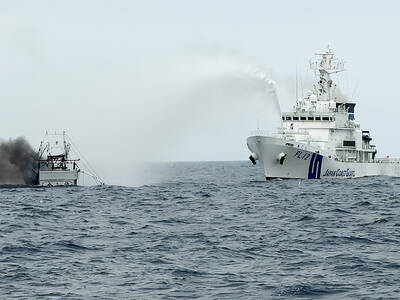
CREDIT-GRABBER: China said its coast guard rescued the crew of a fishing vessel that caught fire, who were actually rescued by a nearby Taiwanese boat and the CGA Maritime search and rescue operations do not have borders, and China should not use a shipwreck to infringe upon Taiwanese sovereignty, the Coast Guard Administration (CGA) said yesterday. The coast guard made the statement in response to the China Coast Guard (CCG) saying it saved a Taiwanese fishing boat. The Chuan Yu No. 6 (全漁6號), a fishing vessel registered in Keelung, on Thursday caught fire and sank in waters northeast of Diaoyutai Islands (釣魚台). The vessel left Keelung’s Badouzih Fishing Harbor (八斗子漁港) at 3:35pm on Sunday last week, with seven people on board — a 62-year-old Taiwanese captain surnamed Chang (張) and six
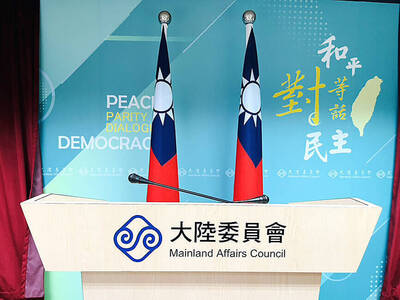
RISKY BUSINESS: The ‘incentives’ include initiatives that get suspended for no reason, creating uncertainty and resulting in considerable losses for Taiwanese, the MAC said China’s “incentives” failed to sway sentiment in Taiwan, as willingness to work in China hit a record low of 1.6 percent, a Ministry of Labor survey showed. The Directorate-General of Budget, Accounting and Statistics (DGBAS) also reported that the number of Taiwanese workers in China has nearly halved from a peak of 430,000 in 2012 to an estimated 231,000 in 2024. That marked a new low in the proportion of Taiwanese going abroad to work. The ministry’s annual survey on “Labor Life and Employment Status” includes questions respondents’ willingness to seek employment overseas. Willingness to work in China has steadily declined from

The Legislative Yuan’s Finance Committee yesterday approved proposed amendments to the Amusement Tax Act (娛樂稅法) that would abolish taxes on films, cultural activities and competitive sporting events, retaining the fee only for dance halls and golf courses. The proposed changes would set the maximum tax rate for dance halls and golf courses at 50 and 20 percent respectively, with local governments authorized to suspend the levies. Article 2 of the act says that “amusement tax shall be levied on tickets sold or fees charged by amusement places, facilities or activities” in six categories: “Cinema; professional singing, story-telling, dancing, circus, magic show, acrobatics

INFLATION UP? The IMF said CPI would increase to 1.5 percent this year, while the DGBAS projected it would rise to 1.68 percent, with GDP per capita of US$44,181 The IMF projected Taiwan’s real GDP would grow 5.2 percent this year, up from its 2.1 percent outlook in January, despite fears of global economic disruptions sparked by the US-Iran conflict. Taiwan’s consumer price index (CPI) is projected to increase to 1.5 percent, while unemployment would be 3.4 percent, roughly in line with estimates for Asia as a whole, the international body wrote in its Global Economic Outlook Report published in the US on Monday. The figures are comparatively better than the IMF outlook for the rest of the world, which pegged real GDP growth at 3.1 percent, down from 3.3 percent


 RSS
RSS