

President Tsai Ing-wen (蔡英文) yesterday reiterated the nation’s commitment to net zero carbon emissions by 2050, adding that a series of enforcement rules would soon be added to the Climate Change Response Act (氣候變遷因應法).
Tsai made the remarks when meeting with representatives of environmental protection groups at a National Environmental Conference yesterday afternoon, adding that her government would continue to bolster the resilience of the power grid and install more energy storage facilities to ensure power supply stability.
Tsai said that the Legislative Yuan this session has passed many important bills and amendments related to environmental sustainability, including the Mining Act (礦業法), the Marine Pollution Control Act (海洋污染防治法) and the Marine Industry Development Regulations (海洋產業發展條例).
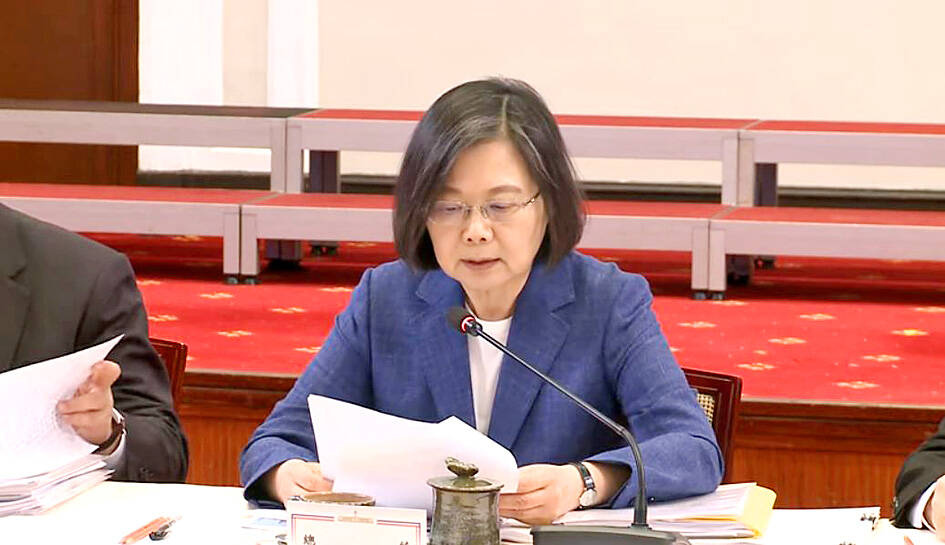
Photo: screen shot from a Presidential Office video
The controversial “overlord clause” in the Mining Act was removed following six years of deliberation, and the management and control of the mining industry has been comprehensively improved, she said.
Local residents and indigenous people also have a mechanism to manage the areas where mining takes place, she said.
“The Marine Pollution Control Act and the newly formulated Marine Industry Development Regulations strengthen the mechanisms for dealing with marine pollution,” Tsai said.
In addition to passing the Climate Change Response Act at the beginning of this year, the government also proposed a path toward net zero carbon emissions by 2050, Tsai said, adding that enforcement rules would be proposed.
Carbon trading, incremental offsets and voluntary reductions are the government’s three-pronged approach to achieve the goal of net zero emissions, she said, adding that a carbon exchange is to be established in the second half of the year.
Taiwan has also made progress in the use of renewable energy, Tsai said.
Last year, the installations of wind power and photovoltaics both hit single-year highs, generating 14 terawatt-hours, five times that of 2016, she said.
Meanwhile, power generated via renewable energy also surpassed that created by nuclear power plants for the first time, she added.
“With the passage of the amendment to the Renewable Energy Development Act (再生能源發展條例), a more eco-friendly environment would be created through the development of renewable energy, including geothermal power generation and other emerging energy sources,” Tsai said.
By 2030, new power plants, after excluding renewable energy and deducting the net increase of decommissioned units, would generate 9.1 gigawatt-hours, she said, adding that the increase would be close to three times the energy generated by the first and second nuclear power plants combined.
“The certification mechanism and standards for ‘other effective area-based conservation measures’ is a topic advocated by many environmentalists at the conference this year and the government hopes to incorporate such an international trend into its policies,” Tsai said.
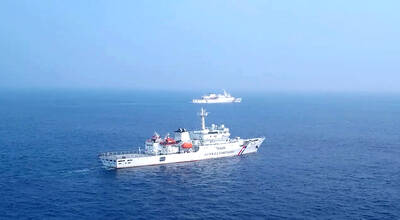
PATROL PARTNERS: The ‘Chiayi’ and the ‘Penghu’ departed for a two-day joint patrol of Palau’s exclusive economic zone, the CGA’s second diplomatic visit to the country The Coast Guard Administration (CGA) set a record for its southernmost deployment of a coast guard vessel as the vessels Chiayi and the Penghu reached Palau’s Pulo Anna Island on Saturday in a cooperative exercise between the two countries. The island, about 217 nautical miles (401km) southwest of Koror in the Palauan state of Sonsorol and 1,220 nautical miles from Taiwan’s southernmost point, Oluanpi (鵝鑾鼻), is the furthest south a CGA vessel has sailed. The two vessels are in Palau for the coast guard’s second diplomatic visit to the country. They docked at Malakal Harbor on Tuesday last week. The coast guard
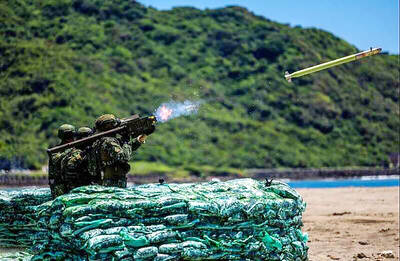
BATCH 1: The military has plans to assign the weapons to the army to defend Taiwan proper, as well as outlying islands and the navy for the Marine Corps, the official said Taiwan is to receive 500 Stinger missiles and 178 launchers from the US by the end of the year, the first batch under a planned two-stage acquisition totaling 2,621 missiles and 763 launchers, a defense official said yesterday on condition of anonymity. The portable missiles would play a vital role in the nation’s air defense capabilities, the source said. The army plans to deploy 2,235 missiles and 657 launchers to defend Taiwan proper and outlying islands, they said, citing military documents. The navy is allotted 295 missiles and 85 launchers to arm the Marine Corps and some surface vessels that lack air defense

The European Parliament on Wednesday adopted a recommendation on EU-China political relations that rejected China’s efforts to restrict Taiwan’s participation in international organizations and exchanges. The recommendation, addressed to the European Council, the European Commission and EU High Representative for Foreign Affairs and Security Policy Kaja Kallas, includes several references to EU-Taiwan relations and expresses support for closer ties, saying they would bring positive benefits and have strategic importance. Describing Taiwan as a valuable partner in trade and technology, the European Parliament said it “rejects China’s attempts to coerce international organizations, third countries and other actors into restricting Taiwan’s international participation and

Former president Tsai Ing-wen (蔡英文) on Monday arrived in San Francisco, receiving a warm welcome from hundreds of overseas Taiwanese as she launched a week-long visit. Accompanied by Representative to the US Alexander Yui (俞大?), and head of Taiwan’s San Francisco office Wu Chih-hsiang (伍志翔), Tsai arrived at her hotel, waving, smiling and giving high-fives to Taiwanese compatriots amid cheers of “Taiwan’s democracy involves you and me” to welcome her to the San Francisco Bay Area. It is Tsai’s first visit to the US since she left office in May 2024 after serving two four-year terms as president. Tsai is today to deliver


 RSS
RSS