


A magnitude 6.4 earthquake on Monday rocked Turkey’s southern province of Hatay and northern Syria, killing six people and sparking fresh panic after a massive Feb. 6 tremor left nearly 45,000 dead in both countries.
The AFAD disaster response agency reported the deaths, as well as nearly 300 hospitalizations, while in Syria the White Helmets aid group said that at least 150 people were injured in the Aleppo region.
The quake hit the Turkish town of Defne at 8:04pm and was strongly felt in the nearby city of Antakya.
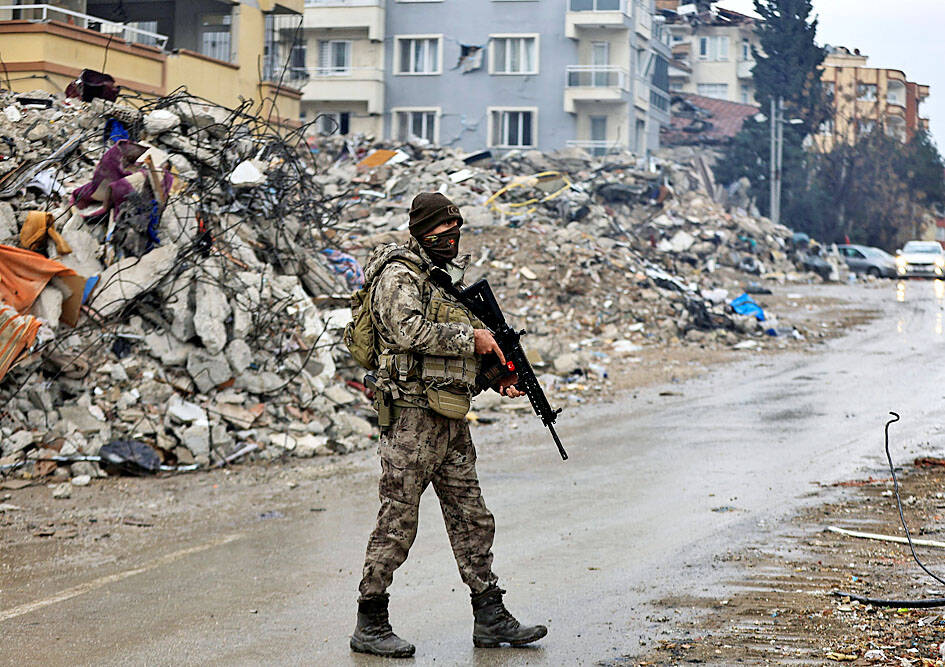
Photo: Reuters
It was also felt in Lebanon and Cyprus.
Turkey’s disaster management agency wrote on Twitter that a magnitude 5.8 quake followed three minutes later, with its epicenter in the Hatay’s Samandag district.
“The road moved like waves. The building moved back and forth, the cars moved left to right. It knocked me off my feet,” said Mehmet Irmak, who works at a notary’s office in Antakya.
“Hatay is no longer a safe place. We could hear a lot of buildings collapsing,” said Irmak, who had been sleeping in his car for two weeks after the first quake. “We will wait for a new day, but I don’t know what I’m going to do.”
Among the dead were three people who became trapped after returning to their damaged apartments to retrieve belongings, AFAD said.
On Tuesday, the organization said that it was sending 6,000 extra tents to the region to shelter those in need.
On a street in Antakya, Ali Mazlum, 18, told reporters: “We were with AFAD who were looking for the bodies of our family when the quake hit.”
“You don’t know what to do... We grabbed each other and right in front of us, the walls started to fall,” Mazlum said. “It felt like the earth was opening up to swallow us up.”
Mazlum, who has lived in Antakya for 12 years, was looking for the bodies of his sister and her family as well as his brother-in-law and his family.
The Syrian American Medical Society said that five hospitals it supports in northwest Syria received several people who had sustained minor injuries, some when parts of damaged buildings fell on them.
“My thoughts continue to be with the people of Turkiye and Syria, as they face the impact of new earthquakes striking the region this evening,” UN Secretary-General Antonio Guterres wrote on Twitter.
UN teams there “are assessing the situation, and we stand ready to provide additional support as needed,” he wrote.
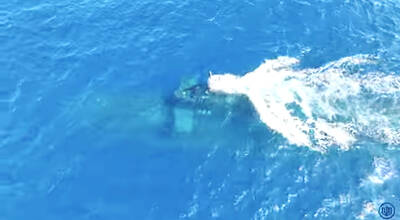
CSBC Corp, Taiwan (台灣國際造船) yesterday released the first video documenting the submerged sea trials of Taiwan’s indigenous defense submarine prototype, the Hai Kun (海鯤), or Narwhal, showing underwater navigation and the launch of countermeasures. The footage shows the vessel’s first dive, steering and control system tests, and the raising and lowering of the periscope and antenna masts. It offered a rare look at the progress in the submarine’s sea acceptance tests. The Hai Kun carried out its first shallow-water diving trial late last month and has since completed four submerged tests, CSBC said. The newly released video compiles images recorded from Jan. 29 to
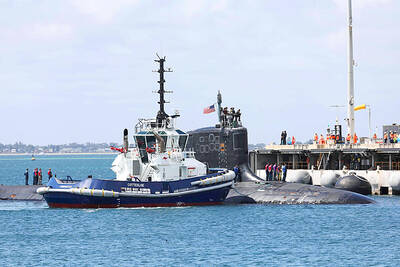
DETERRENCE EFFORTS: Washington and partners hope demonstrations of force would convince Beijing that military action against Taiwan would carry high costs The US is considering using HMAS Stirling in Western Australia as a forward base to strengthen its naval posture in a potential conflict with China, particularly over Taiwan, the Wall Street Journal reported on Saturday. As part of its Indo-Pacific strategy, Washington plans to deploy up to four nuclear-powered submarines at Stirling starting in 2027, providing a base near potential hot spots such as Taiwan and the South China Sea. The move also aims to enhance military integration with Pacific allies under the Australia-UK-US trilateral security partnership, the report said. Currently, US submarines operate from Guam, but the island could
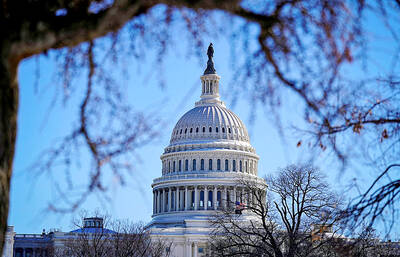
RESTRAINTS: Should China’s actions pose any threat to Taiwan’s security, economic or social systems, China would be excluded from major financial institutions, the bill says The US House of Representatives on Monday passed the PROTECT Taiwan Act, which states that Washington would exclude China from participating in major global financial organizations if its actions directly threaten Taiwan’s security. The bill, proposed by Republican Representative Frank Lucas, passed with 395 votes in favor and two against. It stipulates that if China’s actions pose any threat to Taiwan’s security, economic or social systems, the US would, “to the maximum extent practicable,” exclude Beijing from international financial institutions, including the G20, the Bank for International Settlements and the Financial Stability Board. The bill makes it clear that China must be prepared
The partisan standoff over President William Lai’s (賴清德) proposed defense budget has raised questions about the nation’s ability to adequately fund its own defense, the US Congressional Research Service (CRS) said in a report released on Tuesday. The report, titled Taiwan: Defense and Military Issues, said the government has increased its defense budget at an average annual rate of 5 percent from 2019 to 2023, with about 2.5 percent of its GDP spent on defense in 2024. Lai in November last year proposed a special budget of about US$40 billion over eight years, and said he intends to increase defense spending to


 RSS
RSS