


The US yesterday held joint air exercises bilaterally with South Korea and Japan involving strategic bombers, a day after North Korea fired a Hwasong-15 ICBM in a “sudden launching drill.”
The South Korean Joint Chiefs of Staff said the exercise, in which South Korea’s fighter jets escorted the US’ B-1B bombers, demonstrated the allies’ “overwhelming” defense capabilities and readiness posture.
The exercise “strengthened the combined operation capability and affirmed the United States’ ironclad commitment to the defense of the Korean Peninsula and the implementation of extended deterrence,” the South’s military said in a statement.
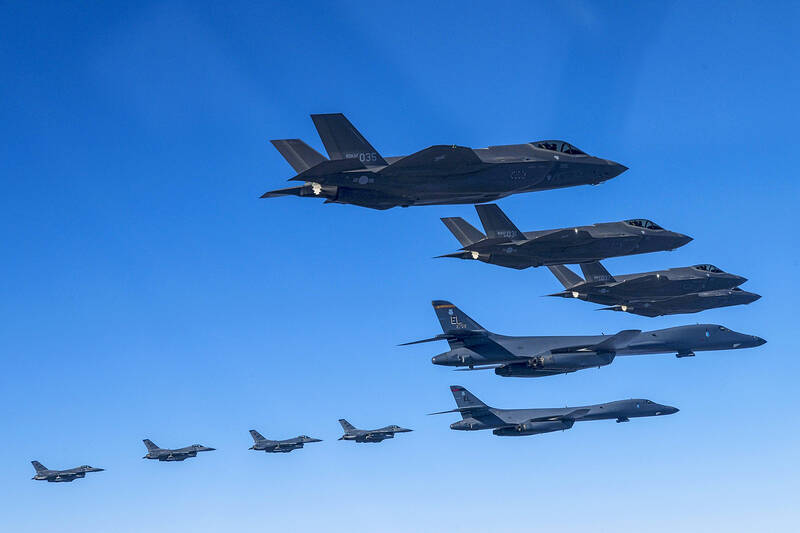
Photo: EPA-EFE
Japan flew F-15s over the Sea of Japan with the US’ B-1 bombers and F-16s in tactical exercises, the Japanese Ministry of Defense said in a statement, calling the security environment “increasingly severe” after the latest North Korean missile landed within its exclusive economic zone.
“This bilateral exercise reaffirms the strong will between Japan and the United States to respond to any situation, the readiness of [Japan’s Self Defense Forces] and US Armed Forces, and further strengthens the deterrence and response capabilities of the Japan-US Alliance,” the ministry said.
The air drills came a day after North Korea launched a long-range ballistic missile into the sea off Japan’s west coast, following a warning of a strong response to upcoming military drills by South Korea and the US.
The North’s Korean Central News Agency (KCNA) said the country conducted a “sudden launching drill” on Saturday in “actual proof” of its efforts to turn the “capacity of fatal nuclear counterattack on the hostile forces into the irresistible one.”
North Korean leader Kim Jong-un’s sister, Kim Yo-jong, yesterday issued yet another warning, and bristled at the UN for trying to turn the UN Security Council into what she called a “tool for its heinous hostile policy” toward Pyongyang.
“I warn that we will watch every movement of the enemy, and take corresponding and very powerful and overwhelming counteraction against its every move hostile to us,” she said in a statement.
Saturday’s missile launch, the North’s first since Jan. 1, came after Pyongyang on Friday threatened an “unprecedentedly persistent, strong” response as South Korea and the US gear up for annual military exercises as part of efforts to fend off the North’s growing nuclear and missile threats.
The KCNA said the missile had flown for 1 hour, 6 minutes and 55 seconds, and as high as 5,768km, before accurately hitting a pre-set area 989km away in open waters. Hwasong-15 was first tested in 2017.
South Korean Minister of Foreign Affairs Park Jin said Saturday’s launch “clearly” signals the North’s intent to conduct additional provocations.
“If North Korea conducts the seventh nuclear test, which could happen at any time, it will be a game changer in a sense that North Korea could develop and deploy tactical nuclear missiles,” Park told the Munich Security Conference on Saturday.
Additional reporting by Bloomberg
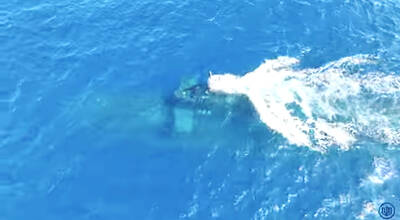
CSBC Corp, Taiwan (台灣國際造船) yesterday released the first video documenting the submerged sea trials of Taiwan’s indigenous defense submarine prototype, the Hai Kun (海鯤), or Narwhal, showing underwater navigation and the launch of countermeasures. The footage shows the vessel’s first dive, steering and control system tests, and the raising and lowering of the periscope and antenna masts. It offered a rare look at the progress in the submarine’s sea acceptance tests. The Hai Kun carried out its first shallow-water diving trial late last month and has since completed four submerged tests, CSBC said. The newly released video compiles images recorded from Jan. 29 to
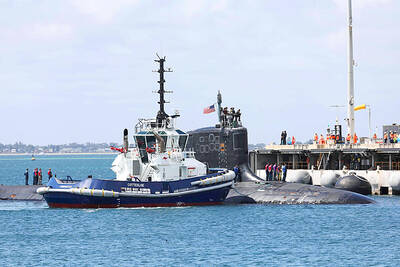
DETERRENCE EFFORTS: Washington and partners hope demonstrations of force would convince Beijing that military action against Taiwan would carry high costs The US is considering using HMAS Stirling in Western Australia as a forward base to strengthen its naval posture in a potential conflict with China, particularly over Taiwan, the Wall Street Journal reported on Saturday. As part of its Indo-Pacific strategy, Washington plans to deploy up to four nuclear-powered submarines at Stirling starting in 2027, providing a base near potential hot spots such as Taiwan and the South China Sea. The move also aims to enhance military integration with Pacific allies under the Australia-UK-US trilateral security partnership, the report said. Currently, US submarines operate from Guam, but the island could
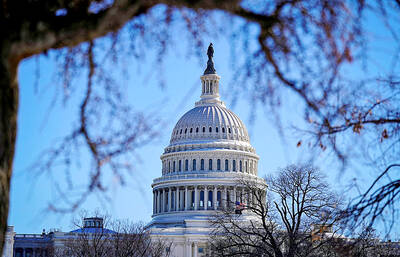
RESTRAINTS: Should China’s actions pose any threat to Taiwan’s security, economic or social systems, China would be excluded from major financial institutions, the bill says The US House of Representatives on Monday passed the PROTECT Taiwan Act, which states that Washington would exclude China from participating in major global financial organizations if its actions directly threaten Taiwan’s security. The bill, proposed by Republican Representative Frank Lucas, passed with 395 votes in favor and two against. It stipulates that if China’s actions pose any threat to Taiwan’s security, economic or social systems, the US would, “to the maximum extent practicable,” exclude Beijing from international financial institutions, including the G20, the Bank for International Settlements and the Financial Stability Board. The bill makes it clear that China must be prepared
The partisan standoff over President William Lai’s (賴清德) proposed defense budget has raised questions about the nation’s ability to adequately fund its own defense, the US Congressional Research Service (CRS) said in a report released on Tuesday. The report, titled Taiwan: Defense and Military Issues, said the government has increased its defense budget at an average annual rate of 5 percent from 2019 to 2023, with about 2.5 percent of its GDP spent on defense in 2024. Lai in November last year proposed a special budget of about US$40 billion over eight years, and said he intends to increase defense spending to


 RSS
RSS